how did we go so long without writing about saudi arabia?

see also: islamic liberation theology, religion as revolutionary social justice, radical empathy and a relationship with god, the necessity of doubt, religious law and human fallibility

we have no idea, but let’s rectify that asap.

let’s start with the topical stuff. the saudi ruling family has put a blockade in place, dropped more bombs than have been used in most wars in history, and created the worst man-made famine in decades that is starving the entire country of yemen. they use slave labor for construction, deny women citizens rights, execute activists, and, as they’ve admitted now, murder and dismember foreign journalists on foreign soil. that’s all been covered at length elsewhere and that’s not what we’re gonna cover in this post, which is the fact that the saudi establishment funds massive campaigns of religious colonialism using restricted aid/sponsorship to change entire countries’ practice of islam to a wahhabism that benefits saudi state interests (we’ll get to that in a bit) and the obscene greed of the saudi ruling family:
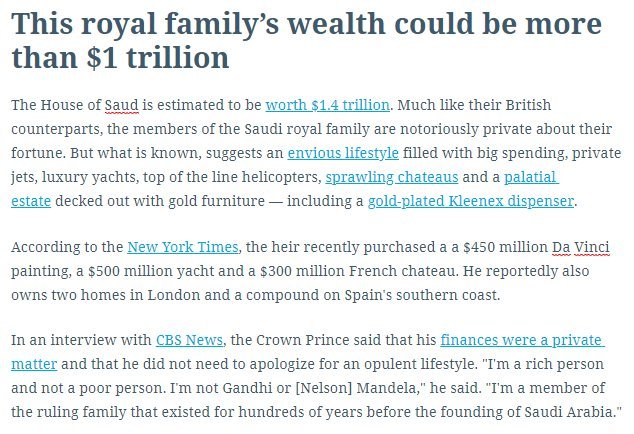
$1 trillion dollars! that’s an obscene, incomprehensible amount. that’s enough to give all 800 million people on earth living in extreme poverty (under $2 a day) $1200 each, or MVR 20,000. all 800 million people in extreme poverty on this planet, most doing back-breaking work every day, even if they somehow didn’t spend a cent of their income, would take two years to save up that much wealth.

$1 trillion dollars generates about $60-100 billion every year in just interest alone even if it all just sits there in a fund untouched (without compounding, so if you spent all $60-100 billion of that interest every year. that’s roughly the total wealth of mark zuckerburg, EVERY YEAR. it’s such an unbelievable number i want to emphasize it: if the saudi royal family spent SIXTY BILLION DOLLARS A YEAR, they would still have a trillion, that’s one thousand billion, dollars left). that said, it doesn’t stay untouched:
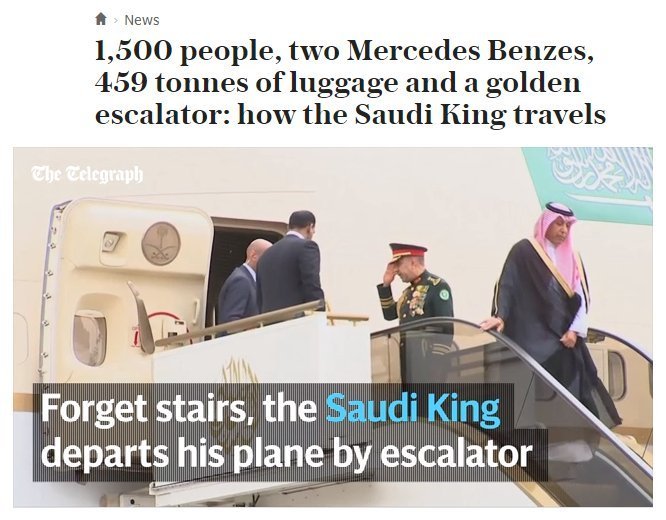
who the fuck needs a gold escalator to move 20 feet? and these are the folks claiming to have some kind of unique religious authority? i don’t remember stories of the sahabah getting custom-made gold caravans shipped over to cross the street.

for context– and remember that the whole conceit of wahhabism is a return to the ways of the prophet and the sahabah– that sounds very different from this:

hmm. everything we know about the lifestyles of saudi royalty (used interchangeably with saudi state, or saudi establishment, as is the case in an absolute monarchy), doesn’t really seem to vibe with those principles. anyway.

and prepare to be even more blown away by obscene wealth and obscene greed, this time even on the doorstep of the kaaba:
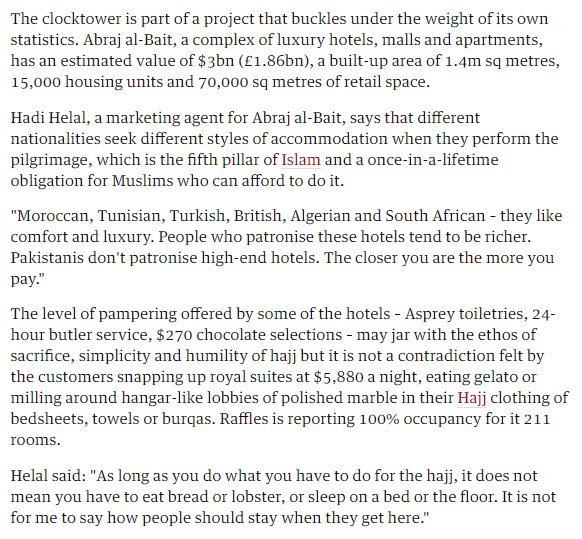
what the fuck, man.

it’s also important to note here that these hundreds of billions of dollars spent on extravagant displays of wealth could easily have been a smidge less extravagant and actually paid and treated the workers building all of this well. most human trafficking offenses are legal in saudi arabia, and the state has barely bothered to do anything about it. domestic workers are denied protections under saudi labor law. the government resolves most complaints of foreign worker abuse through mediation, setting up a largely powerless non-citizen worker with no provided legal aid thousands of miles from home to receive any justice in name only, and for the most part just sends victims back to their home countries without investigating or prosecuting crimes against them. that said, we as a country are implicit in doing kinda the same things ourselves and it’s horrific in both cases.

but anyway. now for how they’ve affected us as a country. it’s not a unique path that the saudi establishment has taken with the maldives: it’s right out of a playbook that’s applied around the world.

But Saudi Arabia has, for decades, been making investments of a different sort—those aimed at influencing Indonesian culture and religion. The king’s current visit is the apex of that methodical campaign, and “has the potential to accelerate the expansion of Saudi Arabia’s cultural resources in Indonesia,” according to Chris Chaplin, a researcher at the Royal Netherlands Institute of Southeast Asia. “In fact, given the size of his entourage, I wouldn’t be surprised if there will be a flurry of networking activity amongst Indonesian alumni of Saudi universities.”

Since 1980, Saudi Arabia has devoted millions of dollars to exporting its strict brand of Islam, Salafism, to historically tolerant and diverse Indonesia. It has built more than 150 mosques (albeit in a country that has about 800,000), a huge free university in Jakarta, and several Arabic language institutes; supplied more than 100 boarding schools with books and teachers (albeit in a country estimated to have between 13,000 and 30,000 boarding schools); brought in preachers and teachers; and disbursed thousands of scholarships for graduate study in Saudi Arabia. All this adds up to a deep network of Saudi influence.

“The advent of Salafism in Indonesia is part of Saudi Arabia’s global project to spread its brand of Islam throughout the Muslim world,” said Din Wahid, an expert on Indonesian Salafism at Syarif Hidayatullah State Islamic University (UIN) in Jakarta.

Indonesia may be the largest stage for Saudi Arabia’s cultural diplomacy, but it’s hardly the only one. Saudi Arabia built satellite campuses for Egypt’s Al-Azhar university in the 1980s, funded Bosnian rebels and later built them schools in the 1990s, bankrolled numerous madrassas in pre-Taliban Pakistan and Afghanistan, and sent 25,000 clerics to India between 2011 and 2013. Al-Hattem, of LIPIA Jakarta, was previously stationed at Saudi outfits in Bosnia and Djibouti. [x]

for a little backstory, i’m gonna let the same atlantic article summarize it for me:

It arose in reaction to 18th-century European colonialism in the Middle East, but it took particular root in Saudi Arabia in the hands of the influential preacher Muhammad ibn Abd al-Wahhab. Al-Wahhab’s alliance with the House of Saud in 1744 cemented Wahhabism as the spiritual backbone of the Saudi Arabian state. And in the 20th century, Saudi Arabia, which had become fabulously oil-rich, started to invest its considerable resources in propagating its ideology abroad.

the pattern starts to become familiar:

“Theology, which is a mandatory subject there, is only taught by committed Wahhabis, and I really think their ideology is antithetical to traditional Indonesian Islam, which is usually syncretic and relaxed,” he explained.

Hundreds of Indonesians receive scholarships to study at Saudi universities every year. A few decades in, alumni of these programs are becoming nationally influential in their home country. Habib Rizieq, the founder of the Islamic Defenders Front, a hardline organization associated with religion-related violence, attended both LIPIA and King Saud University in Riyadh. Jafar Umar Thalib, who founded the militant Salafi group Laskar Jihad, also graduated from LIPIA. Right-wing Islamist leaders like Hidayat Nur Wahid, a member of parliament who earned three degrees on scholarship from the University of Medina, are prominent in mainstream politics.

LIPIA alumni have also set up pesantren, or Islamic boarding schools, across Indonesia. Many of the country’s 100-odd Salafi pesantren are supplied by Saudi Arabia with teachers, especially of Arabic language, and textbooks, according to Din Wahid. For many poor families, these pesantren are the only feasible option for their kids’ schooling, despite ideological quibbles, Wahid said.

Enterprising Saudi envoys have even made inroads in places like Aceh, the westernmost Indonesian province that’s been wracked by natural disasters like the 2004 tsunami. “We have built mosques, hospitals, and schools there,” the Saudi ambassador to Indonesia, Mohammad Abdullah Alshuaibi, told me. “And an Arabic language institute.”

that timeline is important, by the way. the devastation of the 2004 tsunami on many primarily muslim regions around the indian ocean brought in an influx of rebuilding funds from saudi arabia. of course, that money comes with strings attached, and some of that rebuilding occurred in its own image. think about it. think about the timeline, before 2004 and after 2004.

and why is this important? because controlling access to knowledge is a staggering form of power. it allows you to shape the very fabric of reality that exists because, in many ways, “reality” as we see it is a sort of consensus, where we all agree on hearing and seeing and learning about the same things. but when you shape what we know of reality, what we’re told is the way that we actually live. i’m gonna be lazy and quote from something we’d written before:

the material history of islam wasn’t just a matter of interest for the history books, but a cornerstone of the way people practiced their entire faith, and either a potential source of or threat to the legitimacy of the current ruling establishment. control over that history was, and remains, extremely powerful. i am aware of my own fallibility. i don’t know if the history i know is the right history. i don’t know which details might have been shifted by conservative leaders to justify establishment power, or which details may have been added by ideologues in academia.

i don’t know which translations of arabic, a famously subtle and complex language with more ambiguity and possibilities of interpretation than any other major world language, back up my positions, or even whether verbal and oral histories would have captured those subtleties in their exact form instead of as the listener heard and understood it. i don’t know which philosophical and judicial scholarship over the centuries was brought into this history, and which were left out, and what selection bias might have shaped my knowledge of islamic history, thought, and practice…

here is something we do know, that i think illustrates everything above about the multitude of interpretations, histories, traditions, practices, identities that shift and evolve but, at each point during that evolution, insists that the way things are now is in fact how they always were.. let’s take a zoomed-out view and try to describe the maldives as an observer. confirm this with your own memories: think about dragonfly season from your childhood and try to visualize how you saw faith practiced then. think about old men reading salawat, or about amulets or pieces of paper with written dua that your grandparents told you to keep. dhivehi islamic identity from our first conversion, through to as recently as my childhood, was a form of indigenous-traditional sufi-inspired sunnism. abu barakat al-barbari was a somalian with sufi inspirations. religious leaders’ tombs, zikr, mawlud, barakai kiyevun, all sufism inspired. the idea that it was always wahhabi-inspired sunnism, and the idea that modern political religious figures are upholding our traditional identity is revisionism. half our traditional islam, as practiced by generations and generations before us, would be considered bid’a now.

who decided that, anyway? how did that happen, and how did i not even notice? why was there no real public interrogation of such a drastic shift in how institutions defined what religion was and how we should practice it? how does a country that literally defines itself by its faith switch completely from one interpretation to the other? i mean, the maldives considers its muslim identity such a crucial part of national identity that it’s a condition for citizenship. a huge change in what constitutes muslim identity is a crucial question. and i think it’s an important one.

the answer to “who decided, anyway?” is simple. this is who decides what reality is, and how they do it:

people will protest that what they learn and preach is directly from the texts, that they know arabic and know what’s said, but religious scripture is almost by definition incredibly complex and any study of scripture is influenced by the exegesis. nobody becomes a scholar of anything by just knowing the primary texts without a framework built by hundreds of scholars over decades, even centuries.

this applies even more for a text in arabic, a language that (to directly quote myself from earlier) is known for being more subtle and complex, with more room for ambiguity and possibilities of interpretation than almost any other major world language. any understanding of texts in historical dialects of a language that was literally known for a level of ambiguity and complexity that made it a perfect language for poetry, even in the time of the prophet (pbuh), is based on exegesis. the control of exegesis in any religion is, in a sense, exerting control over how people understand the scripture of that religion, and in this case the extreme wealth of the saudi state and its control over the kaaba means that they’re the ones controlling the realities and knowledge of what we consider religion to begin with, and they shape our entire body of knowledge in ways that bolster their objectives. here’s one example:

there’s other forms of control, aside from the massive funding and the control of access to religious knowledge:

One reason Indonesia has been reluctant to push back on Saudi cultural advances is the all-important hajj quota, the number of citizens who can make pilgrimage to Mecca in a given year. Indonesia gets the largest allowance in the world: 221,000 this year. But decade-long hajj waiting lists are common in many provinces, and jeopardizing the national allowance could provoke a huge backlash, said Dadi Darmadi, a UIN researcher and hajj expert.

“That being said, the Indonesian government has to be more wise and stop considering the hajj quota as a political gambit to attract more populist support in this country,” Darmadi said.

and that’s not good for us. having what we believe to be real about our religion and our own history and memory of how we practiced religion be shaped by parties with clear self-interest. this is particularly clear when we look at extremism here, which, again, is part of a pattern around the world:

Some of Indonesia’s leading jihadists have passed through Saudi institutions. Although Salafism is [officially] largely “quietist,” or discouraging of political activity, there is a growing faction of Salafi jihadists in Indonesia, according to Din Wahid.

In 1972, Saudi money helped to found the “ivy league” of jihadist pesantren, the Al-Mukmin school in Ngruki, Central Java. The Indonesian terrorist group Jemaah Islamiyah received funding from Saudi charities in the early 2000s. Salafi TV, YouTube channels, Facebook groups, and Telegram channels have become a fertile ground for female extremists and ISIS sympathizers in Indonesia in the last few years, according to a 2017 report from the Institute of Policy Analysis and Conflict (IPAC).

“We’ve been seeing some evidence of the transition from Salafism to extremism among female extremists of the ISIS generation,” said Nava Nuraniyah, an IPAC researcher.

“We need King Salman to make a clear and bold statement denouncing radicalism,” said Yahya Cholil Staquf of the moderate Muslim organization Nahdlatul Ulama. Otherwise, he said, “His visit will be easily perceived as more support to radical Islamic movements in Indonesia, as it is already a common public understanding that those radical movements take theological reference from Saudi Wahhabism and have been enjoying various kinds of support from Saudi Arabia.”

“Salafi pesantren, and Saudi-inspired religious education in general, no longer necessarily rely on Saudi donations, as followers have become incredibly adept at raising money locally,” Chaplin said.

As the rise of hardliners, the Arabic language, and Salafi jihadist cells in Indonesia show, Salafism has some undeniable, durable appeal here. In Indonesia, at least, Saudi Arabia is already seeing the fruits of its labor. This new religious ecosystem may be self-sustaining.

“this new religious ecosystem may be self-sustaining.” in other words, we’re now stuck with this shit, just like dozens of countries around the world. i sure hope not, but we may be screwed in ways that will be really hard to repair.

and i’ll leave you on that haunting note: the way things are now may be self-sustaining.

deliberative democracy

Deliberative democracy is one of my favorite ideas for how we might govern ourselves in the future, and I believe that we’ll see universal basic income and deliberative democracy happen in some countries in our lifetimes. I think deliberative democracy could find a real home in the Maldives when we’ve gotten our politics back to a reasonable place, so I’m going to do a series on it [guest post]

About deliberative democracy and how it might be a perfect fit for the Maldives

Deliberative democracy is a form of direct democracy that has learnt from the pitfalls of earlier experiments in direct democracy. A common leftist goal, it has only taken place in a few limited situations so far around the world.

A selection of constituents is randomly drawn for a citizens’ jury. The selection is designed to reflect the actual demographics of the region in factors such as gender and age. The citizens’ jury sees stakeholders from all sides and experts on the area to be fully informed on the issue at question. They then deliberate among themselves and come to a conclusion.

In direct models, this decision is a binding vote on the matter. In other models, this decision is seen as a strong recommendation for the elected representative on how to vote. This is also known as deliberative polling and creates a very strong norm for the candidate to vote accordingly, even though it isn’t officially binding.

Candidates that promise to vote according to deliberative polling of their citizens essentially promise to act as a conduit to direct democracy by their constituents.  Even if these candidates don’t win, introducing and normalizing the idea of deliberative democracy to the wider public contributes greatly to its likelihood of success in the future. This is the most likely path to eventually achieving full, binding deliberative democracy.

Deliberative democracy is merely our traditions over hundreds of years, brought back and updated for modern times. The core idea of deliberative democracy is much more natural to Maldivians that it would be in many other countries. Traditionally, Maldivian islands have held island meetings of elders and stakeholders to discuss among themselves and come to a conclusion.

The advantages of deliberative democracy

Deliberative democracy models allow for greater participation by citizens in the democratic process as it reflects the entire constituency.

Citizens’ juries are short-term, randomly drawn, and disbanded after meetings. This means that corruption is extremely unlikely, unlike with elected politicians who can be nudged or bribed by powerful interests. Members of citizens’ juries also have no career political power to try hold on to.

Most voters are not very knowledgeable about policies they vote for. Citizens’ juries get to make informed decisions based on a strong understanding of the issues, not just what politicians say.

It keeps citizens politically engaged. Case studies show deliberative democracy reducing voter turnoff. With the current state of Maldivian politics keeping most citizens disillusioned with the political process altogether, this is important.

Often, the most active or committed citizens or those with the most resources get the biggest say. Citizens’ juries reflect the views of the majority of ordinary citizens.

Citizens’ juries have very high accountability. Written notes of the deliberations of citizens’ juries are made available online, and are often recorded or livestreamed. This lets anyone in the public see the reasoning and evidence supporting their decisions, which means the reasoning has to stand up to scrutiny.

It removes sole decision-making ability from people with power, avoiding the inherently corrupting nature of power over those who wield it. Since citizens’ juries convene, deliberate, and then un-convene with a new set of participants every instance, decisions are not made by career politicians but by ordinary citizens. Decision-making authority being vested purely to career politicians means that our lives are governed by people self-selected to be willing to devote their careers to gaining power, and who need to worry about keeping other power-brokers happy to remain in power. Deliberative democracy is a first step towards dismantling this flaw.

A grassroots plan of action

Ideally, we would be able to establish a deliberative democratic model as part of our system of government. One way that could work would be for an upper house run deliberatively as a branch of government. A biannual council of citizens, drawn randomly but to match population demographics, would meet anew for days of deliberating over a variety of issues with the model outlined above: stakeholders, experts, information, discussion, and so on. After each biannual selection, the council will be dissolved and a new random but representative group of citizens will be selected for the next council. We should call for our political leadership to implement a similar system. But until then, we have to work at the grassroots level. Some goals we might have are:

To create a community of enthusiastic supporters of deliberative democracy to organize, discuss, and promote the idea to as many people as possible: through local organizing, media appearances, direct campaigning, convincing public figures, social media, and so on.

To hold one or two small pilot programs as proof of concept, by being able to have one deliberation meeting run and some results chosen successfully.

To recruit candidates, no matter how unlikely, to run on a platform of deliberative democracy.

In doing so, to raise the profile of deliberative democracy and introduce the idea of establishing it in the grassroots through candidates instead of waiting for it to be implemented top-down in a distant, unlikely future.

Someday, to elect a candidate that has successfully run on a deliberative democracy platform.

Deliberative democracy around the world

Some of the earliest examples of democracy such as in Ancient Athens had a very similar model of sortition, where an assembly of randomly chosen citizens that convened regularly had governing power. Sortition was considered a crucial aspect of true democracy, and seen as necessary to prevent leaders from succumbing to the corrupting nature of power.

Because officially instating deliberative democracy would mean massive changes to the political system, there has only been a few instances in modern times.

Denmark has a variation on deliberative democracy known as Consensus Conferences. A detailed manual of how they carry out consensus conferences is available. Consensus conferences aren’t the same, but share many similarities. South Australia has also recently held a deliberative democracy program on the state’s nuclear power policy.Here is a timeline of deliberative democratic events in recent years.

Top-down change towards deliberative democracy anywhere around the world is unlikely. The most feasible path towards a future of deliberative democracy is for candidates to run on the promise to vote according to citizens’ juries of their constituents. This would raise public awareness of the concept of deliberative democracy and raise support for the policy.

If such a candidate wins a seat, they would hold regular deliberative democracy meetings and vote according to the decisions of their citizens’ juries as a way for their citizens to vote directly could inspire more support as people in the Maldives and around the world see the advantages of deliberative democracy. But a candidate doesn’t have to win to make a change: just running, introducing the idea to the public and normalizing it, could be a huge boost to its acceptance among the public both locally and internationally.

More information on deliberative democracy

An introduction is here. An article on the topic is here. Some studies are hereherehere and here. Some books are hereherehereherehere.

how could we reduce corruption and prevent another dictatorship?

Well, it’s an open question and I don’t have all the answers. These are just a handful of possible suggestions drawn from our earlier crowdsourced manifesto, attempting to create enough fallbacks and checks and balances and devolution to prevent a dictatorship from happening again and again. Please send in any feedback and suggestions.


Transparency of finances for members of government

The public has the right to see whether those in power receive financial benefits for their actions, and to see which conflicts of interests may be held by those in power.

1. Elected officials, cabinet members, and heads of major independent government bodies having to declare assets at the beginning of each term, and will have to be audited once a year.

2. All transactions in or out of over 50,000 Rufiyaa by any elected official, cabinet member, or judge having to be put on the public record within one month of the transaction happening, and financial institutions will be required to disclose information for such transactions.

3. Non-home assets of the President, Vice President, and Supreme Court Justices having to be placed in a blind trust for the duration of their term.


Transparency of the activities of government

1. An open government portal with information at the island level, with updates on the progress of any development in every island mandated on at least a quarterly basis, so that every citizen in the Maldives can monitor what the government is doing anywhere in the country.

2. Protections for whistle-blowers. A fully anonymous system, vetted by international authorities to ensure security, for whistle-blowers.

3. An independent public inquiry into major crimes with suspected government culpability, such as disappearances, murders, and theft of public resources, for fact-finding and restorative justice.


Devolution of powers from central authority

Decentralization of political authority, both to other branches of government and to other physical locations in the Maldives, reduces the possible amount of power held by any one individual from Male’.

1. A biannual citizens’ council as an upper house of parliament that consists of a demographically representative panel of citizens drawn randomly twice a year, in a deliberative democratic model. Citizens meet with stakeholders and experts over days of deliberation, similar to a jury, and come to a verdict. The citizens’ council would have veto power for major legislation and propose recommendations to parliament so that politicians can no longer override the wishes of ordinary citizens. A new set of citizens are drawn for each biannual council, which is immediately dissolved after each session. Unlike career politicians, these citizens have no need to kowtow to the rich to hold on to power. The biannual citizens’ council will alternate between a major Southern and Northern island.

2. A non-governmental organization consisting of experts who evaluate government policies, budgets, financial disclosures, and all other activities of government and publish simple reports for ordinary citizens, will be established by a government endowment. This organization will be established in Addu City, physically and politically insulated from the powers in Male’.

3. Some taxation and spending autonomy for atolls. While the central government would still be the major taxation and spending authority, atolls having municipal authority to collect some forms of taxes and to spend those as it sees fit would make them less dependent on the largesse of the central government in Male’. With spending more localized, those in charge of local budgets would have much closer relationships with the citizens whose tax money is being spent, and so have an incentive to spend well and avoid the anger of their fellow residents.


Prevent a dictatorship from happening again

Reduce the powers of the Presidency and ensure independence of government bodies.

1. A firewall legally preventing the executive or legislative branch from interference in independent government bodies such as those overseeing the media, elections, judicial oversight, anti-corruption activities, or the Truth and Reconciliation Commission.

2. An independent government body to administer military benefits, such as housing and pay, from a budget allocated by parliament, with the President or executive branch no longer having any influence over military benefits and no politicians able to secure military support by promising increased benefits.

3. The President’s Office would no longer have the power to unilaterally appoint or remove appointees to any independent government bodies. Instead, heads of these bodies can only be removed by vote from a majority of its members.

4. The President’s Office would not be allowed access to internal information on the operations of those bodies aside from what is officially required.

5. To prevent coercion, the heads of independent oversight bodies would have immunity from a certain list of charges such as terrorism or sedition during their terms, and cannot be restricted from freely leaving or entering the country.


crowdsourcing a manifesto

This post is inspired by many of the responses to this post about what people would like to see from a government, as well as from over Twitter. What do we really want from a government? This is our compilation of both Twitter’s and our ideas, edited and written up in manifesto form. You can add comments and suggestions here.


CREATE AN EQUAL SOCIETY

Equitable sharing of our natural resources

We believe the resources of the Maldives belong collectively to all citizens, not just the rich. We would assign a 30% ownership stake to every resort for citizens of that atoll, with the profit dividend paid out too all atoll citizens as a starting point for a Universal Basic Income. Local citizens would have a say in decisions, and would be able to attend Annual General Meetings of resort companies and receive the annual financial statements of the resort.

Biannual citizens’ council as an upper house

Career politicians have too strong an incentive to kowtow to the rich and powerful to keep their power, and are vulnerable to corruption. We will establish an upper house of parliament that consists of a demographically representative panel of citizens drawn randomly twice a year, in a deliberative democratic model. Citizens meet with stakeholders and experts over days of deliberation, similar to a jury, and come to a verdict. A new set of citizens are drawn for each biannual council, which is immediately dissolved after each session. This reduces corruption and gives power back to the people. The citizens’ council will have veto power for major legislation and propose recommendations to parliament so that politicians can no longer override the wishes of ordinary citizens. [x]

Progressive income tax and land tax

We need a wider revenue base to continue development in the country. We would establish an annual land tax on registered plots for 2% of the market value of that land. We would also implement a progressive income tax for all earners with an income above 25,000 Rufiyaa, with a higher marginal tax for the highest income bracket. Land tax rebates will be given for productive uses of land such as rental housing or high-tech agriculture.

Build social housing to push down market rent

Rent is unaffordable for most citizens. We will build social housing to push down market rents, with a target of providing enough housing supply for the market rent to reach levels affordable to working adults.

Justice for women

We will criminalize street harassment, update the legal definition of sexual assault to international standards, and instate harsher penalties for domestic abuse, sexual assault, “revenge porn”, and other forms of violence against women. As the current justice system is inadequate on issues of violence against women or sexual violence, we will create a judicial oversight body staffed entirely by women to provide oversight, recommendations, and appeals on cases to do with gender discrimination or violence against women. Company boards will be required to reserve at least one-third of their seats for exclusively women, and at least one-third of the slate of candidates any party registers for elections must be women. We will also eliminate the Massaru Tax. Education for school students on consent, sexual safety, and reproductive health will be required.

Workers’ rights

We will require half of the board to be assigned to worker representatives for companies with 50+ employees. We will legally enshrine regulations for minimum standards of wages, working conditions, and hours for private companies as well as public. Companies will be required to provide workers’ compensation for injuries on the job. [x]

Expatriate rights

Expatriate workers from other South Asian countries should not have to live in squalor while facing exploitation and discrimination. Workers’ rights will apply equally to expatriate workers, not just citizens. We will instate punishments and fines for employers found to have exploitative working conditions. Expatriate workers will be entitled to holiday periods to be able to visit their families without losing their jobs. The practice of employers holding on to deposits, passports, or documents of expatriate workers to restrict their free movement will be criminalized.

Treat drugs as a public health issue

Our current way of dealing with the drug crisis hasn’t worked. We should learn from the Portuguese model, which eased their heroin crisis, by focusing on rehabilitation for non-dealing drug users instead of imprisonment with hardened criminals. [x]

Proactive mental health care

Aasandha will be expanded to include mental health care. An official mental health hotline will be created and awareness campaigns about mental health will be held. All school students will be assigned five appointments with a mental health professional over each year. The government will also fund visits by a team of mental health professionals to schools in every island at least annually.

Public health monitoring

Large parts of the population have deficiencies in basic minerals such as iron or zinc, especially in the atolls where fresh produce is less easily available than in Male’. Citizens also face exposure to environmental toxins, such as dioxins from the burning of plastic waste. We will monitor levels of environmental toxins, lead, and nutrient deficiencies across the country with every island monitored at least once a year. In regions with micronutrient deficiencies, the government will provide supplementation. Increased levels of lead or environmental toxins will be met with immediate action to reduce exposure and remove sources. [x]


SUSTAINABLY DEVELOP THE ECONOMY

Meaningful decentralization

The development of Kulhudhuffushi and Hithadhoo ports will promote local commerce and industry, the land tax will incentivize moves away from costly Male’ land and towards development in the atolls, local ownership in resorts will provide an income source for atoll residents, and the government microfinance body will focus on investment in the atolls. In addition, we will open provincial offices for ministries in a major Northern and Southern island, and require at least 25% of ministry staff operations to be based in the provincial office.

The government will offer young people incentives to move to communities in regional capitals that can absorb and integrate an influx of youth– this could be offers of free government-built housing (usually free with conditions, for example a ten year rent-free period upon moving), business startup funds, loan forgiveness, or scholarship money. [x]

Partial taxation and spending autonomy for atolls

While the central government would still be the major taxation and spending authority, we will entrust atolls with authority to collect some forms taxes and to spend those as it sees fit, making the atolls less dependent on the largesse of the central government in Male’. With spending more localized, those in charge of local budgets would have closer relationships with the citizens whose tax money is being spent.

Diversify the economy with high tech industry and renewables

We will build an ICT services outsourcing center like those fueling the ICT industry in India, to employ local coders and technical workers. Cutting-edge vertical farming, aquaculture, and solar power firms will be invited to develop in the Maldives with promise of contract for commercially viable developments, employing and training young workers. We will also develop our national infrastructure in an efficient and sustainable way by fully digitizing the public sector and beginning a rapid transition to using renewable energy sources.

Microfinance body funded by small-scale foreign investment

We will establish a government microfinance body to lend to listed small projects throughout the country. To fund this, the microfinance body will issue no-dividend securities marketed to luxury resort tourists by appealing to current trends of socially conscious tourism. For wealthy tourists able to spend thousands of dollars a night for resort stays, it provides a way of giving back to local communities. For us, it provides foreign direct investment on a microfinance scale. Projects from the islands will be given priority over those from the Male’ area.

Upgrade international ports in Male’, Kulhudhuffushi, and Hithadhoo

Male’ Port has a capacity well below what is needed, and operates slowly and inefficiently. Issues with ports can add up to 30% to the cost of imported goods. Currently, all imports to atolls first arrive to Male’ Port and then are shipped domestically to atolls, where the cost of shipping goods to islands from Male’ is even higher than shipping from Male’ to Singapore. Many goods also have to be shipped from Male’ on passenger boats, and the difficulty makes providing fresh imported produce difficult or impossible. Kulhudhuffushi and Hithadhoo have international ports, but those are currently only used for resort building material and not consumer goods. We will modernize Male’ Port to meet needs efficiently, reducing costs, and we will develop Kulhudhuffushi and Hithadhoo international ports to receive consumer goods for the atolls.

Environmental protections

We will designate the EPA as an independent body with oversight responsibilities. We will also ban single-use plastic products, and protect environmentally vulnerable ecosystems by creating special protected areas. The EPA will carry out a survey of lead and environmental toxin levels in the population of every island and take steps to minimize these levels. Thilafushi will be developed to minimize the exposure of  nearby inhabited islands to toxins from burning waste.

Getting out of the debt trap

We will reduce our dependence on China and Saudi Arabia, and its effect on our sovereignty, by looking to restructure our debt to a more diverse set of lenders. In the longer term, we will begin to use income tax and land tax revenue to reduce our debt burden and keep our public finances in check. [x]


HOLD GOVERNMENT ACCOUNTABLE

Reduce corruption

We will create an open government portal with information at the island level, with updates on the progress of any development in every island mandated on at least a quarterly basis, so that every citizen in the Maldives can monitor what the government is doing anywhere in the country. A non-governmental organization consisting of experts who evaluate government policies, budgets, financial disclosures, and all other activities of government and publish simple reports for ordinary citizens, will be established by a government endowment. This organization will be established in Addu City, physically and politically insulated from the powers in Male’. A fully anonymous system, vetted by international authorities to ensure security, will be established for whistle-blowing, and protections will be provided for whistle-blowers.

Elected officials and cabinet members have to declare assets upon entering office, and will face an audit every year. Non-home assets of the President, Vice President, and Supreme Court Justices will be placed in a blind trust for the duration of their term. All transactions in or out of over 50,000 Rufiyaa by any elected official, cabinet member, or judge will have to be put on the public record within one month of the transaction happening, and financial institutions will be required to disclose information for such transactions. Rules allowing the sale of islands without bidding will be reversed. [x]

Prevent a dictatorship from happening again

The President’s Office will no longer have the power to unilaterally appoint or remove appointees to any independent government bodies. Instead, heads of these bodies can only be removed by vote from a majority of its members. Aside from what is officially required, the President’s Office will not be allowed access to internal information on the operations of those bodies. To prevent coercion, the heads of independent oversight bodies will have immunity from a narrow range of selected charges such as terrorism, sedition, or disrupting the peace during their terms and cannot legally be restricted from freely leaving or entering the country. Heads of the major independent bodies also have to declare all transactions in and out of over 50,000 Rufiyaa.

We will establish a “firewall” legally preventing the executive or legislative branch from interference in independent government bodies such as those overseeing the media, elections, judicial oversight, anti-corruption activities, or the Truth and Reconciliation Commission. One such body will carry out the administration of military benefits, such as housing and pay, from a budget allocated by parliament, with the President or executive branch no longer having any influence over military benefits and no politicians able to secure military support by promising increased benefits. Reforms will be carried out for law enforcement and military agencies.

Truth and Reconciliation Commission

We will hold an independent public inquiry into disappearances, murders, theft of public resources and other crimes for fact-finding and restorative justice.

Automatic voter registration

All voters who will turn 18 by polling date will be automatically registered to vote.


A shorter version as a much more shareable image:

prelim manif v2


This is a rough draft. Specific details, such as the 2% number for land tax or the details of which charges immunity would be given for heads of independent bodies during their terms, are placeholders for now.


a look at government policy, china, and our debt

Under half a billion dollars (about $405 million) is allocated for the entire Public Sector Investment Program for the year. The Maldives does currently have a very high share of GDP going to health because the hospital mega-project is a large share of this small an economy, but mentioned are absolute numbers, not percentages, maybe because percentages are zero-sum and that makes it impossible to have high percentage numbers for every single sector of government expenditure.

According to the 2018 government budget booklet, 11% of our budget went to interest payments on our debt. Our total debt is more than half our GDP. Falling into a debt trap isn’t guaranteed, of course, but it’s silly to say that it’s not a risk.

obor debt trap

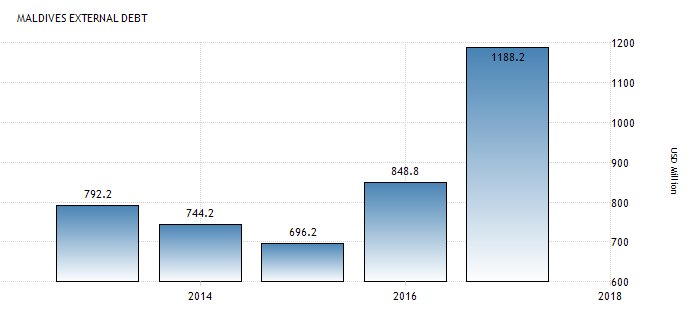
The Maldives’ external debt has gone from $790 million to almost $1.2 billion.

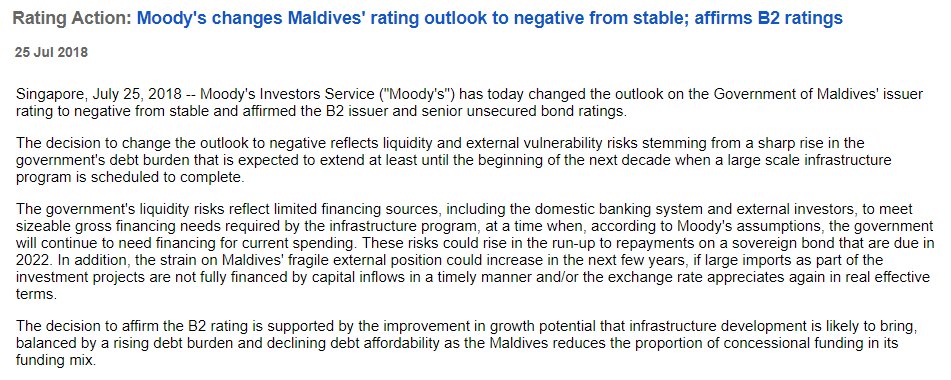
Our credit rating outlook* was recently downgraded because investors feel we might be unable to repay debt obligations. So, financial institutions don’t actually feel all that sure that we’ll be able to repay our debts.

There’s no need to panic, but saying default and the debt trap isn’t a risk is bullshit.

Going by minutes from their meeting with another Twitter user, YRY has argued that YAG managed to wrangle loans from China and that another leader wouldn’t be able to secure these loans. This is silly and intellectually dishonest. China started massive international investment around 2013 to achieve strategic and economic objectives with their One Belt One Road program. YAG didn’t inspire Xi Jinping to start a strategic investment of over a trillion dollars across Eurasia, including in the Maldives.

Some other projects (of hundreds) also happening over the past few years:

  • Khorgos, a massive “landlocked port” in a shared zone with Kazakhstan
  • A “new Dubai” near Colombo along with a massive port in Hambantota. To pay back debt, Sri Lanka gave the port to China on a long-term lease with promise they’d keep military out
  • Chinese overseas military base in Djibouti
  • Chinese port and presence in Gwadar, a small fishing village in Pakistan that is planned to be turned into major port on the maritime silk road

Over 60 countries receive loans from Chinese banks as part of the One Belt One Road initiative, which began massive spending in countries  all around Asia, Europe, and some of East Africa to build trade routes and to send some of China’s excess capacity in construction industry to other countries where those employees could continue to work and those companies could continue to make profits.

China doesn’t make investment decisions based on who happens to be the President of the Maldives. There’s power imbalance between the two nations is way too huge. Investment has happened across dozens of countries with very different political leadership, including many different policy, regulatory, and business environments. There are ways a government could dissuade investment, but realistically, China has a strong incentive to continue for economic, political, and strategic reasons.

China relies on rapid growth to maintain the popularity and legitimacy of the government. With their growth boom starting to slow down as they become more of a consumption-based instead of export-based economy, there remains a lot of Chinese industrial firms that were excess to current requirements of building within China. These firms and their workers are used productively to invest in infrastructure along routes of commerce around the world to keep firms employed and the growth rates going.

The Maldives, along with Sri Lanka, lies in a strategically vital part of maritime trade routes. The One and a Half Degree Channel in the Maldives and the narrow ocean path between us and Sri Lanka are key, and if China can secure one, they can ease the geopolitical risk of another government or military cutting off those routes with a blockade. If China can establish a military base, like they have in Djibouti on the coast of East Africa, they would also be able to project military power in the Indian Ocean and counterbalance India’s power in the region. (This clearly spooks India, which is why they’ve responded to the Maldives’ growing dependence on China with alarm).

Sri Lanka recently faced a debt trap with massive Chinese investments, in both a port and in building a flashy mega-project supposed to be a “new Dubai”. To settle their debt, they had to essentially hand over a port to China, leasing it out for 99 years. China has a clear strategic interest in getting a physical presence in the Maldives: we’re in an important location on ocean trading routes, we’re close to India and a Chinese presence here helps China counter its primary geopolitical rival, and Chinese influence over the One and a Half Degree Channel “choke point” would allow it to continue to trade with Europe and Africa while losing it would make China more vulnerable to a blockade by a rival power.

A lot of our recent economic growth has been driven by external factors, mostly in China. One is the Chinese infrastructure boom, where China is investing $1 trillion worldwide, mostly as part of the One Belt One Road project but also in general. Chinese investment and worries of neocolonialism has been a major issue across Africa for the past decade, for example. Another key factor is the Chinese middle class boom, with hundreds of millions of Chinese citizens entering the middle class over the past year with hundreds of millions more projected to reach those levels of wealth over coming years. The Chinese middle class has massive purchasing power and more upscale tastes, including in vacations. The number of Chinese tourists arriving in the Maldives has increased more than tenfold over the past decade and a half and is accelerating, and they’re bringing wealth with them. These factors would have happened regardless of who was President and will continue to happen regardless of who becomes President.

Something else stands out. If there’s been a consistent thread in recent Maldivian foreign policy, it’s acquiescing to China and Saudi Arabia. Let’s look at who we get the majority of our loans used to fund the investment policies of this government:

PSIP funders

That’s right: the flagship policies of this government, which it’s touting as reason for re-election, are funded with heavy backing from the China Export-Import Bank, which is a state-owned company that exists to further Chinese state policy, and the Saudi Fund, which is owned by the government of Saudi Arabia. I wonder if this government’s indebtedness to China and Saudi Arabia affected our sovereignty by, for example, making the government openly take sides in Saudi Arabia’s conflicts that have nothing to do with us?


*Corrected an error: it should have read “credit rating outlook” instead of “credit rating”, as supported by the accompanying image.


on YRY

What do I think of YRY?

I think they’re cynical sock-puppets for a repressive government that realizes a soft-spoken, agreeable brand does better at making increasingly dictatorial behavior more palatable.

I think that of all the possible branding they could’ve gone with for a pro-government campaign, they went with a play on “y?”, which is either tone-deaf or disgusting and callous.

I think they use academic credentials as a way to lend a sense of authority to calmly spoken bullshit, and their academic experience to know how best to frame bullshit in a way that sounds like it means something. There’s so many better uses of the skills you learn slapping together an essay for college without having done all the readings than using it to try prop up an authoritarian.

I think they’re the Dhivehi Ben Shapiro.

I think that labeling themselves Marxist or Socialist is as bad-faith as every other aspect of the YRY brand and a way to try brand authoritarian ideas as being somehow socialist to try get some of the left on board while discrediting socialist ideas. I’m not saying that they’re National Socialists, but it’s the same tactic.

I think that refusing to put their arguments online here in detail is a cowardly refusal to subject those arguments to scrutiny, and that their insistence on in-person debate is because they’re better at sounding like they’re making good points than they are at making good points.

I think they don’t have answers to any real questions, and are really good at evading them.

I think insisting on debating opposition in person and in public is a cowardly attempt to benefit from the fact that people opposed to the government have some fear for their safety if they’re too public and too vocal about it. Whether or not they insist there’s no reason for fear, the fact is that people do have reason to fear reprisal.

I think that they’re more style than substance, and that that style is just a cynical appeal to patriotism and religion.

I think that insisting only one ordinary mortal man can keep the country from becoming “laadheenee” is a demonstration of the same arrogance shown by politicians saying the same. The Maldives is a country full of devout Muslims. Who holds the presidency doesn’t dictate what lies within the hearts of our people, and what fate befalls us lies in the hands of Allah, not with any ordinary man. It’s not a serious argument and I think there’s no point in engaging with it.

I think them firmly saying that they have support from the statistics but their Statistics page just being links to the National Yearbook, Service Charges Update, and Tourism Update, not any detailed reports of supporting statistical evidence, is because that’s what their whole thing is: misdirection. Talk about your views as if they’re just obvious facts backed up by mountains of evidence and do so with enough confidence, and people might believe you.

I think that their insistence on separating the policy from the person is self-contradicting. If YAG really is responsible for all these policies, then what he is as a person has real policy implications. If the policies are separate from the person, why make a Faustian bargain to keep on an authoritarian to ensure they continue?

But let’s look at some of the points they’ve made on their Twitter. Normally I wouldn’t go through someone’s Twitter because I think it’s pretty rude and doesn’t give much insight into an individual, but I don’t think that applies to a political campaign social media account with the explicit purpose of making points to the public. Anyway, we’ll leave the stuff about debt, infrastructure, and China for later and look at a few of the others first:

Loans aren’t given to people who can’t pay them back, so there’s no reason to worry about our debt burden as a government (x, x)

Banks don’t have anything to gain geopolitically from debt holders struggling with payments or defaulting on them. Countries do. China in particular does, which we’ll outline below.

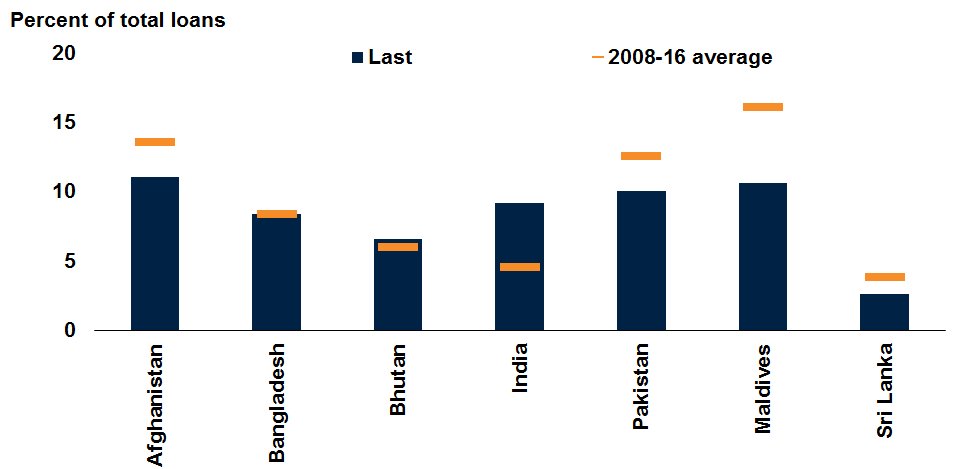
There’s also the little point that saying we don’t need to worry about defaults because lenders don’t give loans unless they’ll definitely be paid back is ridiculous. Many bank loans do end up unable to be paid back. This is the percentage of non-performing loans in the Maldives compared to other SAARC countries- we’re on the high end of average, and 10-15% of loans are non-performing. That’s over one in every ten.

Nothing good can be brought to a land without peace (x)

I have no idea how this is supposed to be a point for RY, because I don’t think disappearances, murders, massive corruption scandals, terror threats, states of emergency, and civil unrest due to crackdowns on opposition count as peace.

YAG has been good for our foreign relations

Well, aside from the Commonwealth, and major tourism market the EU, and any country an increasingly reckless Saudi Arabia decides to oppose on the day, including Qatar who were looking to invest here before we sided with Saudi Arabia against them instead of staying neutral, and an India increasingly spooked by Chinese presence here…

There’s also the question of how much of our sovereignty has been ceded to our two main sources of debt, China and Saudi Arabia. For example, do we jump into every conflict of the Saudi regime, whether it’s with Qatar or with Canada, for our national self-interest, or do we do so because the Saudi government has undue influence over ours?

Political freedoms given without economic freedoms benefit only the political class (x)

Firstly, there’s no reason the two should be mutually exclusive. It’s possible for people to have economic freedoms while also being politically free. Secondly, is it economic freedom if you’re pressured to show support to a party to be able to keep your government job and maintain a source of income? What if you’re an employee in a company that’s been given debilitating fines for speaking against the government? What if you’re unable to pursue your life, economic or otherwise, without fear or threat of harm?

Stability of the nation is more important than the political agenda of any individual faction (x)

… Is this gaslighting?

We’re focused on the long term development of the country (x)

It’s impossible to isolate questions of freedom, rights, the ability to live without fear, and equal justice and only discuss the economy as a way to measure development. Quoting Amartya Sen:

DlFMwjsVsAE7GvJ

The long-term deterioration of the democratic process and democratic institutions is part of it. Keeping someone who will only continue to suppress democracy and freedom in power is neglecting the long-term.

In conclusion…

I’m not convinced.


what do parties promise in other countries most like our own?

What do we do differently in our politics? What do countries in similar situations and contexts as us have going on politically? What might a policy platform or manifesto look like in a country similar to ours? What might our politics look like, in some alternate universe? We’re gonna look at one possible comparison, the platform for the center-left Democratic Labor Party of Barbados.

Why Barbados? The Maldives and Barbados are both island nations heavily dependent on tourism, which accounts for about half of the Barbadian economy. Barbados is probably the closest match to the Maldives of any country in the world. They’re similarly sized (115 sq mi for the Maldives to 170 sq mi for Bahamas), have similar populations (430,000 to 280,000), and have a population density closer to the Maldives than most other nations on Earth (2900 per sq mi to 1700 per sq mi) that is ethnically quite homogeneous (over 90% belong to one ethnicity).

The two also have similarly sized economies at $4.8b and $4.4b respectively, similar GDP per capita accounted for purchasing power at roughly $20,200 to $16,700, a similar Human Development Index score at 0.706 to 0.796, and Barbados also has currency pegged to the US Dollar (exchange rate 2 BBD per USD).

Barbados has a two-party system with the two major parties, the Barbados Labor Party and the Democratic Labor Party, both relatively moderate parties without major ideological differences. Elections have a strong personal aspect and voter allegiance is often based on tradition. The major problems it faces are creating jobs, especially for youth, as well as economic diversification, supporting small business, and continuing to develop the tourism sector.

An important context going into this manifesto is that Barbados has a land tax, at rates ranging from 0.1% of the current market value of their property for units with smaller valuations up to 0.75% for more valuable properties, with over a hundred thousand units listed and paying land tax. Exemptions to the land tax are made for universities, religious institutions, charity organizations, cemeteries, and the like. In 2012, the revenue from the land tax was about US$60 million, of which $22m was from residential plots, $21m from non-residential, and $17m from land-only.

This post is just a look at the platform of a mainstream center-left party in another country like ours, for purpose of comparison. Some of these policies won’t apply to the Maldives, some are already being done here, and some might work in Barbados but wouldn’t in our context. Either way, it’s an interesting read. I haven’t included every single detailed policy proposal and I left out the obvious and generic ones, but this will be a pretty good look at their policy proposals.


Policy positions from the Democratic Labor Party Barbados manifesto

Develop the tourism industry:

  • 15% land tax rebate for tourism related entities that demonstrate at least a 25% increase in use of local inputs from local agriculture, cultural industries, and manufacturing and maintain that use.
  • Further 10% land rebate for tourism related entities that install systems for at least 50% of electricity generation requirements from renewable sources.
  • Tourism entities can claim corporate tax deductions of up to 150% of expenditures related to use of local inputs.
  • Fund a programs to link agricultural businesses and entertainers with tourism and hospitality industry businesses for partner relationships.

Promote entrepreneurship, small business, and innovation:

  • Promote SMEs in education, healthcare, tech, renewables, agriculture, and cultural industries.
  • Foster linkages/partnerships between SMEs and tourism industry.
  • Partner with credit union and co-op sector in SME financing
  • Double the budget of the Youth Entrepreneurship Scheme

Boost investment in local communities through credit unions and co-ops:

  • Reintroduce income tax deduction for credit union shares and deposits.
  • Remove asset tax on co-ops.
  • Provide deposit insurance on deposits at co-ops.
  • Include credit unions and co-ops in facilitating SME financing.
  • Incentivize development of crowd-funding platforms, mobile banking, and other fintech solutions.

Modernize the public sector:

  • Implement service charters and performance indicators for all government departments and statutory corporations to maintain accountability.
  • Create a youth-led project to digitize the entire records system of the public service to boost efficiency, employ youth, and improve the ease of doing business.

Improve public health:

  • Establish a program providing in-home and community based health checks and information along the lines of the Cuban model.
  • Provide mandatory health checks at schools.
  • Enhance the use of telemedicine and other digital technologies to reduce the cost of healthcare delivery and healthcare management.
  • Give tax credits for preventative health activities such as gym memberships.

Establish better mental health care:

  • Free counseling as primary care for all 16-25 year olds.
  • Mandate an additional training course for all GPs in mental health issues.
  • Establish a permanent mental health awareness and advertising program.
  • Build a registration and licensing system for mental health professionals.
  • Develop a new service to address addiction and mental health dual diagnoses.

Focus on harm reduction in the war on drugs:

  • Decriminalize possession of less than a minimum quantity of marijuana.
  • Ensure the resources of the criminal justice system are targeted at pushers and that medical supports are focused on the victims of drug abuse.
  • Create a drug court to direct drug users towards treatment and management instead of prison.

Create a disability friendly society:

  • Work with key stakeholders in the disabled community and in line with international best practices.
  • Develop international and private/public partnerships to provide wheelchair access to all public buildings and complete a wheelchair friendly sidewalk program.
  • Improve educational supports for children with special needs by expanding the number of educational psychologists in the Ministry of Education.
  • Develop and implement a Comprehensive Employment Strategy for People with Disabilities.

Take a community-based approach to crime:

  • Zero tolerance to domestic abuse.
  • Conduct community based anger management and dispute resolution cases.
  • Expand a national Youth Service and similar programs to provide young males in particular with viable alternatives to crime.
  • Enhance prison rehabilitation programs.
  • Partner with civil society to expand programs in parenting skills.

Support social renewal:

  • Carry out ongoing workshops on conflict resolution in schools from primary to secondary.
  • Teach civics in primary and secondary school.
  • Promote community policing and healthcare.
  • In-home community based health care and health checks by trained youth volunteers from the community.

Promote gender equality:

  • Mandate at least 50% female membership on all state boards by 2026.
  • Mandate at least 25% female membership on all private sector boards.
  • Compel all large companies to publish gender discrimination data publicly.

[note: we’ve argued before here that quotas mandating representation of women actually increases not just fairness but productivity]

Ensure national food security and developing agricultural capacity:

  • Build a new agricultural training institute that is among the best in the region and will attract local and international candidates.
  • Provide government-owned land for agricultural projects that are focused on youth and/or are scalable and commercially viable.
  • Facilitate foreign direct investment into high impact agricultural projects.
  • Promote widespread use of cutting edge agricultural technologies such as aquaponics or vertical farming, and remove all taxes related to import of equipment and supplies.
  • Provide a market for farmers’ products by offering long term purchase contracts to supply fresh food to government institutions and promoting Barbados in tourism as a fresh food destination.
  • Agri-business incentives:
    • 10 year tax holiday for new agri-business entities or for venture capital funds focusing on agricultural businesses.
    • Make up to 150% of loan interests, R&D research, staff training expenditures, and marketing expenditures for agri-businesses tax-deductible.
    • No withholding tax on interest earned by financial institutions for 10 years on agricultural investments, or dividends received by shareholders in agri-business entities

Develop cultural industries:

  • Create a permanent home for a National Cultural Foundation (NIFCA).
  • Provide scholarships and business financing for NIFCA winners.
  • Fund a programs to link artists and entertainers with tourism and hospitality industry businesses for partner relationships.

Bring about a renewable energy revolution:

  • Facilitate utility-scale renewable energy projects to get to 50% of peak demand by renewables by 2026.
  • Establish a green public transport fund to support the replacement of the state public transport fleet with greener vehicles or vessels.
  • Provide a 25% rebate on land taxes to households with vehicles not powered by fossil fuels.
  • Invite international investment into developing high-tech renewable energy.

Increase digital connectivity:

  • Equip schools for the digital age.
  • Promote free wi-fi access in public spaces.
  • Provide accelerated depreciation for capital costs of establishing an e-commerce or digital commerce platform.
  • Provide corporation tax credits for up to 150% of the costs of operating a digital commerce platform.
  • Direct capital investment in updating health, education, transport, energy, agriculture, tourism, and other sectors.
  • Promote Barbados as location of choice for ICT businesses in the region through Invest Barbados.
  • Develop and implement a National Broadband Plan.

the case for voting

You can look at the only realistic options presented to you and like none of them. In most majoritarian democracies, the choices on offer are often difficult to justify morally. In many majoritarian democracies, the policy proposals on offer are so vague and incoherent, and the system itself is so gummed up and dysfunctional, that it’s hard to argue that real change will happen through electoral politics instead of direct action, grassroots organizing, working outside the system to change the system.

That’s right. I agree. But here’s the case for voting strategically anyway.

I’m a leftist. The policies I want are things that electoral politics might not be equipped for, at least within the near-future. But electoral politics doesn’t have to be about endorsing a candidate or a platform. As a leftist, electoral politics to me is a vote on the environment I want to be organizing in. I want to do grassroots work. I want to get ideas and policy proposals out there. I want to be able to freely convince people about the value of my ideas and the advantages of my proposals.

The policies I want aren’t on offer. The policies we want are things we have to make happen, outside of the conventional electoral system. A repressive authoritarian government makes direct action, the spread of new ideas, grassroots organizing, and any behavior critical of the ruling establishment much, much harder.

You don’t have to work within the system. For real change, you might need to work outside it. But you want to ask- in what kind of external environment do you think you would best be able to bring about this real, outside-the-system change?

Will a government that regularly carries out heavy-handed crackdowns on opposition and changes the rules constantly to crush dissent, allow an environment where you would be able to best effect change? Even if you’re courageous and unfazed, would it allow those more vulnerable to participate freely in bringing about change?

Voting is a means to an end. The lesser of two evils doesn’t have to be something you endorse. The lesser of two evils just needs to be the option that makes tearing down those evils, bringing about real change, more likely to happen. The lesser of two evils as the establishment makes targeting the establishment an easier, safer, and more effective task. The lesser of two evils is taking the sting out of state power and its control over our every move. To bring about wholesale change, you want an easier target- one without a reckless authoritarian consolidating their power by the day, growing stronger and more repressive, pulling together more and more levers of power to keep the populace in check.