islamic liberation theology

This puts together and edits writings by Kaloi Abdu-Rahman and Sohaib Sultan. Both are about religion as a duty of the powerful to protect the powerless, and as a duty of the individual to stand with the powerless against the powerful, where the role of religion is a guiding light toward building a society that takes care of its most marginalized.

Related posts: Religion as revolutionary social justice, Radical empathy and a relationship with God, Religious law and human fallibility


Islamic Liberation Theology – Kaloi Abdu-Rahman

Liberation theology requires practicing Islam with the knowledge that all we receive in this world is because of the grace of God, not our own action and will. It understands that all humans are equal and that some are facing trials and misfortunes that aren’t of their own making.

With that knowledge, we know that the wealthy and the middle-class are not better than the poor, men are not better than women, no race is better than the other, no one group of people are harder-working or more intelligent: we were created all equal under God, with our lots in life determined by circumstance.

The Prophet (PBUH) understood that the privileges allowed to people of Mecca before Islam were determined by the relative value that their tribe or gender or class or status gave them, much like in our societies today, and sought to dismantle this system for one of equality.

Liberation theology sees the social power of religion as a tool that religious institutions have a responsibility to use. The power and respect of religious institutions must be used to advance the status of the marginalized. Those with power within religious institutions that do not use their power for the advancement of the marginalized and fighting for equality are breaching their religious duties by doing so.


Background of Liberation Theology

The term “liberation theology,” according to the Oxford Dictionary of Religions, means “an understanding of the role of theology in moving from abstraction to action, in which the actual condition of the poor is the starting point.” The Encyclopedia of Religion defines liberation theology “as critical reflection on the historical praxis of liberation in a concrete situation of oppression and discrimination.” It is also known as a social movement within the Christian Church and a school of thought, both of which react against human suffering due to poverty and various forms of oppression.

Liberation theology, in fact, was a religious movement that sought to liberate people from poor social conditions and injustice. It emphasizes the mission of bringing justice to the poor and oppressed. The actual message of liberation theology is to the plight of the oppressed, hungry, poor and marginalized. God exhorts us to struggle for human well-being, to strive for human rights and to liberate humanity from social and economic injustice. In other words, it is a way, a discipline, an exercise that must be practically carried out. Liberation theology stresses that institutions of religion must advocate and help the poor and try to save them from affliction and marginalization due to social and political injustice, in a spiritual way and with regard to the scriptural message.

In a broader sense, liberation theology includes an interpretation of scripture that is rooted in the everyday experience of poverty. It is an effort to improve human welfare in very basic ways. Liberation theology is a system and structure, like an organization that works for the betterment of every individual in society; everyone has a right to benefit from its sources and means; no one should be deprived of its benefits. It sees Islam as a set of responsibilities for institutions with power.

Islamic liberation theology emerged when the Qur’an started to be revealed to the Prophet Muhammad. The Qur’an seeks to liberate people from all kinds of sufferings and in different ways (socioeconomic and theological). The Qur’anic commandments were an open challenge to the tribal lords of Mecca, who would oppress and dehumanize the poor. Islam, since its beginning, through the teachings and commandments of the Qur’an, denounced injustice and oppression, and condemned the prevailing social system of Mecca. With the message of the Qur’an, Islam proclaimed liberation, freedom, justice and equality, it was stated that all people are equal before God and there is no entity who deserves to be worshiped but He (God) (Qur’an, 2:255).

Qur’anic liberation theology accords with social and economic balance, an equal social structure and assigns a high position to human dignity. In the modern age, injustice and discrimination against oppressed and marginalized people is taking place in almost every part of the world, especially in underdeveloped countries. So, how to address the issues of injustice and oppression? What are God’s commandments in relation to abuses in the contemporary age? How to mitigate these pressures upon the weaker parts of society? How do scriptures and theology admonish the authorities to help the poor and ease their suffering?

The Prophet Muhammad liberated people from the oppression of the Meccan upper classes. He conveyed the message of God to the people, with warnings and glad tidings, for the construction of a just society that should be based on equality, fraternity and justice. Islamic liberation theology started when the Prophet Muhammad received inspiration in the first message of revelation, which instructed him to “Read”. This was a message that sought to liberate humanity from darkness, ignorance and illiteracy. It also taught awareness that God is the One who created humanity. From this verse, it is inferred that man should not hold any misconceptions about his creation. Such indications and instructions were also mentioned in previous divine scriptures and messages.

When Muhammad received revelation, it came in the form of a reformative and revolutionary message to all the people of the world, as he was given the title of mercy for all the worlds (al-Qur’an, 21:107). He delivered the message of the Qur’an, the message which was revealed to him for the reformation of society. The Qur’an affirms that God sent him to deliver glad-tidings to people (al-Qur’an, 2:119). The Prophet Muhammad worked for the liberation of the oppressed, the poor, the needy and the ignorant. In his project of liberation, he was not just a prophet, teacher and philosopher, but also an activist who sacrificed his life for justice and equality. Under his inspiration, the Arabs not only liberated themselves but in turn liberated others from oppression and subjugation.


The Socio-Economic and Religious Background of Arabia before Muhammad (PBUH)

The Prophet Muhammad was born at a time when people were engaged in arrogant displays of tribal superiority. Privileges were based on unjust conditions and prejudices. In such circumstances, he stood up and challenged unjustified privilege and established social and moral values based upon the revealed message. In this environment, Muhammad was inspired by God to deliver the revealed message. It was a call to worship God in gratitude for His goodness both to each individual and to the Meccans as a whole. But the people of Mecca refused to accept the message, except for a few. Due to the opposition and rejection of the Meccans, the first ten years of Muhammad’s preaching were hard. He was persecuted and threatened.

Muhammad’s message and aim were to bring reform to society and condemn the socioeconomic inequalities of Meccan life. He therefore presented a direct threat not just to traditional polytheistic religion, but also to the power and status of the establishment, threatening its economic, social and political interests. He condemned false contracts, usury, as well as the negligence and exploitation of orphans and widows. He defended the rights of the poor and the oppressed, declaring that the rich had a responsibility to the poor to use a portion of their wealth for their benefit.

A truly liberating theology grew from this tradition. Islamic theology is grounded within this historical tradition, which in turn is derived from the primary foundations of the Islamic tradition—the Qur’an and the Sunnah and, more importantly, in how the core message affects the daily lives of the people in need of this theology. The importance of Islamic liberation theology is not just its relation to historical, religious, and cultural contexts; it provides the grounds on which the liberating elements must be developed for the welfare of the people in general.

Progressive Muslim scholars have criticized and opposed classical Islamic theology and Muslim theologians. In fact, theology in its received form, according to progressive Muslims, does not support human liberation. It only supports the status quo; moreover, theologians who support this form of theology are partners to the status quo. The actual purpose of liberation theology is liberation from suffering.


The Qur’anic Paradigms of Liberation Theology

The first objective of Islamic liberation theology, as has been shown by the verses of revelation, is to liberate people from ignorance, illiteracy, superstitions and polytheism. The Qur’an also liberates humanity from racism. Racism is the worst type of evil, in which people think that a particular race is superior to others. It exists in almost every society, creates social problems and hatred between social classes. The Qur’an condemns notions of racial superiority or inferiority. Instead, it teaches that all people are the children of Adam and Eve and equal before God (49:13).

The main goal of liberation theology, according to the Qur’an, is to provide financial help to the poor and liberate them from poverty (4:95). The Qur’an teaches that a Muslim must always take the side of the weak regardless of their religion and race, and asks the question, “Who among those in need would require more attention than the poor and the destitute?” (4:95).

The Qur’an also protects man from subjugation. It liberates man from the tyranny of governments and rulers. The Qur’an gives rights to every individual equally so that all will be treated and judged on an equal basis, irrespective of race, colour and faith (49:130). It also admonishes believers to establish justice in all spheres of life (4: 135). Qur’anic liberation focuses on justice, freedom and equality on the one hand, and the condemnation of exploitation of man by man, oppression, and persecution on the other.

The idea of Islamic liberation theology is retrieved from the Qur’anic teachings. Its core values in “key terms of the Qur’an” comprising tawhid, (oneness of God), din (religion), adal (justice), rahmah (compassion), ihsan (benevolence), and hikmah (wisdom). These key terms are the main tools for constructing the platform of Islamic liberation theology.


The Prophet Muhammad as a Liberator

The Prophet Muhammad liberated people from all sorts of sufferings. Through the Qur’an, he liberated people from ignorance and superstition, from polytheism and racism, from poverty, inequality, subjugation and injustice. This means that Islamic liberation theology is an all rounded affair.

The Prophet Muhammad struggled on behalf of promoting Islamic injunctions against the tribal cruelties without engaging in violence. He and his companions bore the brutalities of the Meccans and continued to propagate and practice a way of life that was based upon revealed teachings.

The paradigm of struggle and resistance to injustice, established by the Prophet Muhammad and his early followers, was a movement of liberation. Many Muslim movements that developed in later centuries attempted to follow this prophetic paradigm, and together these have become important sources of inspiration for many contemporary Muslim liberation struggles.

The Prophet Muhammad was the beacon of light who announced through the Qur’an a charter of rights for women. The Qur’an, for the first time, gave them various rights: the right to be a witness, the right to marry a husband of her own choice, the right to divorce her husband without any pre-condition, the right to inherit her father’s property, the right of mothers and relatives to have property, the right to have custody of children, and the right to make decisions freely. Thus, due to Muhammad’s prophethood, women gained social dignity and respect.

The Prophet aimed to establish justice within the social and economic environment of Mecca; he was deeply disturbed by the conditions of women. Islam teaches the values of equality, justice and freedom. Women’s rights and gender equality are emphasized greatly in the Qur’an.

Though the idea of modern liberation theology has been derived from Christian hermeneutics, we can say that all religious scriptures have a solution for liberating people from suffering. The Qur’an not only supports the oppressed and weak sections of society, but teaches lessons of equality, dignity, freedom and respect for each other. It also calls on its believers to respect and recognize the truth of other religions.

The Qur’an provides the guidelines and ways to liberate people from all kinds of sufferings. God has sent the prophets to each and every community for their guidance. A universal theology of liberation is found among all religions. It is a method by which the implementation of God’s rule on earth, the establishment of justice, equal rights and uplifting peoples’ standard of living may be achieved. Liberation theology prioritizes actions over theory. It advocates the protection of the oppressed from the oppressors. It provides socio-political resistance against oppressors. It is a theology in real sense that aims to implement a world reality based upon respect for human dignity and the realization justice.


The Quranic framework for liberation

Esack claims that the Qur’an’s stress on helping preferentially the mustad’af refers to someone who is oppressed or deemed weak. The mustad’afun are people of inferior social status, people who are vulnerable, marginalised and oppressed. The Qur’an also uses other terms to describe the lower and impoverished classes of society, such as aradhil, marginalised (al-Qur’an, 11: 27), the poor (2: 271) and the indigent (2: 83).

The Qur’an also denounces the powerful and their accumulation of wealth, and exhorts the believers to treat women with equality and to free slaves. According to Esack, the most significant and relevant Qur’anic text in the South African situation encompasses verses 28: 4-8. In particular, Esack quotes this verse frequently: “And it is Our will to bestow Our grace upon the mustad’afun on the Earth”. This verse shows the Qur’an’s socially engaged message of liberation and empathy for the oppressed.


The road to liberation

Liberation generally signifies redemption, salvation and freedom. Liberation theology seeks salvation and deliverance from all forms of oppression, especially socio-political and economic injustice, under the instructions of the scriptures that were interpreted by the prophets and theologians, and in order to help marginalized people.

Thus, scriptures exhort us to struggle for the welfare of human beings, to help them against all sorts of injustice and inequality. Islamic liberation theology addresses all aspects of existence. These include not only the socio-political, economic and theological, but also the historical, religious, and cultural.

The best sources of Islamic liberation theology are the Qur’an and the traditions of Muhammad. Both provide guidance to those who suffer in the world. They condemn ignorance, illiteracy, and injustice.

Many human beings still face the distress of unemployment, poverty, starvation, malnourishment and homelessness. On the other, the world has also been suffering from inter and intra-religious extremism and ethno-religious nationalism. People want to be liberated from both torments.

Liberation theology suggests the following:

  • To obtain liberation from poverty, injustice and inequality. Human liberation lies in helping out the poor from a sociological and not only a metaphysical perspective.
  • The Monarchical practices of Muslim rulers and religious leaders should not include nationalism, tribal and communal favor. They are supposed to be free from the intoxication of power. Their role should be like that of the model caliphs, who gave rights and dignity to every individual, irrespective of color, race, gender and religion; to help and serve the people, and to bring peace and justice to society.
  • Guidance derived from the teachings of the Quran, must play a central and critical role not only in creating harmony and religious coexistence but also in explaining that human and religious diversity is normal.


The Social Qur’an – Sohaib Sultan

Faith is incomplete without a radical commitment to social justice.

In the late 19th to early 20th century there emerged an influential intellectual Christian movement that preached, what became known as, the “Social Gospel.” In summary, the movement sought to apply Christian ethics, taken from the Gospel, to social problems such as poverty and war. It was and remains a progressive movement essentially rooted in the Gospel’s radical social justice message.

Interestingly, around the same period, there also emerged movements within Islam that sought to do something very similar – apply Islamic ethics, taken from the Qur’an, to the myriad of social problems Muslim societies were facing. This movement attempted to advocate and argue for human freedom from tyrannical governments, economic fairness, and so on.

Unfortunately, when some of these movements went from standing up against unjust political authority to wanting to become the political authority itself, the movements were quickly and brutally suppressed and fractured – sometimes leading to the formation of radical political organizations that responded to the suppression with calls to militancy.

Today, this much maligned and far too easily discredited movement is known in the West as “Islamism” and their followers are called “Islamists.” It has become a bad word from the halls of government to the world of academia. If you want to malign or discredit a Muslim public intellectual or activist, all you have to do is call them an Islamist. Sadly, many radical proponents of the Christian Social Gospel message have met a similar end.

In the Muslim World, the movement is received with much more nuance. There are, of course, the violent extremists who have the loudest bullhorn on the block because of their tactics – “what bleeds leads” as they say in journalism. Every major study has shown that these violent groups are largely rejected by the vast majority of Muslims.

But, some of the most effective grassroots movements in the Muslim World today are informed and inspired, at least to some degree, by the social justice message of the Qur’an as articulated by the likes of Hassan al-Banna (d.1949) in Egypt and Abul Ala Mawdudi (d.1979) in Pakistan. The attraction is not so much in the wholesale revolutionary message, necessarily, but simply in the positive concern for addressing social injustices with something that sounds and feels authentic to the Muslim imagination – as opposed to something that sounds and feels like a Western colonialist import or plot.

While there was something certainly brewing in the waters in the late 19th – early 20th century in terms of socio-political movements rooted in the Qur’anic social justice message, these movements were largely revivalist movements that were inspired by much earlier periods in Muslim history including many Sufi Orders that were committed to serving the most marginalized in society and affecting grassroots change. Indeed, it would be hard not to read the Prophet Muhammad’s biography and the story of his mission as a radical movement for social justice. The intellectuals behind the Social Gospel would see the life and mission of Jesus in a similar way.

So, in brief, what is the Social Qur’an – if we can borrow terminology from the Social Gospel movement? It is a message that calls on believers to stand up for justice and bear witness to the truth “even if it is against yourselves, your parents, or your close relatives” (4:135) and warns believers to never allow “hatred of others to lead you away from justice” (5:8).

It is a teaching that commands believers throughout the Qur’an to “be a community that calls for what is good, urges what is right, and forbids what is wrong” (3:104).

It is an urging to follow a higher ethical plane that “Is to free the slave, to feed at a time of hunger an orphaned relative or a poor person in distress, and to be one of those believe and urge one another to steadfastness [in doing good] and compassion” (90:13—17).

It is prescribing as a pillar of Islam the institutionalization of almsgiving for the poor and needy (9:60) and an ethic of charity that affirms and restores the dignity of socially neglected people (2:261—274).

It is encouraging the “fair and kind” treatment of women (4:19—21). And, it is pushing people to defend the oppressed even if it means putting their own lives at risk (4:74—76).

This is just a brief glimpse into the social justice message of the Qur’an.

The Social Qur’an is also a message that prohibits usurious loans that enslave people and entire communities to a lifetime of debt (2:275—281). It strongly condemns people “who give short measure” in their business dealings (83:1—6); exploit the orphans (4:10); “act like tyrants” (26:130); set out to “spread corruption” in the world (2:203), to give just a few examples. Social crimes such as sex slavery (24:33), female infanticide (81:8—9), and so on are spoken against in the strongest language.

So, this is a summary of what the Social Qur’an looks like. It is a message and teaching for the socially conscientious people to root their social justice work in a God-centric and spiritually focused way. And, it is a lesson to those who strive to be mindful of God that faith is incomplete without a radical commitment to social justice.
deliberative democracy

Deliberative democracy is one of my favorite ideas for how we might govern ourselves in the future, and I believe that we’ll see universal basic income and deliberative democracy happen in some countries in our lifetimes. I think deliberative democracy could find a real home in the Maldives when we’ve gotten our politics back to a reasonable place, so I’m going to do a series on it [guest post]

About deliberative democracy and how it might be a perfect fit for the Maldives

Deliberative democracy is a form of direct democracy that has learnt from the pitfalls of earlier experiments in direct democracy. A common leftist goal, it has only taken place in a few limited situations so far around the world.

A selection of constituents is randomly drawn for a citizens’ jury. The selection is designed to reflect the actual demographics of the region in factors such as gender and age. The citizens’ jury sees stakeholders from all sides and experts on the area to be fully informed on the issue at question. They then deliberate among themselves and come to a conclusion.

In direct models, this decision is a binding vote on the matter. In other models, this decision is seen as a strong recommendation for the elected representative on how to vote. This is also known as deliberative polling and creates a very strong norm for the candidate to vote accordingly, even though it isn’t officially binding.

Candidates that promise to vote according to deliberative polling of their citizens essentially promise to act as a conduit to direct democracy by their constituents.  Even if these candidates don’t win, introducing and normalizing the idea of deliberative democracy to the wider public contributes greatly to its likelihood of success in the future. This is the most likely path to eventually achieving full, binding deliberative democracy.

Deliberative democracy is merely our traditions over hundreds of years, brought back and updated for modern times. The core idea of deliberative democracy is much more natural to Maldivians that it would be in many other countries. Traditionally, Maldivian islands have held island meetings of elders and stakeholders to discuss among themselves and come to a conclusion.

The advantages of deliberative democracy

Deliberative democracy models allow for greater participation by citizens in the democratic process as it reflects the entire constituency.

Citizens’ juries are short-term, randomly drawn, and disbanded after meetings. This means that corruption is extremely unlikely, unlike with elected politicians who can be nudged or bribed by powerful interests. Members of citizens’ juries also have no career political power to try hold on to.

Most voters are not very knowledgeable about policies they vote for. Citizens’ juries get to make informed decisions based on a strong understanding of the issues, not just what politicians say.

It keeps citizens politically engaged. Case studies show deliberative democracy reducing voter turnoff. With the current state of Maldivian politics keeping most citizens disillusioned with the political process altogether, this is important.

Often, the most active or committed citizens or those with the most resources get the biggest say. Citizens’ juries reflect the views of the majority of ordinary citizens.

Citizens’ juries have very high accountability. Written notes of the deliberations of citizens’ juries are made available online, and are often recorded or livestreamed. This lets anyone in the public see the reasoning and evidence supporting their decisions, which means the reasoning has to stand up to scrutiny.

It removes sole decision-making ability from people with power, avoiding the inherently corrupting nature of power over those who wield it. Since citizens’ juries convene, deliberate, and then un-convene with a new set of participants every instance, decisions are not made by career politicians but by ordinary citizens. Decision-making authority being vested purely to career politicians means that our lives are governed by people self-selected to be willing to devote their careers to gaining power, and who need to worry about keeping other power-brokers happy to remain in power. Deliberative democracy is a first step towards dismantling this flaw.

A grassroots plan of action

Ideally, we would be able to establish a deliberative democratic model as part of our system of government. One way that could work would be for an upper house run deliberatively as a branch of government. A biannual council of citizens, drawn randomly but to match population demographics, would meet anew for days of deliberating over a variety of issues with the model outlined above: stakeholders, experts, information, discussion, and so on. After each biannual selection, the council will be dissolved and a new random but representative group of citizens will be selected for the next council. We should call for our political leadership to implement a similar system. But until then, we have to work at the grassroots level. Some goals we might have are:

To create a community of enthusiastic supporters of deliberative democracy to organize, discuss, and promote the idea to as many people as possible: through local organizing, media appearances, direct campaigning, convincing public figures, social media, and so on.

To hold one or two small pilot programs as proof of concept, by being able to have one deliberation meeting run and some results chosen successfully.

To recruit candidates, no matter how unlikely, to run on a platform of deliberative democracy.

In doing so, to raise the profile of deliberative democracy and introduce the idea of establishing it in the grassroots through candidates instead of waiting for it to be implemented top-down in a distant, unlikely future.

Someday, to elect a candidate that has successfully run on a deliberative democracy platform.

Deliberative democracy around the world

Some of the earliest examples of democracy such as in Ancient Athens had a very similar model of sortition, where an assembly of randomly chosen citizens that convened regularly had governing power. Sortition was considered a crucial aspect of true democracy, and seen as necessary to prevent leaders from succumbing to the corrupting nature of power.

Because officially instating deliberative democracy would mean massive changes to the political system, there has only been a few instances in modern times.

Denmark has a variation on deliberative democracy known as Consensus Conferences. A detailed manual of how they carry out consensus conferences is available. Consensus conferences aren’t the same, but share many similarities. South Australia has also recently held a deliberative democracy program on the state’s nuclear power policy.Here is a timeline of deliberative democratic events in recent years.

Top-down change towards deliberative democracy anywhere around the world is unlikely. The most feasible path towards a future of deliberative democracy is for candidates to run on the promise to vote according to citizens’ juries of their constituents. This would raise public awareness of the concept of deliberative democracy and raise support for the policy.

If such a candidate wins a seat, they would hold regular deliberative democracy meetings and vote according to the decisions of their citizens’ juries as a way for their citizens to vote directly could inspire more support as people in the Maldives and around the world see the advantages of deliberative democracy. But a candidate doesn’t have to win to make a change: just running, introducing the idea to the public and normalizing it, could be a huge boost to its acceptance among the public both locally and internationally.

More information on deliberative democracy

An introduction is here. An article on the topic is here. Some studies are hereherehere and here. Some books are hereherehereherehere.

environmental toxins may have led to our current crime wave

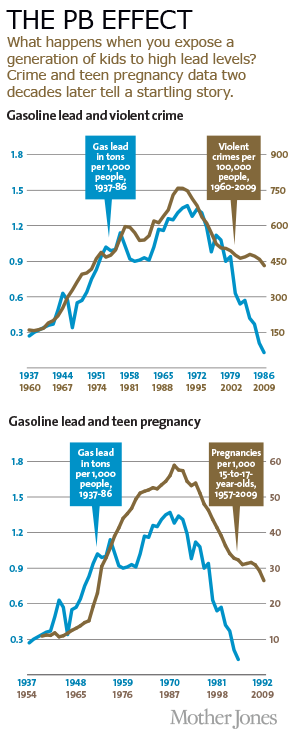
In cities across America, violent crime peaked in the early 90s and then declined sharply, in many cases by up to almost 80%. Crime rates and their decline haven’t shown links to the economy, to demographics, or to policies cracking down on crime. That said, there is one thing that shows a very strong link to crime rates: lead exposure levels from leaded petrol 20 or so years previously. Strict econometric techniques haven’t found any explanations for the variability in crime rates from any specific crime-fighting strategies by governments.

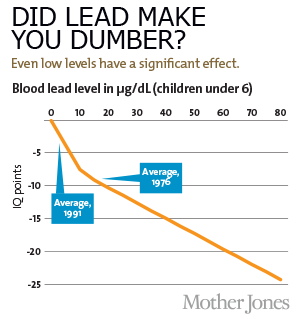
Lead poisoning in children, from sources such as leaded petrol and certain kinds of paint, damages brain development and leads to a whole host of complications later in life: drops in IQ, hyperactivity, behavioral problems, learning disabilities, impulse control, even juvenile delinquency further down the line. This damage is persistent, and lead to much higher rates of crime, teen pregnancy, and drug abuse down the line as a poisoned generation of children reach adulthood.

In studies conducted in America, lead emissions with a lag time of 23 years was found to explain 90 percent(!) of the variation in violent crime in America. In states where the use of leaded petrol declined slowly, crime also declined slowly, while a quick decline in use showed a quick decline in crime two decades later. Another study, looking at crime trends around the world, showed the same pattern found in America to also apply to Australia, and Canada, and the UK, and Finland and France and Italy and New Zealand and Germany, with every single country studied showing the same pattern.

This even applied to the neighborhood level: neighborhoods with high lead concentrations map up near-perfectly with crime maps. Even tiny levels of lead can cause significant and permanent damage to children that lasts over their lives. In the United States, almost 1 in every 40 children had levels of lead in their blood high enough to cause significant damage. What might that number be in a less developed country, without as strict an authority as the US FDA and EPA overseeing levels of toxins in the environment, and with leaded petrol being phased out much later?

Chart: The PB Effect

The biggest source of lead in the environment was leaded petrol, with other sources including leaded paint. Lead emissions around the world rose steadily from the 1940s through to the early 1970s, and then began to fall again as unleaded petrol replaced the leaded variety in many developed countries. With a 20-year offset, this mirrored the much-feared crime waves seen in many American cities, which peaked through the 1980s into the early 1990s before a massive fall.

In many developing countries, leaded petrol continued to be used. I can’t find data on the exact time periods in which we stopped using lead, but when I asked around people mostly remembered it as being in the early-to-mid 1990s. Between the rapid development set off by the tourism industry in the 1970s, which likely led to much increased use of motor vehicles by a now wealthier populace, and the replacement of leaded petrol by presumably the early 1990s, there would be a 20 or so year window where children faced high levels of lead exposure- generations that would be in their twenties and thirties now. If this is true, we should be able to expect an easing of the crime epidemic over coming years.

Chart: Did Lead Make You Dumber?

But we might be repeating this historical mistake, this time through exposure to dioxins and other byproducts from the burning and disposal of plastics. Dioxins are often found built up through the food chain in animal products, mostly cattle products and sometimes, in areas with high exposure, fish high up in the food chain, such as tuna. More directly, it is likely produced in the incomplete burning of huge quantities of plastic waste such as in Thilafushi.

Dioxins are carcinogenic and teratogenic, which means they can cause cancer and birth defects. Exposure to dioxins and other PCBs also affect fertility and reproductive health, and disrupt the balance of hormones in the body. Like lead, dioxins and PCBs may also cause developmental issues in children that persist over years. Some evidence has been found showing links between high PCB levels in children and poor performance on developmental and cognitive tests, with the effect most significant at birth. It appears that Male’, or anywhere exposed to toxins from Thilafushi smoke, is potentially a particularly harmful place to be pregnant in.

We deserve answers

We should be able to demand answers from our governments. For starters, a study on lead exposure and environmental lead levels throughout the Maldives, measuring blood lead levels in children and adults, and a thorough review of other developmentally damaging toxins that may be present in the environment along with a plan of action for cutting down on them. Nobody knew about the dangers of leaded petrol in the 1990s, but with current knowledge, it is the responsibility of the government to conduct proper reviews and the right of the public to know which toxins enter our bodies everyday and which effects they might have on us or our children.

how could we reduce corruption and prevent another dictatorship?

Well, it’s an open question and I don’t have all the answers. These are just a handful of possible suggestions drawn from our earlier crowdsourced manifesto, attempting to create enough fallbacks and checks and balances and devolution to prevent a dictatorship from happening again and again. Please send in any feedback and suggestions.


Transparency of finances for members of government

The public has the right to see whether those in power receive financial benefits for their actions, and to see which conflicts of interests may be held by those in power.

1. Elected officials, cabinet members, and heads of major independent government bodies having to declare assets at the beginning of each term, and will have to be audited once a year.

2. All transactions in or out of over 50,000 Rufiyaa by any elected official, cabinet member, or judge having to be put on the public record within one month of the transaction happening, and financial institutions will be required to disclose information for such transactions.

3. Non-home assets of the President, Vice President, and Supreme Court Justices having to be placed in a blind trust for the duration of their term.


Transparency of the activities of government

1. An open government portal with information at the island level, with updates on the progress of any development in every island mandated on at least a quarterly basis, so that every citizen in the Maldives can monitor what the government is doing anywhere in the country.

2. Protections for whistle-blowers. A fully anonymous system, vetted by international authorities to ensure security, for whistle-blowers.

3. An independent public inquiry into major crimes with suspected government culpability, such as disappearances, murders, and theft of public resources, for fact-finding and restorative justice.


Devolution of powers from central authority

Decentralization of political authority, both to other branches of government and to other physical locations in the Maldives, reduces the possible amount of power held by any one individual from Male’.

1. A biannual citizens’ council as an upper house of parliament that consists of a demographically representative panel of citizens drawn randomly twice a year, in a deliberative democratic model. Citizens meet with stakeholders and experts over days of deliberation, similar to a jury, and come to a verdict. The citizens’ council would have veto power for major legislation and propose recommendations to parliament so that politicians can no longer override the wishes of ordinary citizens. A new set of citizens are drawn for each biannual council, which is immediately dissolved after each session. Unlike career politicians, these citizens have no need to kowtow to the rich to hold on to power. The biannual citizens’ council will alternate between a major Southern and Northern island.

2. A non-governmental organization consisting of experts who evaluate government policies, budgets, financial disclosures, and all other activities of government and publish simple reports for ordinary citizens, will be established by a government endowment. This organization will be established in Addu City, physically and politically insulated from the powers in Male’.

3. Some taxation and spending autonomy for atolls. While the central government would still be the major taxation and spending authority, atolls having municipal authority to collect some forms of taxes and to spend those as it sees fit would make them less dependent on the largesse of the central government in Male’. With spending more localized, those in charge of local budgets would have much closer relationships with the citizens whose tax money is being spent, and so have an incentive to spend well and avoid the anger of their fellow residents.


Prevent a dictatorship from happening again

Reduce the powers of the Presidency and ensure independence of government bodies.

1. A firewall legally preventing the executive or legislative branch from interference in independent government bodies such as those overseeing the media, elections, judicial oversight, anti-corruption activities, or the Truth and Reconciliation Commission.

2. An independent government body to administer military benefits, such as housing and pay, from a budget allocated by parliament, with the President or executive branch no longer having any influence over military benefits and no politicians able to secure military support by promising increased benefits.

3. The President’s Office would no longer have the power to unilaterally appoint or remove appointees to any independent government bodies. Instead, heads of these bodies can only be removed by vote from a majority of its members.

4. The President’s Office would not be allowed access to internal information on the operations of those bodies aside from what is officially required.

5. To prevent coercion, the heads of independent oversight bodies would have immunity from a certain list of charges such as terrorism or sedition during their terms, and cannot be restricted from freely leaving or entering the country.


crowdsourcing a manifesto

This post is inspired by many of the responses to this post about what people would like to see from a government, as well as from over Twitter. What do we really want from a government? This is our compilation of both Twitter’s and our ideas, edited and written up in manifesto form. You can add comments and suggestions here.


CREATE AN EQUAL SOCIETY

Equitable sharing of our natural resources

We believe the resources of the Maldives belong collectively to all citizens, not just the rich. We would assign a 30% ownership stake to every resort for citizens of that atoll, with the profit dividend paid out too all atoll citizens as a starting point for a Universal Basic Income. Local citizens would have a say in decisions, and would be able to attend Annual General Meetings of resort companies and receive the annual financial statements of the resort.

Biannual citizens’ council as an upper house

Career politicians have too strong an incentive to kowtow to the rich and powerful to keep their power, and are vulnerable to corruption. We will establish an upper house of parliament that consists of a demographically representative panel of citizens drawn randomly twice a year, in a deliberative democratic model. Citizens meet with stakeholders and experts over days of deliberation, similar to a jury, and come to a verdict. A new set of citizens are drawn for each biannual council, which is immediately dissolved after each session. This reduces corruption and gives power back to the people. The citizens’ council will have veto power for major legislation and propose recommendations to parliament so that politicians can no longer override the wishes of ordinary citizens. [x]

Progressive income tax and land tax

We need a wider revenue base to continue development in the country. We would establish an annual land tax on registered plots for 2% of the market value of that land. We would also implement a progressive income tax for all earners with an income above 25,000 Rufiyaa, with a higher marginal tax for the highest income bracket. Land tax rebates will be given for productive uses of land such as rental housing or high-tech agriculture.

Build social housing to push down market rent

Rent is unaffordable for most citizens. We will build social housing to push down market rents, with a target of providing enough housing supply for the market rent to reach levels affordable to working adults.

Justice for women

We will criminalize street harassment, update the legal definition of sexual assault to international standards, and instate harsher penalties for domestic abuse, sexual assault, “revenge porn”, and other forms of violence against women. As the current justice system is inadequate on issues of violence against women or sexual violence, we will create a judicial oversight body staffed entirely by women to provide oversight, recommendations, and appeals on cases to do with gender discrimination or violence against women. Company boards will be required to reserve at least one-third of their seats for exclusively women, and at least one-third of the slate of candidates any party registers for elections must be women. We will also eliminate the Massaru Tax. Education for school students on consent, sexual safety, and reproductive health will be required.

Workers’ rights

We will require half of the board to be assigned to worker representatives for companies with 50+ employees. We will legally enshrine regulations for minimum standards of wages, working conditions, and hours for private companies as well as public. Companies will be required to provide workers’ compensation for injuries on the job. [x]

Expatriate rights

Expatriate workers from other South Asian countries should not have to live in squalor while facing exploitation and discrimination. Workers’ rights will apply equally to expatriate workers, not just citizens. We will instate punishments and fines for employers found to have exploitative working conditions. Expatriate workers will be entitled to holiday periods to be able to visit their families without losing their jobs. The practice of employers holding on to deposits, passports, or documents of expatriate workers to restrict their free movement will be criminalized.

Treat drugs as a public health issue

Our current way of dealing with the drug crisis hasn’t worked. We should learn from the Portuguese model, which eased their heroin crisis, by focusing on rehabilitation for non-dealing drug users instead of imprisonment with hardened criminals. [x]

Proactive mental health care

Aasandha will be expanded to include mental health care. An official mental health hotline will be created and awareness campaigns about mental health will be held. All school students will be assigned five appointments with a mental health professional over each year. The government will also fund visits by a team of mental health professionals to schools in every island at least annually.

Public health monitoring

Large parts of the population have deficiencies in basic minerals such as iron or zinc, especially in the atolls where fresh produce is less easily available than in Male’. Citizens also face exposure to environmental toxins, such as dioxins from the burning of plastic waste. We will monitor levels of environmental toxins, lead, and nutrient deficiencies across the country with every island monitored at least once a year. In regions with micronutrient deficiencies, the government will provide supplementation. Increased levels of lead or environmental toxins will be met with immediate action to reduce exposure and remove sources. [x]


SUSTAINABLY DEVELOP THE ECONOMY

Meaningful decentralization

The development of Kulhudhuffushi and Hithadhoo ports will promote local commerce and industry, the land tax will incentivize moves away from costly Male’ land and towards development in the atolls, local ownership in resorts will provide an income source for atoll residents, and the government microfinance body will focus on investment in the atolls. In addition, we will open provincial offices for ministries in a major Northern and Southern island, and require at least 25% of ministry staff operations to be based in the provincial office.

The government will offer young people incentives to move to communities in regional capitals that can absorb and integrate an influx of youth– this could be offers of free government-built housing (usually free with conditions, for example a ten year rent-free period upon moving), business startup funds, loan forgiveness, or scholarship money. [x]

Partial taxation and spending autonomy for atolls

While the central government would still be the major taxation and spending authority, we will entrust atolls with authority to collect some forms taxes and to spend those as it sees fit, making the atolls less dependent on the largesse of the central government in Male’. With spending more localized, those in charge of local budgets would have closer relationships with the citizens whose tax money is being spent.

Diversify the economy with high tech industry and renewables

We will build an ICT services outsourcing center like those fueling the ICT industry in India, to employ local coders and technical workers. Cutting-edge vertical farming, aquaculture, and solar power firms will be invited to develop in the Maldives with promise of contract for commercially viable developments, employing and training young workers. We will also develop our national infrastructure in an efficient and sustainable way by fully digitizing the public sector and beginning a rapid transition to using renewable energy sources.

Microfinance body funded by small-scale foreign investment

We will establish a government microfinance body to lend to listed small projects throughout the country. To fund this, the microfinance body will issue no-dividend securities marketed to luxury resort tourists by appealing to current trends of socially conscious tourism. For wealthy tourists able to spend thousands of dollars a night for resort stays, it provides a way of giving back to local communities. For us, it provides foreign direct investment on a microfinance scale. Projects from the islands will be given priority over those from the Male’ area.

Upgrade international ports in Male’, Kulhudhuffushi, and Hithadhoo

Male’ Port has a capacity well below what is needed, and operates slowly and inefficiently. Issues with ports can add up to 30% to the cost of imported goods. Currently, all imports to atolls first arrive to Male’ Port and then are shipped domestically to atolls, where the cost of shipping goods to islands from Male’ is even higher than shipping from Male’ to Singapore. Many goods also have to be shipped from Male’ on passenger boats, and the difficulty makes providing fresh imported produce difficult or impossible. Kulhudhuffushi and Hithadhoo have international ports, but those are currently only used for resort building material and not consumer goods. We will modernize Male’ Port to meet needs efficiently, reducing costs, and we will develop Kulhudhuffushi and Hithadhoo international ports to receive consumer goods for the atolls.

Environmental protections

We will designate the EPA as an independent body with oversight responsibilities. We will also ban single-use plastic products, and protect environmentally vulnerable ecosystems by creating special protected areas. The EPA will carry out a survey of lead and environmental toxin levels in the population of every island and take steps to minimize these levels. Thilafushi will be developed to minimize the exposure of  nearby inhabited islands to toxins from burning waste.

Getting out of the debt trap

We will reduce our dependence on China and Saudi Arabia, and its effect on our sovereignty, by looking to restructure our debt to a more diverse set of lenders. In the longer term, we will begin to use income tax and land tax revenue to reduce our debt burden and keep our public finances in check. [x]


HOLD GOVERNMENT ACCOUNTABLE

Reduce corruption

We will create an open government portal with information at the island level, with updates on the progress of any development in every island mandated on at least a quarterly basis, so that every citizen in the Maldives can monitor what the government is doing anywhere in the country. A non-governmental organization consisting of experts who evaluate government policies, budgets, financial disclosures, and all other activities of government and publish simple reports for ordinary citizens, will be established by a government endowment. This organization will be established in Addu City, physically and politically insulated from the powers in Male’. A fully anonymous system, vetted by international authorities to ensure security, will be established for whistle-blowing, and protections will be provided for whistle-blowers.

Elected officials and cabinet members have to declare assets upon entering office, and will face an audit every year. Non-home assets of the President, Vice President, and Supreme Court Justices will be placed in a blind trust for the duration of their term. All transactions in or out of over 50,000 Rufiyaa by any elected official, cabinet member, or judge will have to be put on the public record within one month of the transaction happening, and financial institutions will be required to disclose information for such transactions. Rules allowing the sale of islands without bidding will be reversed. [x]

Prevent a dictatorship from happening again

The President’s Office will no longer have the power to unilaterally appoint or remove appointees to any independent government bodies. Instead, heads of these bodies can only be removed by vote from a majority of its members. Aside from what is officially required, the President’s Office will not be allowed access to internal information on the operations of those bodies. To prevent coercion, the heads of independent oversight bodies will have immunity from a narrow range of selected charges such as terrorism, sedition, or disrupting the peace during their terms and cannot legally be restricted from freely leaving or entering the country. Heads of the major independent bodies also have to declare all transactions in and out of over 50,000 Rufiyaa.

We will establish a “firewall” legally preventing the executive or legislative branch from interference in independent government bodies such as those overseeing the media, elections, judicial oversight, anti-corruption activities, or the Truth and Reconciliation Commission. One such body will carry out the administration of military benefits, such as housing and pay, from a budget allocated by parliament, with the President or executive branch no longer having any influence over military benefits and no politicians able to secure military support by promising increased benefits. Reforms will be carried out for law enforcement and military agencies.

Truth and Reconciliation Commission

We will hold an independent public inquiry into disappearances, murders, theft of public resources and other crimes for fact-finding and restorative justice.

Automatic voter registration

All voters who will turn 18 by polling date will be automatically registered to vote.


A shorter version as a much more shareable image:

prelim manif v2


This is a rough draft. Specific details, such as the 2% number for land tax or the details of which charges immunity would be given for heads of independent bodies during their terms, are placeholders for now.


a look at government policy, china, and our debt

Under half a billion dollars (about $405 million) is allocated for the entire Public Sector Investment Program for the year. The Maldives does currently have a very high share of GDP going to health because the hospital mega-project is a large share of this small an economy, but mentioned are absolute numbers, not percentages, maybe because percentages are zero-sum and that makes it impossible to have high percentage numbers for every single sector of government expenditure.

According to the 2018 government budget booklet, 11% of our budget went to interest payments on our debt. Our total debt is more than half our GDP. Falling into a debt trap isn’t guaranteed, of course, but it’s silly to say that it’s not a risk.

obor debt trap

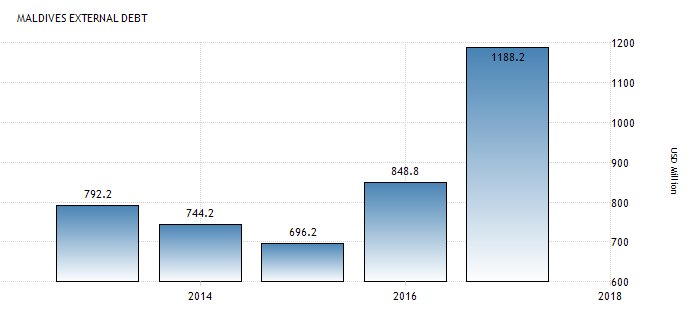
The Maldives’ external debt has gone from $790 million to almost $1.2 billion.

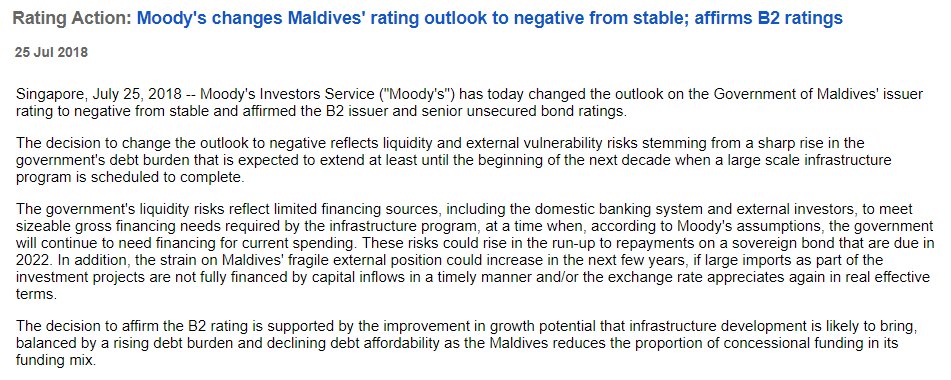
Our credit rating outlook* was recently downgraded because investors feel we might be unable to repay debt obligations. So, financial institutions don’t actually feel all that sure that we’ll be able to repay our debts.

There’s no need to panic, but saying default and the debt trap isn’t a risk is bullshit.

Going by minutes from their meeting with another Twitter user, YRY has argued that YAG managed to wrangle loans from China and that another leader wouldn’t be able to secure these loans. This is silly and intellectually dishonest. China started massive international investment around 2013 to achieve strategic and economic objectives with their One Belt One Road program. YAG didn’t inspire Xi Jinping to start a strategic investment of over a trillion dollars across Eurasia, including in the Maldives.

Some other projects (of hundreds) also happening over the past few years:

  • Khorgos, a massive “landlocked port” in a shared zone with Kazakhstan
  • A “new Dubai” near Colombo along with a massive port in Hambantota. To pay back debt, Sri Lanka gave the port to China on a long-term lease with promise they’d keep military out
  • Chinese overseas military base in Djibouti
  • Chinese port and presence in Gwadar, a small fishing village in Pakistan that is planned to be turned into major port on the maritime silk road

Over 60 countries receive loans from Chinese banks as part of the One Belt One Road initiative, which began massive spending in countries  all around Asia, Europe, and some of East Africa to build trade routes and to send some of China’s excess capacity in construction industry to other countries where those employees could continue to work and those companies could continue to make profits.

China doesn’t make investment decisions based on who happens to be the President of the Maldives. There’s power imbalance between the two nations is way too huge. Investment has happened across dozens of countries with very different political leadership, including many different policy, regulatory, and business environments. There are ways a government could dissuade investment, but realistically, China has a strong incentive to continue for economic, political, and strategic reasons.

China relies on rapid growth to maintain the popularity and legitimacy of the government. With their growth boom starting to slow down as they become more of a consumption-based instead of export-based economy, there remains a lot of Chinese industrial firms that were excess to current requirements of building within China. These firms and their workers are used productively to invest in infrastructure along routes of commerce around the world to keep firms employed and the growth rates going.

The Maldives, along with Sri Lanka, lies in a strategically vital part of maritime trade routes. The One and a Half Degree Channel in the Maldives and the narrow ocean path between us and Sri Lanka are key, and if China can secure one, they can ease the geopolitical risk of another government or military cutting off those routes with a blockade. If China can establish a military base, like they have in Djibouti on the coast of East Africa, they would also be able to project military power in the Indian Ocean and counterbalance India’s power in the region. (This clearly spooks India, which is why they’ve responded to the Maldives’ growing dependence on China with alarm).

Sri Lanka recently faced a debt trap with massive Chinese investments, in both a port and in building a flashy mega-project supposed to be a “new Dubai”. To settle their debt, they had to essentially hand over a port to China, leasing it out for 99 years. China has a clear strategic interest in getting a physical presence in the Maldives: we’re in an important location on ocean trading routes, we’re close to India and a Chinese presence here helps China counter its primary geopolitical rival, and Chinese influence over the One and a Half Degree Channel “choke point” would allow it to continue to trade with Europe and Africa while losing it would make China more vulnerable to a blockade by a rival power.

A lot of our recent economic growth has been driven by external factors, mostly in China. One is the Chinese infrastructure boom, where China is investing $1 trillion worldwide, mostly as part of the One Belt One Road project but also in general. Chinese investment and worries of neocolonialism has been a major issue across Africa for the past decade, for example. Another key factor is the Chinese middle class boom, with hundreds of millions of Chinese citizens entering the middle class over the past year with hundreds of millions more projected to reach those levels of wealth over coming years. The Chinese middle class has massive purchasing power and more upscale tastes, including in vacations. The number of Chinese tourists arriving in the Maldives has increased more than tenfold over the past decade and a half and is accelerating, and they’re bringing wealth with them. These factors would have happened regardless of who was President and will continue to happen regardless of who becomes President.

Something else stands out. If there’s been a consistent thread in recent Maldivian foreign policy, it’s acquiescing to China and Saudi Arabia. Let’s look at who we get the majority of our loans used to fund the investment policies of this government:

PSIP funders

That’s right: the flagship policies of this government, which it’s touting as reason for re-election, are funded with heavy backing from the China Export-Import Bank, which is a state-owned company that exists to further Chinese state policy, and the Saudi Fund, which is owned by the government of Saudi Arabia. I wonder if this government’s indebtedness to China and Saudi Arabia affected our sovereignty by, for example, making the government openly take sides in Saudi Arabia’s conflicts that have nothing to do with us?


*Corrected an error: it should have read “credit rating outlook” instead of “credit rating”, as supported by the accompanying image.