islamic liberation theology

This puts together and edits writings by Kaloi Abdu-Rahman and Sohaib Sultan. Both are about religion as a duty of the powerful to protect the powerless, and as a duty of the individual to stand with the powerless against the powerful, where the role of religion is a guiding light toward building a society that takes care of its most marginalized.

Related posts: Religion as revolutionary social justice, Radical empathy and a relationship with God, Religious law and human fallibility


Islamic Liberation Theology – Kaloi Abdu-Rahman

Liberation theology requires practicing Islam with the knowledge that all we receive in this world is because of the grace of God, not our own action and will. It understands that all humans are equal and that some are facing trials and misfortunes that aren’t of their own making.

With that knowledge, we know that the wealthy and the middle-class are not better than the poor, men are not better than women, no race is better than the other, no one group of people are harder-working or more intelligent: we were created all equal under God, with our lots in life determined by circumstance.

The Prophet (PBUH) understood that the privileges allowed to people of Mecca before Islam were determined by the relative value that their tribe or gender or class or status gave them, much like in our societies today, and sought to dismantle this system for one of equality.

Liberation theology sees the social power of religion as a tool that religious institutions have a responsibility to use. The power and respect of religious institutions must be used to advance the status of the marginalized. Those with power within religious institutions that do not use their power for the advancement of the marginalized and fighting for equality are breaching their religious duties by doing so.


Background of Liberation Theology

The term “liberation theology,” according to the Oxford Dictionary of Religions, means “an understanding of the role of theology in moving from abstraction to action, in which the actual condition of the poor is the starting point.” The Encyclopedia of Religion defines liberation theology “as critical reflection on the historical praxis of liberation in a concrete situation of oppression and discrimination.” It is also known as a social movement within the Christian Church and a school of thought, both of which react against human suffering due to poverty and various forms of oppression.

Liberation theology, in fact, was a religious movement that sought to liberate people from poor social conditions and injustice. It emphasizes the mission of bringing justice to the poor and oppressed. The actual message of liberation theology is to the plight of the oppressed, hungry, poor and marginalized. God exhorts us to struggle for human well-being, to strive for human rights and to liberate humanity from social and economic injustice. In other words, it is a way, a discipline, an exercise that must be practically carried out. Liberation theology stresses that institutions of religion must advocate and help the poor and try to save them from affliction and marginalization due to social and political injustice, in a spiritual way and with regard to the scriptural message.

In a broader sense, liberation theology includes an interpretation of scripture that is rooted in the everyday experience of poverty. It is an effort to improve human welfare in very basic ways. Liberation theology is a system and structure, like an organization that works for the betterment of every individual in society; everyone has a right to benefit from its sources and means; no one should be deprived of its benefits. It sees Islam as a set of responsibilities for institutions with power.

Islamic liberation theology emerged when the Qur’an started to be revealed to the Prophet Muhammad. The Qur’an seeks to liberate people from all kinds of sufferings and in different ways (socioeconomic and theological). The Qur’anic commandments were an open challenge to the tribal lords of Mecca, who would oppress and dehumanize the poor. Islam, since its beginning, through the teachings and commandments of the Qur’an, denounced injustice and oppression, and condemned the prevailing social system of Mecca. With the message of the Qur’an, Islam proclaimed liberation, freedom, justice and equality, it was stated that all people are equal before God and there is no entity who deserves to be worshiped but He (God) (Qur’an, 2:255).

Qur’anic liberation theology accords with social and economic balance, an equal social structure and assigns a high position to human dignity. In the modern age, injustice and discrimination against oppressed and marginalized people is taking place in almost every part of the world, especially in underdeveloped countries. So, how to address the issues of injustice and oppression? What are God’s commandments in relation to abuses in the contemporary age? How to mitigate these pressures upon the weaker parts of society? How do scriptures and theology admonish the authorities to help the poor and ease their suffering?

The Prophet Muhammad liberated people from the oppression of the Meccan upper classes. He conveyed the message of God to the people, with warnings and glad tidings, for the construction of a just society that should be based on equality, fraternity and justice. Islamic liberation theology started when the Prophet Muhammad received inspiration in the first message of revelation, which instructed him to “Read”. This was a message that sought to liberate humanity from darkness, ignorance and illiteracy. It also taught awareness that God is the One who created humanity. From this verse, it is inferred that man should not hold any misconceptions about his creation. Such indications and instructions were also mentioned in previous divine scriptures and messages.

When Muhammad received revelation, it came in the form of a reformative and revolutionary message to all the people of the world, as he was given the title of mercy for all the worlds (al-Qur’an, 21:107). He delivered the message of the Qur’an, the message which was revealed to him for the reformation of society. The Qur’an affirms that God sent him to deliver glad-tidings to people (al-Qur’an, 2:119). The Prophet Muhammad worked for the liberation of the oppressed, the poor, the needy and the ignorant. In his project of liberation, he was not just a prophet, teacher and philosopher, but also an activist who sacrificed his life for justice and equality. Under his inspiration, the Arabs not only liberated themselves but in turn liberated others from oppression and subjugation.


The Socio-Economic and Religious Background of Arabia before Muhammad (PBUH)

The Prophet Muhammad was born at a time when people were engaged in arrogant displays of tribal superiority. Privileges were based on unjust conditions and prejudices. In such circumstances, he stood up and challenged unjustified privilege and established social and moral values based upon the revealed message. In this environment, Muhammad was inspired by God to deliver the revealed message. It was a call to worship God in gratitude for His goodness both to each individual and to the Meccans as a whole. But the people of Mecca refused to accept the message, except for a few. Due to the opposition and rejection of the Meccans, the first ten years of Muhammad’s preaching were hard. He was persecuted and threatened.

Muhammad’s message and aim were to bring reform to society and condemn the socioeconomic inequalities of Meccan life. He therefore presented a direct threat not just to traditional polytheistic religion, but also to the power and status of the establishment, threatening its economic, social and political interests. He condemned false contracts, usury, as well as the negligence and exploitation of orphans and widows. He defended the rights of the poor and the oppressed, declaring that the rich had a responsibility to the poor to use a portion of their wealth for their benefit.

A truly liberating theology grew from this tradition. Islamic theology is grounded within this historical tradition, which in turn is derived from the primary foundations of the Islamic tradition—the Qur’an and the Sunnah and, more importantly, in how the core message affects the daily lives of the people in need of this theology. The importance of Islamic liberation theology is not just its relation to historical, religious, and cultural contexts; it provides the grounds on which the liberating elements must be developed for the welfare of the people in general.

Progressive Muslim scholars have criticized and opposed classical Islamic theology and Muslim theologians. In fact, theology in its received form, according to progressive Muslims, does not support human liberation. It only supports the status quo; moreover, theologians who support this form of theology are partners to the status quo. The actual purpose of liberation theology is liberation from suffering.


The Qur’anic Paradigms of Liberation Theology

The first objective of Islamic liberation theology, as has been shown by the verses of revelation, is to liberate people from ignorance, illiteracy, superstitions and polytheism. The Qur’an also liberates humanity from racism. Racism is the worst type of evil, in which people think that a particular race is superior to others. It exists in almost every society, creates social problems and hatred between social classes. The Qur’an condemns notions of racial superiority or inferiority. Instead, it teaches that all people are the children of Adam and Eve and equal before God (49:13).

The main goal of liberation theology, according to the Qur’an, is to provide financial help to the poor and liberate them from poverty (4:95). The Qur’an teaches that a Muslim must always take the side of the weak regardless of their religion and race, and asks the question, “Who among those in need would require more attention than the poor and the destitute?” (4:95).

The Qur’an also protects man from subjugation. It liberates man from the tyranny of governments and rulers. The Qur’an gives rights to every individual equally so that all will be treated and judged on an equal basis, irrespective of race, colour and faith (49:130). It also admonishes believers to establish justice in all spheres of life (4: 135). Qur’anic liberation focuses on justice, freedom and equality on the one hand, and the condemnation of exploitation of man by man, oppression, and persecution on the other.

The idea of Islamic liberation theology is retrieved from the Qur’anic teachings. Its core values in “key terms of the Qur’an” comprising tawhid, (oneness of God), din (religion), adal (justice), rahmah (compassion), ihsan (benevolence), and hikmah (wisdom). These key terms are the main tools for constructing the platform of Islamic liberation theology.


The Prophet Muhammad as a Liberator

The Prophet Muhammad liberated people from all sorts of sufferings. Through the Qur’an, he liberated people from ignorance and superstition, from polytheism and racism, from poverty, inequality, subjugation and injustice. This means that Islamic liberation theology is an all rounded affair.

The Prophet Muhammad struggled on behalf of promoting Islamic injunctions against the tribal cruelties without engaging in violence. He and his companions bore the brutalities of the Meccans and continued to propagate and practice a way of life that was based upon revealed teachings.

The paradigm of struggle and resistance to injustice, established by the Prophet Muhammad and his early followers, was a movement of liberation. Many Muslim movements that developed in later centuries attempted to follow this prophetic paradigm, and together these have become important sources of inspiration for many contemporary Muslim liberation struggles.

The Prophet Muhammad was the beacon of light who announced through the Qur’an a charter of rights for women. The Qur’an, for the first time, gave them various rights: the right to be a witness, the right to marry a husband of her own choice, the right to divorce her husband without any pre-condition, the right to inherit her father’s property, the right of mothers and relatives to have property, the right to have custody of children, and the right to make decisions freely. Thus, due to Muhammad’s prophethood, women gained social dignity and respect.

The Prophet aimed to establish justice within the social and economic environment of Mecca; he was deeply disturbed by the conditions of women. Islam teaches the values of equality, justice and freedom. Women’s rights and gender equality are emphasized greatly in the Qur’an.

Though the idea of modern liberation theology has been derived from Christian hermeneutics, we can say that all religious scriptures have a solution for liberating people from suffering. The Qur’an not only supports the oppressed and weak sections of society, but teaches lessons of equality, dignity, freedom and respect for each other. It also calls on its believers to respect and recognize the truth of other religions.

The Qur’an provides the guidelines and ways to liberate people from all kinds of sufferings. God has sent the prophets to each and every community for their guidance. A universal theology of liberation is found among all religions. It is a method by which the implementation of God’s rule on earth, the establishment of justice, equal rights and uplifting peoples’ standard of living may be achieved. Liberation theology prioritizes actions over theory. It advocates the protection of the oppressed from the oppressors. It provides socio-political resistance against oppressors. It is a theology in real sense that aims to implement a world reality based upon respect for human dignity and the realization justice.


The Quranic framework for liberation

Esack claims that the Qur’an’s stress on helping preferentially the mustad’af refers to someone who is oppressed or deemed weak. The mustad’afun are people of inferior social status, people who are vulnerable, marginalised and oppressed. The Qur’an also uses other terms to describe the lower and impoverished classes of society, such as aradhil, marginalised (al-Qur’an, 11: 27), the poor (2: 271) and the indigent (2: 83).

The Qur’an also denounces the powerful and their accumulation of wealth, and exhorts the believers to treat women with equality and to free slaves. According to Esack, the most significant and relevant Qur’anic text in the South African situation encompasses verses 28: 4-8. In particular, Esack quotes this verse frequently: “And it is Our will to bestow Our grace upon the mustad’afun on the Earth”. This verse shows the Qur’an’s socially engaged message of liberation and empathy for the oppressed.


The road to liberation

Liberation generally signifies redemption, salvation and freedom. Liberation theology seeks salvation and deliverance from all forms of oppression, especially socio-political and economic injustice, under the instructions of the scriptures that were interpreted by the prophets and theologians, and in order to help marginalized people.

Thus, scriptures exhort us to struggle for the welfare of human beings, to help them against all sorts of injustice and inequality. Islamic liberation theology addresses all aspects of existence. These include not only the socio-political, economic and theological, but also the historical, religious, and cultural.

The best sources of Islamic liberation theology are the Qur’an and the traditions of Muhammad. Both provide guidance to those who suffer in the world. They condemn ignorance, illiteracy, and injustice.

Many human beings still face the distress of unemployment, poverty, starvation, malnourishment and homelessness. On the other, the world has also been suffering from inter and intra-religious extremism and ethno-religious nationalism. People want to be liberated from both torments.

Liberation theology suggests the following:

  • To obtain liberation from poverty, injustice and inequality. Human liberation lies in helping out the poor from a sociological and not only a metaphysical perspective.
  • The Monarchical practices of Muslim rulers and religious leaders should not include nationalism, tribal and communal favor. They are supposed to be free from the intoxication of power. Their role should be like that of the model caliphs, who gave rights and dignity to every individual, irrespective of color, race, gender and religion; to help and serve the people, and to bring peace and justice to society.
  • Guidance derived from the teachings of the Quran, must play a central and critical role not only in creating harmony and religious coexistence but also in explaining that human and religious diversity is normal.


The Social Qur’an – Sohaib Sultan

Faith is incomplete without a radical commitment to social justice.

In the late 19th to early 20th century there emerged an influential intellectual Christian movement that preached, what became known as, the “Social Gospel.” In summary, the movement sought to apply Christian ethics, taken from the Gospel, to social problems such as poverty and war. It was and remains a progressive movement essentially rooted in the Gospel’s radical social justice message.

Interestingly, around the same period, there also emerged movements within Islam that sought to do something very similar – apply Islamic ethics, taken from the Qur’an, to the myriad of social problems Muslim societies were facing. This movement attempted to advocate and argue for human freedom from tyrannical governments, economic fairness, and so on.

Unfortunately, when some of these movements went from standing up against unjust political authority to wanting to become the political authority itself, the movements were quickly and brutally suppressed and fractured – sometimes leading to the formation of radical political organizations that responded to the suppression with calls to militancy.

Today, this much maligned and far too easily discredited movement is known in the West as “Islamism” and their followers are called “Islamists.” It has become a bad word from the halls of government to the world of academia. If you want to malign or discredit a Muslim public intellectual or activist, all you have to do is call them an Islamist. Sadly, many radical proponents of the Christian Social Gospel message have met a similar end.

In the Muslim World, the movement is received with much more nuance. There are, of course, the violent extremists who have the loudest bullhorn on the block because of their tactics – “what bleeds leads” as they say in journalism. Every major study has shown that these violent groups are largely rejected by the vast majority of Muslims.

But, some of the most effective grassroots movements in the Muslim World today are informed and inspired, at least to some degree, by the social justice message of the Qur’an as articulated by the likes of Hassan al-Banna (d.1949) in Egypt and Abul Ala Mawdudi (d.1979) in Pakistan. The attraction is not so much in the wholesale revolutionary message, necessarily, but simply in the positive concern for addressing social injustices with something that sounds and feels authentic to the Muslim imagination – as opposed to something that sounds and feels like a Western colonialist import or plot.

While there was something certainly brewing in the waters in the late 19th – early 20th century in terms of socio-political movements rooted in the Qur’anic social justice message, these movements were largely revivalist movements that were inspired by much earlier periods in Muslim history including many Sufi Orders that were committed to serving the most marginalized in society and affecting grassroots change. Indeed, it would be hard not to read the Prophet Muhammad’s biography and the story of his mission as a radical movement for social justice. The intellectuals behind the Social Gospel would see the life and mission of Jesus in a similar way.

So, in brief, what is the Social Qur’an – if we can borrow terminology from the Social Gospel movement? It is a message that calls on believers to stand up for justice and bear witness to the truth “even if it is against yourselves, your parents, or your close relatives” (4:135) and warns believers to never allow “hatred of others to lead you away from justice” (5:8).

It is a teaching that commands believers throughout the Qur’an to “be a community that calls for what is good, urges what is right, and forbids what is wrong” (3:104).

It is an urging to follow a higher ethical plane that “Is to free the slave, to feed at a time of hunger an orphaned relative or a poor person in distress, and to be one of those believe and urge one another to steadfastness [in doing good] and compassion” (90:13—17).

It is prescribing as a pillar of Islam the institutionalization of almsgiving for the poor and needy (9:60) and an ethic of charity that affirms and restores the dignity of socially neglected people (2:261—274).

It is encouraging the “fair and kind” treatment of women (4:19—21). And, it is pushing people to defend the oppressed even if it means putting their own lives at risk (4:74—76).

This is just a brief glimpse into the social justice message of the Qur’an.

The Social Qur’an is also a message that prohibits usurious loans that enslave people and entire communities to a lifetime of debt (2:275—281). It strongly condemns people “who give short measure” in their business dealings (83:1—6); exploit the orphans (4:10); “act like tyrants” (26:130); set out to “spread corruption” in the world (2:203), to give just a few examples. Social crimes such as sex slavery (24:33), female infanticide (81:8—9), and so on are spoken against in the strongest language.

So, this is a summary of what the Social Qur’an looks like. It is a message and teaching for the socially conscientious people to root their social justice work in a God-centric and spiritually focused way. And, it is a lesson to those who strive to be mindful of God that faith is incomplete without a radical commitment to social justice.

how did we go so long without writing about saudi arabia?

see also: islamic liberation theology, religion as revolutionary social justice, radical empathy and a relationship with god, the necessity of doubt, religious law and human fallibility

we have no idea, but let’s rectify that asap.

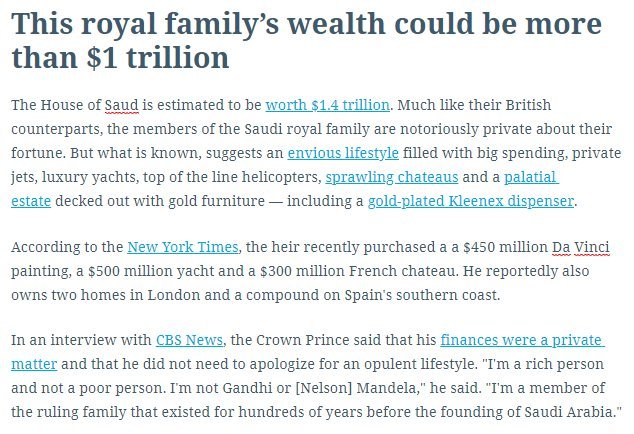
let’s start with the topical stuff. the saudi ruling family has put a blockade in place, dropped more bombs than have been used in most wars in history, and created the worst man-made famine in decades that is starving the entire country of yemen. they use slave labor for construction, deny women citizens rights, execute activists, and, as they’ve admitted now, murder and dismember foreign journalists on foreign soil. that’s all been covered at length elsewhere and that’s not what we’re gonna cover in this post, which is the fact that the saudi establishment funds massive campaigns of religious colonialism using restricted aid/sponsorship to change entire countries’ practice of islam to a wahhabism that benefits saudi state interests (we’ll get to that in a bit) and the obscene greed of the saudi ruling family:

$1 trillion dollars! that’s an obscene, incomprehensible amount. that’s enough to give all 800 million people on earth living in extreme poverty (under $2 a day) $1200 each, or MVR 20,000. all 800 million people in extreme poverty on this planet, most doing back-breaking work every day, even if they somehow didn’t spend a cent of their income, would take two years to save up that much wealth.

$1 trillion dollars generates about $60-100 billion every year in just interest alone even if it all just sits there in a fund untouched (without compounding, so if you spent all $60-100 billion of that interest every year. that’s roughly the total wealth of mark zuckerburg, EVERY YEAR. it’s such an unbelievable number i want to emphasize it: if the saudi royal family spent SIXTY BILLION DOLLARS A YEAR, they would still have a trillion, that’s one thousand billion, dollars left). that said, it doesn’t stay untouched:

who the fuck needs a gold escalator to move 20 feet? and these are the folks claiming to have some kind of unique religious authority? i don’t remember stories of the sahabah getting custom-made gold caravans shipped over to cross the street.

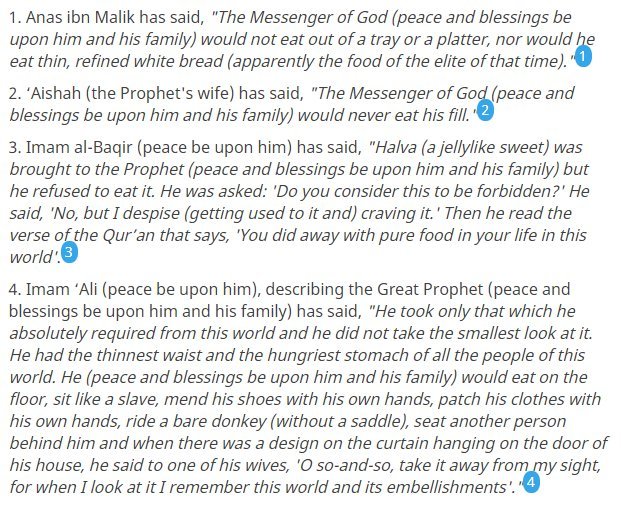
for context– and remember that the whole conceit of wahhabism is a return to the ways of the prophet and the sahabah– that sounds very different from this:

hmm. everything we know about the lifestyles of saudi royalty (used interchangeably with saudi state, or saudi establishment, as is the case in an absolute monarchy), doesn’t really seem to vibe with those principles. anyway.

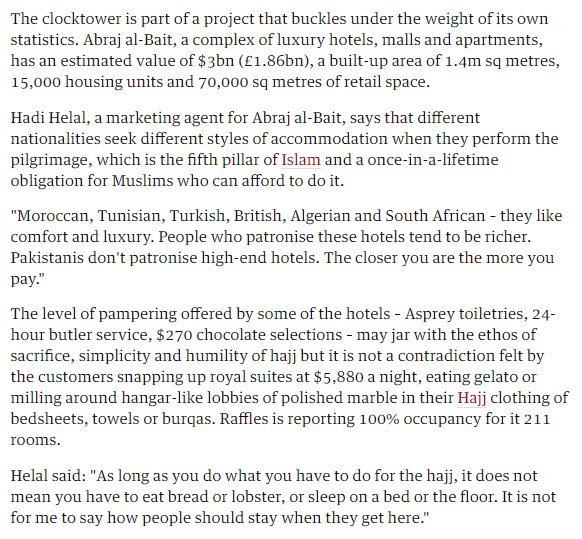
and prepare to be even more blown away by obscene wealth and obscene greed, this time even on the doorstep of the kaaba:

what the fuck, man.

it’s also important to note here that these hundreds of billions of dollars spent on extravagant displays of wealth could easily have been a smidge less extravagant and actually paid and treated the workers building all of this well. most human trafficking offenses are legal in saudi arabia, and the state has barely bothered to do anything about it. domestic workers are denied protections under saudi labor law. the government resolves most complaints of foreign worker abuse through mediation, setting up a largely powerless non-citizen worker with no provided legal aid thousands of miles from home to receive any justice in name only, and for the most part just sends victims back to their home countries without investigating or prosecuting crimes against them. that said, we as a country are implicit in doing kinda the same things ourselves and it’s horrific in both cases.

but anyway. now for how they’ve affected us as a country. it’s not a unique path that the saudi establishment has taken with the maldives: it’s right out of a playbook that’s applied around the world.

But Saudi Arabia has, for decades, been making investments of a different sort—those aimed at influencing Indonesian culture and religion. The king’s current visit is the apex of that methodical campaign, and “has the potential to accelerate the expansion of Saudi Arabia’s cultural resources in Indonesia,” according to Chris Chaplin, a researcher at the Royal Netherlands Institute of Southeast Asia. “In fact, given the size of his entourage, I wouldn’t be surprised if there will be a flurry of networking activity amongst Indonesian alumni of Saudi universities.”

Since 1980, Saudi Arabia has devoted millions of dollars to exporting its strict brand of Islam, Salafism, to historically tolerant and diverse Indonesia. It has built more than 150 mosques (albeit in a country that has about 800,000), a huge free university in Jakarta, and several Arabic language institutes; supplied more than 100 boarding schools with books and teachers (albeit in a country estimated to have between 13,000 and 30,000 boarding schools); brought in preachers and teachers; and disbursed thousands of scholarships for graduate study in Saudi Arabia. All this adds up to a deep network of Saudi influence.

“The advent of Salafism in Indonesia is part of Saudi Arabia’s global project to spread its brand of Islam throughout the Muslim world,” said Din Wahid, an expert on Indonesian Salafism at Syarif Hidayatullah State Islamic University (UIN) in Jakarta.

Indonesia may be the largest stage for Saudi Arabia’s cultural diplomacy, but it’s hardly the only one. Saudi Arabia built satellite campuses for Egypt’s Al-Azhar university in the 1980s, funded Bosnian rebels and later built them schools in the 1990s, bankrolled numerous madrassas in pre-Taliban Pakistan and Afghanistan, and sent 25,000 clerics to India between 2011 and 2013. Al-Hattem, of LIPIA Jakarta, was previously stationed at Saudi outfits in Bosnia and Djibouti. [x]

for a little backstory, i’m gonna let the same atlantic article summarize it for me:

It arose in reaction to 18th-century European colonialism in the Middle East, but it took particular root in Saudi Arabia in the hands of the influential preacher Muhammad ibn Abd al-Wahhab. Al-Wahhab’s alliance with the House of Saud in 1744 cemented Wahhabism as the spiritual backbone of the Saudi Arabian state. And in the 20th century, Saudi Arabia, which had become fabulously oil-rich, started to invest its considerable resources in propagating its ideology abroad.

the pattern starts to become familiar:

“Theology, which is a mandatory subject there, is only taught by committed Wahhabis, and I really think their ideology is antithetical to traditional Indonesian Islam, which is usually syncretic and relaxed,” he explained.

Hundreds of Indonesians receive scholarships to study at Saudi universities every year. A few decades in, alumni of these programs are becoming nationally influential in their home country. Habib Rizieq, the founder of the Islamic Defenders Front, a hardline organization associated with religion-related violence, attended both LIPIA and King Saud University in Riyadh. Jafar Umar Thalib, who founded the militant Salafi group Laskar Jihad, also graduated from LIPIA. Right-wing Islamist leaders like Hidayat Nur Wahid, a member of parliament who earned three degrees on scholarship from the University of Medina, are prominent in mainstream politics.

LIPIA alumni have also set up pesantren, or Islamic boarding schools, across Indonesia. Many of the country’s 100-odd Salafi pesantren are supplied by Saudi Arabia with teachers, especially of Arabic language, and textbooks, according to Din Wahid. For many poor families, these pesantren are the only feasible option for their kids’ schooling, despite ideological quibbles, Wahid said.

Enterprising Saudi envoys have even made inroads in places like Aceh, the westernmost Indonesian province that’s been wracked by natural disasters like the 2004 tsunami. “We have built mosques, hospitals, and schools there,” the Saudi ambassador to Indonesia, Mohammad Abdullah Alshuaibi, told me. “And an Arabic language institute.”

that timeline is important, by the way. the devastation of the 2004 tsunami on many primarily muslim regions around the indian ocean brought in an influx of rebuilding funds from saudi arabia. of course, that money comes with strings attached, and some of that rebuilding occurred in its own image. think about it. think about the timeline, before 2004 and after 2004.

and why is this important? because controlling access to knowledge is a staggering form of power. it allows you to shape the very fabric of reality that exists because, in many ways, “reality” as we see it is a sort of consensus, where we all agree on hearing and seeing and learning about the same things. but when you shape what we know of reality, what we’re told is the way that we actually live. i’m gonna be lazy and quote from something we’d written before:

the material history of islam wasn’t just a matter of interest for the history books, but a cornerstone of the way people practiced their entire faith, and either a potential source of or threat to the legitimacy of the current ruling establishment. control over that history was, and remains, extremely powerful. i am aware of my own fallibility. i don’t know if the history i know is the right history. i don’t know which details might have been shifted by conservative leaders to justify establishment power, or which details may have been added by ideologues in academia.

i don’t know which translations of arabic, a famously subtle and complex language with more ambiguity and possibilities of interpretation than any other major world language, back up my positions, or even whether verbal and oral histories would have captured those subtleties in their exact form instead of as the listener heard and understood it. i don’t know which philosophical and judicial scholarship over the centuries was brought into this history, and which were left out, and what selection bias might have shaped my knowledge of islamic history, thought, and practice…

here is something we do know, that i think illustrates everything above about the multitude of interpretations, histories, traditions, practices, identities that shift and evolve but, at each point during that evolution, insists that the way things are now is in fact how they always were.. let’s take a zoomed-out view and try to describe the maldives as an observer. confirm this with your own memories: think about dragonfly season from your childhood and try to visualize how you saw faith practiced then. think about old men reading salawat, or about amulets or pieces of paper with written dua that your grandparents told you to keep. dhivehi islamic identity from our first conversion, through to as recently as my childhood, was a form of indigenous-traditional sufi-inspired sunnism. abu barakat al-barbari was a somalian with sufi inspirations. religious leaders’ tombs, zikr, mawlud, barakai kiyevun, all sufism inspired. the idea that it was always wahhabi-inspired sunnism, and the idea that modern political religious figures are upholding our traditional identity is revisionism. half our traditional islam, as practiced by generations and generations before us, would be considered bid’a now.

who decided that, anyway? how did that happen, and how did i not even notice? why was there no real public interrogation of such a drastic shift in how institutions defined what religion was and how we should practice it? how does a country that literally defines itself by its faith switch completely from one interpretation to the other? i mean, the maldives considers its muslim identity such a crucial part of national identity that it’s a condition for citizenship. a huge change in what constitutes muslim identity is a crucial question. and i think it’s an important one.

the answer to “who decided, anyway?” is simple. this is who decides what reality is, and how they do it:

people will protest that what they learn and preach is directly from the texts, that they know arabic and know what’s said, but religious scripture is almost by definition incredibly complex and any study of scripture is influenced by the exegesis. nobody becomes a scholar of anything by just knowing the primary texts without a framework built by hundreds of scholars over decades, even centuries.

this applies even more for a text in arabic, a language that (to directly quote myself from earlier) is known for being more subtle and complex, with more room for ambiguity and possibilities of interpretation than almost any other major world language. any understanding of texts in historical dialects of a language that was literally known for a level of ambiguity and complexity that made it a perfect language for poetry, even in the time of the prophet (pbuh), is based on exegesis. the control of exegesis in any religion is, in a sense, exerting control over how people understand the scripture of that religion, and in this case the extreme wealth of the saudi state and its control over the kaaba means that they’re the ones controlling the realities and knowledge of what we consider religion to begin with, and they shape our entire body of knowledge in ways that bolster their objectives. here’s one example:

there’s other forms of control, aside from the massive funding and the control of access to religious knowledge:

One reason Indonesia has been reluctant to push back on Saudi cultural advances is the all-important hajj quota, the number of citizens who can make pilgrimage to Mecca in a given year. Indonesia gets the largest allowance in the world: 221,000 this year. But decade-long hajj waiting lists are common in many provinces, and jeopardizing the national allowance could provoke a huge backlash, said Dadi Darmadi, a UIN researcher and hajj expert.

“That being said, the Indonesian government has to be more wise and stop considering the hajj quota as a political gambit to attract more populist support in this country,” Darmadi said.

and that’s not good for us. having what we believe to be real about our religion and our own history and memory of how we practiced religion be shaped by parties with clear self-interest. this is particularly clear when we look at extremism here, which, again, is part of a pattern around the world:

Some of Indonesia’s leading jihadists have passed through Saudi institutions. Although Salafism is [officially] largely “quietist,” or discouraging of political activity, there is a growing faction of Salafi jihadists in Indonesia, according to Din Wahid.

In 1972, Saudi money helped to found the “ivy league” of jihadist pesantren, the Al-Mukmin school in Ngruki, Central Java. The Indonesian terrorist group Jemaah Islamiyah received funding from Saudi charities in the early 2000s. Salafi TV, YouTube channels, Facebook groups, and Telegram channels have become a fertile ground for female extremists and ISIS sympathizers in Indonesia in the last few years, according to a 2017 report from the Institute of Policy Analysis and Conflict (IPAC).

“We’ve been seeing some evidence of the transition from Salafism to extremism among female extremists of the ISIS generation,” said Nava Nuraniyah, an IPAC researcher.

“We need King Salman to make a clear and bold statement denouncing radicalism,” said Yahya Cholil Staquf of the moderate Muslim organization Nahdlatul Ulama. Otherwise, he said, “His visit will be easily perceived as more support to radical Islamic movements in Indonesia, as it is already a common public understanding that those radical movements take theological reference from Saudi Wahhabism and have been enjoying various kinds of support from Saudi Arabia.”

“Salafi pesantren, and Saudi-inspired religious education in general, no longer necessarily rely on Saudi donations, as followers have become incredibly adept at raising money locally,” Chaplin said.

As the rise of hardliners, the Arabic language, and Salafi jihadist cells in Indonesia show, Salafism has some undeniable, durable appeal here. In Indonesia, at least, Saudi Arabia is already seeing the fruits of its labor. This new religious ecosystem may be self-sustaining.

“this new religious ecosystem may be self-sustaining.” in other words, we’re now stuck with this shit, just like dozens of countries around the world. i sure hope not, but we may be screwed in ways that will be really hard to repair.

and i’ll leave you on that haunting note: the way things are now may be self-sustaining.

the necessity of doubt

we all probably got that chain e-mail in the early 2000s about a girl who did something blasphemous and got turned into some kind of strange beast, as physical proof of the power and presence of god. proof that we could see in not-quite-high-quality photographs, back before we knew about photoshop. i only got internet access once a week back then and my mom gathered the entire family around the computer screen so we’d all know too.

i think it did touch at a need i think many of us have: a need to know, a sense that without knowing for sure you’d be experiencing that dreaded feeling of doubt. we live in a culture that’s generally hush-hush about the experience of doubt. you know the drill: if you have doubts, you’re not a good muslim, god needs to be as real to you as everything you can see and feel and touch, cognitively you need to be able to file your belief in god in the same folder as your belief that the sun is real.

i was lucky enough to have once had a teacher who was also a sufi scholar. one day in class we ended up talking about doubt, and he gave us these scenarios.

one: he pours a cup of coffee from a jug in front of us and hands it to us. we know as a physical fact that in front of us is a cup of coffee. we saw it being poured. we smelled it in the air. there’s no faith required to believe that he was giving me a cup of coffee, because we know it happened. there’s no choice to believe. there’s only a reaction to a physical reality. there’s no way to justify a belief that it isn’t coffee, and i’d have to have no sense of self-interest to act like it isn’t.

two: he leaves the classroom and comes back with cups of coffee. mccafe, with a lid, so you can’t see or smell the contents. if he hands this cup to me and i take a sip, without the concrete physical knowledge that it contains coffee instead of water or even poison, that’s a show of faith. i trusted him. i chose to believe that he’d have poured coffee, and took a sip with the belief that i’m drinking coffee. it required no faith when i knew for sure, but the inability to know is what gives weight to the decision. having faith in god isn’t about knowing, it’s about the choice to believe even in the face of the possibility that you might be wrong.

doubt gives weight to your choice to believe. the lack of physical proof is what makes your sacrifices, or anything you do in the service of your religion, an exercise of faith. if we were sent undeniable, concrete physical evidence like a woman actually getting struck down and turned into a beast, then good deeds to avoid guaranteed punishment would be the purely self-interested way to act. being a believer while not knowing for sure means having faith.

to sign off, i want to introduce one of my favorite songs by one of my favorite artists along with a quote about his experience with doubt:

this is sufjan stevens talking about the above song:

“I was a teenager and this was my first experience with death. At that age, you’re easily confused. I couldn’t understand why she had to die. Experiences like this always cause doubt. Because we don’t cope well with the idea of evil in this world. Then you doubt the existence of God and His intentions… actually everything. But that’s good. One of the foundations of faith is the lack of it, the disbelief. It’s very important. Firm belief is a bit unreal. That leads to religious fanaticism. Doubt is inseparable from belief. With every figure in religion you find doubt: Abraham, Moses, all the kings and the apostles. Even Jesus doubted. So isn’t it funny how religions–especially institutions–have eliminated all doubt? They don’t understand how important it is to doubt, with all its consequences.”

you can’t know for sure. you can’t understand the inner workings of god. all you can do is have faith.

religious law and human fallibility

i’ve been asked about my views on institutionalizing religion as part of the state, especially in matters of regulating or punishing behavior, or my views on the theology of having the state. my feelings about it aren’t very subtle. the idea of people being intent on playing god about who gets joy, misery, freedom, pain, life, or death is deeply creepy to me. it either requires certainty in your own infallibility, or not caring about the possible consequences of your fallibility. both of those are things that should disqualify you from any religious authority, or any authority at all.

i don’t even mean a belief in infallibility in the sense of, an innocent man being punished or a guilty one let go, though that’s part of it. i mean the belief that your particular interpretation is the right one, a belief that of all the brilliant and pious minds with differing interpretations of doctrine around the world, that you are more correct whether by luck or character than anyone else, that you are guided by god in a way that others, coming to different conclusions from the same fundamental sources of religious knowledge. of ten thousand scholars throughout history with a devotion to their faith and access to the same scripture who have ever opined on this topic, believing that you must be the most right one is a certainty in your own infallibility that denies your human nature and ascribes something to you that is the sole domain of god.

god is omniscient and all-knowing. no human is. the first step on our relationship with god is understanding that we don’t really know much about it. god is unknowable, god is incomprehensible to humankind; what we know the word of god and the attributes of god. filling in the rest of a vast belief system to this degree of specificity requires plucking a level of certainty from the fourteen-hundred-year history of a faith with a billion adherents across multiple continents that might not be possible without

there are aspects that we know for sure: we know muhammad (pbuh) and we know the quran. beyond that, it’s an exercise of which particular lineage of scholarship you end up having followed down the centuries. and not just any history, either- the material history of islam wasn’t just a matter of interest for the history books, but a cornerstone of the way people practiced their entire faith, and either a potential source of or threat to the legitimacy of the current ruling establishment. control over that history was, and remains, extremely powerful. i am aware of my own fallibility. i don’t know if the history i know is the right history. i don’t know which details might have been shifted by conservative leaders to justify establishment power, or which details may have been added by ideologues in academia. i don’t know which translations of arabic, a famously subtle and complex language with more ambiguity and possibilities of interpretation than any other major world language, back up my positions, or even whether verbal and oral histories would have captured those subtleties in their exact form instead of as the listener heard and understood it. i don’t know which philosophical and judicial scholarship over the centuries was brought into this history, and which were left out, and what selection bias might have shaped my knowledge of islamic history, thought, and practice.

for example, there might have been ideological changes like this:

Annotation 2020-06-14 140343

or more indirect ways of power trying to shape our literal body of knowledge on religion in ways that bolsters their objectives:

Annotation 2020-06-14 140701

Annotation 2020-06-14 140725

all in all, i don’t think any of us can know if we’re the ones that have it right. there are scholars throughout history with at least as much knowledge as, if not more than, anyone else living who have had a thousand different exegeses, muhammad (pbuh) was privy to divine knowledge, and the khulafa ur-rashidun lived alongside muhammad (pbuh) and knew him and his thinking firsthand, knew directly how to interpret all the various details of the quran and quranic law. they could trust that they knew how to apply their state power accordingly. we don’t concretely have that knowledge: we have historical records of them, but no certainty about how true and accurate those records are; we have the quran, but no certainty about the exact interpretations used then.

with that absence of knowledge, it’s an act of near blasphemy to consider yourself to know enough, to think yourself infallible in your knowledge and judgement enough to apply god’s law on earth. in the absence of that knowledge, religious judgement should be left to god in all his justice. all nations need laws and need to apply those laws. it is likely, even, that those laws will be influenced by the religious culture and norms of that nation. this isn’t necessarily an argument against law or even punishment, but one about ascribing the weight of religion to the judgements of man. god will pass judgement on your sins come the afterlife and do so with perfect divine justice. the domain of man is a fully secular legal system built purely to maintain a state and administer to its people, ensure peace and prosperity, and provide for the vulnerable.

here is something we do know, that i think illustrates everything above about the multitude of interpretations, histories, traditions, practices, identities that shift and evolve but, at each point during that evolution, insists that the way things are now is in fact how they always were.. let’s take a zoomed-out view and try to describe the maldives as an observer. confirm this with your own memories: think about dragonfly season from your childhood and try to visualize how you saw faith practiced then. think about old men reading salawat, or about amulets or pieces of paper with written dua that your grandparents told you to keep. dhivehi islamic identity from our first conversion, through to as recently as my childhood, was a form of indigenous-traditional sufi-inspired sunnism. abu barakat al-barbari was a somalian with sufi inspirations. religious leaders’ tombs, zikr, mawlud, barakai kiyevun, all sufism inspired. the idea that it was always wahhabi-inspired sunnism, and the idea that modern political religious figures are upholding our traditional identity is revisionism. half our traditional islam, as practiced by generations and generations before us, would be considered bid’a now.

who decided that, anyway? how did that happen, and how did i not even notice? why was there no real public interrogation of such a drastic shift in how institutions defined what religion was and how we should practice it? how does a country that literally defines itself by its faith switch completely from one interpretation to the other? i mean, the maldives considers its muslim identity such a crucial part of national identity that it’s a condition for citizenship. a huge change in what constitutes muslim identity is a crucial question. and i think it’s an important one.

note: see also this post.