islamic liberation theology

This puts together and edits writings by Kaloi Abdu-Rahman and Sohaib Sultan. Both are about religion as a duty of the powerful to protect the powerless, and as a duty of the individual to stand with the powerless against the powerful, where the role of religion is a guiding light toward building a society that takes care of its most marginalized.

Related posts: Religion as revolutionary social justice, Radical empathy and a relationship with God, Religious law and human fallibility


Islamic Liberation Theology – Kaloi Abdu-Rahman

Liberation theology requires practicing Islam with the knowledge that all we receive in this world is because of the grace of God, not our own action and will. It understands that all humans are equal and that some are facing trials and misfortunes that aren’t of their own making.

With that knowledge, we know that the wealthy and the middle-class are not better than the poor, men are not better than women, no race is better than the other, no one group of people are harder-working or more intelligent: we were created all equal under God, with our lots in life determined by circumstance.

The Prophet (PBUH) understood that the privileges allowed to people of Mecca before Islam were determined by the relative value that their tribe or gender or class or status gave them, much like in our societies today, and sought to dismantle this system for one of equality.

Liberation theology sees the social power of religion as a tool that religious institutions have a responsibility to use. The power and respect of religious institutions must be used to advance the status of the marginalized. Those with power within religious institutions that do not use their power for the advancement of the marginalized and fighting for equality are breaching their religious duties by doing so.


Background of Liberation Theology

The term “liberation theology,” according to the Oxford Dictionary of Religions, means “an understanding of the role of theology in moving from abstraction to action, in which the actual condition of the poor is the starting point.” The Encyclopedia of Religion defines liberation theology “as critical reflection on the historical praxis of liberation in a concrete situation of oppression and discrimination.” It is also known as a social movement within the Christian Church and a school of thought, both of which react against human suffering due to poverty and various forms of oppression.

Liberation theology, in fact, was a religious movement that sought to liberate people from poor social conditions and injustice. It emphasizes the mission of bringing justice to the poor and oppressed. The actual message of liberation theology is to the plight of the oppressed, hungry, poor and marginalized. God exhorts us to struggle for human well-being, to strive for human rights and to liberate humanity from social and economic injustice. In other words, it is a way, a discipline, an exercise that must be practically carried out. Liberation theology stresses that institutions of religion must advocate and help the poor and try to save them from affliction and marginalization due to social and political injustice, in a spiritual way and with regard to the scriptural message.

In a broader sense, liberation theology includes an interpretation of scripture that is rooted in the everyday experience of poverty. It is an effort to improve human welfare in very basic ways. Liberation theology is a system and structure, like an organization that works for the betterment of every individual in society; everyone has a right to benefit from its sources and means; no one should be deprived of its benefits. It sees Islam as a set of responsibilities for institutions with power.

Islamic liberation theology emerged when the Qur’an started to be revealed to the Prophet Muhammad. The Qur’an seeks to liberate people from all kinds of sufferings and in different ways (socioeconomic and theological). The Qur’anic commandments were an open challenge to the tribal lords of Mecca, who would oppress and dehumanize the poor. Islam, since its beginning, through the teachings and commandments of the Qur’an, denounced injustice and oppression, and condemned the prevailing social system of Mecca. With the message of the Qur’an, Islam proclaimed liberation, freedom, justice and equality, it was stated that all people are equal before God and there is no entity who deserves to be worshiped but He (God) (Qur’an, 2:255).

Qur’anic liberation theology accords with social and economic balance, an equal social structure and assigns a high position to human dignity. In the modern age, injustice and discrimination against oppressed and marginalized people is taking place in almost every part of the world, especially in underdeveloped countries. So, how to address the issues of injustice and oppression? What are God’s commandments in relation to abuses in the contemporary age? How to mitigate these pressures upon the weaker parts of society? How do scriptures and theology admonish the authorities to help the poor and ease their suffering?

The Prophet Muhammad liberated people from the oppression of the Meccan upper classes. He conveyed the message of God to the people, with warnings and glad tidings, for the construction of a just society that should be based on equality, fraternity and justice. Islamic liberation theology started when the Prophet Muhammad received inspiration in the first message of revelation, which instructed him to “Read”. This was a message that sought to liberate humanity from darkness, ignorance and illiteracy. It also taught awareness that God is the One who created humanity. From this verse, it is inferred that man should not hold any misconceptions about his creation. Such indications and instructions were also mentioned in previous divine scriptures and messages.

When Muhammad received revelation, it came in the form of a reformative and revolutionary message to all the people of the world, as he was given the title of mercy for all the worlds (al-Qur’an, 21:107). He delivered the message of the Qur’an, the message which was revealed to him for the reformation of society. The Qur’an affirms that God sent him to deliver glad-tidings to people (al-Qur’an, 2:119). The Prophet Muhammad worked for the liberation of the oppressed, the poor, the needy and the ignorant. In his project of liberation, he was not just a prophet, teacher and philosopher, but also an activist who sacrificed his life for justice and equality. Under his inspiration, the Arabs not only liberated themselves but in turn liberated others from oppression and subjugation.


The Socio-Economic and Religious Background of Arabia before Muhammad (PBUH)

The Prophet Muhammad was born at a time when people were engaged in arrogant displays of tribal superiority. Privileges were based on unjust conditions and prejudices. In such circumstances, he stood up and challenged unjustified privilege and established social and moral values based upon the revealed message. In this environment, Muhammad was inspired by God to deliver the revealed message. It was a call to worship God in gratitude for His goodness both to each individual and to the Meccans as a whole. But the people of Mecca refused to accept the message, except for a few. Due to the opposition and rejection of the Meccans, the first ten years of Muhammad’s preaching were hard. He was persecuted and threatened.

Muhammad’s message and aim were to bring reform to society and condemn the socioeconomic inequalities of Meccan life. He therefore presented a direct threat not just to traditional polytheistic religion, but also to the power and status of the establishment, threatening its economic, social and political interests. He condemned false contracts, usury, as well as the negligence and exploitation of orphans and widows. He defended the rights of the poor and the oppressed, declaring that the rich had a responsibility to the poor to use a portion of their wealth for their benefit.

A truly liberating theology grew from this tradition. Islamic theology is grounded within this historical tradition, which in turn is derived from the primary foundations of the Islamic tradition—the Qur’an and the Sunnah and, more importantly, in how the core message affects the daily lives of the people in need of this theology. The importance of Islamic liberation theology is not just its relation to historical, religious, and cultural contexts; it provides the grounds on which the liberating elements must be developed for the welfare of the people in general.

Progressive Muslim scholars have criticized and opposed classical Islamic theology and Muslim theologians. In fact, theology in its received form, according to progressive Muslims, does not support human liberation. It only supports the status quo; moreover, theologians who support this form of theology are partners to the status quo. The actual purpose of liberation theology is liberation from suffering.


The Qur’anic Paradigms of Liberation Theology

The first objective of Islamic liberation theology, as has been shown by the verses of revelation, is to liberate people from ignorance, illiteracy, superstitions and polytheism. The Qur’an also liberates humanity from racism. Racism is the worst type of evil, in which people think that a particular race is superior to others. It exists in almost every society, creates social problems and hatred between social classes. The Qur’an condemns notions of racial superiority or inferiority. Instead, it teaches that all people are the children of Adam and Eve and equal before God (49:13).

The main goal of liberation theology, according to the Qur’an, is to provide financial help to the poor and liberate them from poverty (4:95). The Qur’an teaches that a Muslim must always take the side of the weak regardless of their religion and race, and asks the question, “Who among those in need would require more attention than the poor and the destitute?” (4:95).

The Qur’an also protects man from subjugation. It liberates man from the tyranny of governments and rulers. The Qur’an gives rights to every individual equally so that all will be treated and judged on an equal basis, irrespective of race, colour and faith (49:130). It also admonishes believers to establish justice in all spheres of life (4: 135). Qur’anic liberation focuses on justice, freedom and equality on the one hand, and the condemnation of exploitation of man by man, oppression, and persecution on the other.

The idea of Islamic liberation theology is retrieved from the Qur’anic teachings. Its core values in “key terms of the Qur’an” comprising tawhid, (oneness of God), din (religion), adal (justice), rahmah (compassion), ihsan (benevolence), and hikmah (wisdom). These key terms are the main tools for constructing the platform of Islamic liberation theology.


The Prophet Muhammad as a Liberator

The Prophet Muhammad liberated people from all sorts of sufferings. Through the Qur’an, he liberated people from ignorance and superstition, from polytheism and racism, from poverty, inequality, subjugation and injustice. This means that Islamic liberation theology is an all rounded affair.

The Prophet Muhammad struggled on behalf of promoting Islamic injunctions against the tribal cruelties without engaging in violence. He and his companions bore the brutalities of the Meccans and continued to propagate and practice a way of life that was based upon revealed teachings.

The paradigm of struggle and resistance to injustice, established by the Prophet Muhammad and his early followers, was a movement of liberation. Many Muslim movements that developed in later centuries attempted to follow this prophetic paradigm, and together these have become important sources of inspiration for many contemporary Muslim liberation struggles.

The Prophet Muhammad was the beacon of light who announced through the Qur’an a charter of rights for women. The Qur’an, for the first time, gave them various rights: the right to be a witness, the right to marry a husband of her own choice, the right to divorce her husband without any pre-condition, the right to inherit her father’s property, the right of mothers and relatives to have property, the right to have custody of children, and the right to make decisions freely. Thus, due to Muhammad’s prophethood, women gained social dignity and respect.

The Prophet aimed to establish justice within the social and economic environment of Mecca; he was deeply disturbed by the conditions of women. Islam teaches the values of equality, justice and freedom. Women’s rights and gender equality are emphasized greatly in the Qur’an.

Though the idea of modern liberation theology has been derived from Christian hermeneutics, we can say that all religious scriptures have a solution for liberating people from suffering. The Qur’an not only supports the oppressed and weak sections of society, but teaches lessons of equality, dignity, freedom and respect for each other. It also calls on its believers to respect and recognize the truth of other religions.

The Qur’an provides the guidelines and ways to liberate people from all kinds of sufferings. God has sent the prophets to each and every community for their guidance. A universal theology of liberation is found among all religions. It is a method by which the implementation of God’s rule on earth, the establishment of justice, equal rights and uplifting peoples’ standard of living may be achieved. Liberation theology prioritizes actions over theory. It advocates the protection of the oppressed from the oppressors. It provides socio-political resistance against oppressors. It is a theology in real sense that aims to implement a world reality based upon respect for human dignity and the realization justice.


The Quranic framework for liberation

Esack claims that the Qur’an’s stress on helping preferentially the mustad’af refers to someone who is oppressed or deemed weak. The mustad’afun are people of inferior social status, people who are vulnerable, marginalised and oppressed. The Qur’an also uses other terms to describe the lower and impoverished classes of society, such as aradhil, marginalised (al-Qur’an, 11: 27), the poor (2: 271) and the indigent (2: 83).

The Qur’an also denounces the powerful and their accumulation of wealth, and exhorts the believers to treat women with equality and to free slaves. According to Esack, the most significant and relevant Qur’anic text in the South African situation encompasses verses 28: 4-8. In particular, Esack quotes this verse frequently: “And it is Our will to bestow Our grace upon the mustad’afun on the Earth”. This verse shows the Qur’an’s socially engaged message of liberation and empathy for the oppressed.


The road to liberation

Liberation generally signifies redemption, salvation and freedom. Liberation theology seeks salvation and deliverance from all forms of oppression, especially socio-political and economic injustice, under the instructions of the scriptures that were interpreted by the prophets and theologians, and in order to help marginalized people.

Thus, scriptures exhort us to struggle for the welfare of human beings, to help them against all sorts of injustice and inequality. Islamic liberation theology addresses all aspects of existence. These include not only the socio-political, economic and theological, but also the historical, religious, and cultural.

The best sources of Islamic liberation theology are the Qur’an and the traditions of Muhammad. Both provide guidance to those who suffer in the world. They condemn ignorance, illiteracy, and injustice.

Many human beings still face the distress of unemployment, poverty, starvation, malnourishment and homelessness. On the other, the world has also been suffering from inter and intra-religious extremism and ethno-religious nationalism. People want to be liberated from both torments.

Liberation theology suggests the following:

  • To obtain liberation from poverty, injustice and inequality. Human liberation lies in helping out the poor from a sociological and not only a metaphysical perspective.
  • The Monarchical practices of Muslim rulers and religious leaders should not include nationalism, tribal and communal favor. They are supposed to be free from the intoxication of power. Their role should be like that of the model caliphs, who gave rights and dignity to every individual, irrespective of color, race, gender and religion; to help and serve the people, and to bring peace and justice to society.
  • Guidance derived from the teachings of the Quran, must play a central and critical role not only in creating harmony and religious coexistence but also in explaining that human and religious diversity is normal.


The Social Qur’an – Sohaib Sultan

Faith is incomplete without a radical commitment to social justice.

In the late 19th to early 20th century there emerged an influential intellectual Christian movement that preached, what became known as, the “Social Gospel.” In summary, the movement sought to apply Christian ethics, taken from the Gospel, to social problems such as poverty and war. It was and remains a progressive movement essentially rooted in the Gospel’s radical social justice message.

Interestingly, around the same period, there also emerged movements within Islam that sought to do something very similar – apply Islamic ethics, taken from the Qur’an, to the myriad of social problems Muslim societies were facing. This movement attempted to advocate and argue for human freedom from tyrannical governments, economic fairness, and so on.

Unfortunately, when some of these movements went from standing up against unjust political authority to wanting to become the political authority itself, the movements were quickly and brutally suppressed and fractured – sometimes leading to the formation of radical political organizations that responded to the suppression with calls to militancy.

Today, this much maligned and far too easily discredited movement is known in the West as “Islamism” and their followers are called “Islamists.” It has become a bad word from the halls of government to the world of academia. If you want to malign or discredit a Muslim public intellectual or activist, all you have to do is call them an Islamist. Sadly, many radical proponents of the Christian Social Gospel message have met a similar end.

In the Muslim World, the movement is received with much more nuance. There are, of course, the violent extremists who have the loudest bullhorn on the block because of their tactics – “what bleeds leads” as they say in journalism. Every major study has shown that these violent groups are largely rejected by the vast majority of Muslims.

But, some of the most effective grassroots movements in the Muslim World today are informed and inspired, at least to some degree, by the social justice message of the Qur’an as articulated by the likes of Hassan al-Banna (d.1949) in Egypt and Abul Ala Mawdudi (d.1979) in Pakistan. The attraction is not so much in the wholesale revolutionary message, necessarily, but simply in the positive concern for addressing social injustices with something that sounds and feels authentic to the Muslim imagination – as opposed to something that sounds and feels like a Western colonialist import or plot.

While there was something certainly brewing in the waters in the late 19th – early 20th century in terms of socio-political movements rooted in the Qur’anic social justice message, these movements were largely revivalist movements that were inspired by much earlier periods in Muslim history including many Sufi Orders that were committed to serving the most marginalized in society and affecting grassroots change. Indeed, it would be hard not to read the Prophet Muhammad’s biography and the story of his mission as a radical movement for social justice. The intellectuals behind the Social Gospel would see the life and mission of Jesus in a similar way.

So, in brief, what is the Social Qur’an – if we can borrow terminology from the Social Gospel movement? It is a message that calls on believers to stand up for justice and bear witness to the truth “even if it is against yourselves, your parents, or your close relatives” (4:135) and warns believers to never allow “hatred of others to lead you away from justice” (5:8).

It is a teaching that commands believers throughout the Qur’an to “be a community that calls for what is good, urges what is right, and forbids what is wrong” (3:104).

It is an urging to follow a higher ethical plane that “Is to free the slave, to feed at a time of hunger an orphaned relative or a poor person in distress, and to be one of those believe and urge one another to steadfastness [in doing good] and compassion” (90:13—17).

It is prescribing as a pillar of Islam the institutionalization of almsgiving for the poor and needy (9:60) and an ethic of charity that affirms and restores the dignity of socially neglected people (2:261—274).

It is encouraging the “fair and kind” treatment of women (4:19—21). And, it is pushing people to defend the oppressed even if it means putting their own lives at risk (4:74—76).

This is just a brief glimpse into the social justice message of the Qur’an.

The Social Qur’an is also a message that prohibits usurious loans that enslave people and entire communities to a lifetime of debt (2:275—281). It strongly condemns people “who give short measure” in their business dealings (83:1—6); exploit the orphans (4:10); “act like tyrants” (26:130); set out to “spread corruption” in the world (2:203), to give just a few examples. Social crimes such as sex slavery (24:33), female infanticide (81:8—9), and so on are spoken against in the strongest language.

So, this is a summary of what the Social Qur’an looks like. It is a message and teaching for the socially conscientious people to root their social justice work in a God-centric and spiritually focused way. And, it is a lesson to those who strive to be mindful of God that faith is incomplete without a radical commitment to social justice.

worker representation and co-determination

In our crowdsourced manifesto of policies people wanted in place, we discussed worker co-determination:

Workers’ rights

We will require half of the board to be assigned to worker representatives for companies with 50+ employees, including all resorts. We will legally enshrine regulations for minimum standards of wages, working conditions, and hours for private companies as well as public. Companies will be required to provide workers’ compensation for injuries on the job.

So we’re reprinting some material from online about what worker co-determination is and how we might start.


What is co-determination?

Codetermination is the practice of workers of an enterprise having the right to vote for representatives on the board of directors in a company. It also refers to staff having binding rights in work councils on issues in their workplace. The practice of board level representation is widespread in developed democracies. The first laws requiring worker voting rights passed in 1854. Most countries with codetermination laws have single-tier board of directors in their corporate law (such as Sweden, France or the Netherlands), while a number in central Europe (particularly Germany and Austria) have two-tier boards.

Most laws apply to companies over a certain size, from Denmark at 20 employees, to Germany over 500 (for one-third representation) and 2000 (for just under one half), to France over 5000 employees. This is to minimize the burden for small businesses while ensuring that huge corporations, which represents a large proportion of the economy, have worker and stakeholder representation,

Codetermination gives workers a voice alongside shareholders. Worker co-ownership would also give them a stake in the company, making them shareholders as well. Laws could mandate a certain percentage stake in companies as shares owned by workers, who receive as dividends a proportion of the fruits of their labor instead of it all going to the wealthy.

In economies with codetermination, workers in large companies may form special bodies known as works councils. In smaller companies they may elect worker representatives who act as intermediaries in exercising the workers’ rights of being informed or consulted on decisions concerning employee status and rights. They also elect or select worker representatives in managerial and supervisory organs of companies.

In codetermination systems the employees are given seats on a board of directors in one-tier management systems, or seats in a supervisory board and sometimes management board in two-tier management systems.

In two-tier systems the seats in supervisory boards are usually limited to one to three members. In some systems the employees can select one or two members of the supervisory boards, but a representative of shareholders is always the president and has the deciding vote. An employee representatives on management boards are not present in all economies. They are always limited to a Worker-Director, who votes only on matters concerning employees.

In one-tier systems with codetermination the employees usually have only one or two representatives on a board of directors. Sometimes they are also given seats in certain committees (e.g. the audit committee). They never have representatives among the executive directors.


The German stakeholder system

The German stakeholder system of co-determination, which gives legal rights to workers to co-manage corporations, has held back the forces of short-termism1 that have dominated American corporations for the past three decades, driven our inequality crisis, and weakened our economy.

A national law requiring the boards of public companies to include worker representatives—a key element of co-determination—would, in one fell swoop, upend our current shareholder-oriented corporate governance model and redefine it as a stakeholder system, creating resilience against the pressures of short-termism.

Workers especially, who are investing in companies with their own labor on a daily basis, have a legitimate claim as corporate stakeholders, and it will serve companies, and society more broadly, if we—on the left at least—felt empowered enough to stake this claim.

There are other policy options besides co-determination, particularly different worker ownership models, including employee stock ownership plans (ESOPs) and cooperatives, that would also combat short-termism. However, the larger point remains: Any benefits provided to workers that lack meaningful stakeholder decision-power will fail to foster a sustainable, long-term oriented system for any stakeholders, including workers.

The main differences concern the structure of corporate boards and the influence of workers on decision making at the top. Companies in English-speaking countries tend to have one board, whose chairman is often also the chief executive officer. Employees, meanwhile, have little to no say in strategy. The company’s fiduciaries must act only in the interests of their main “stakeholders,” which are their shareholders. At German companies, all this is different.

worker codetermination german stakeholder

Germany made it compulsory to have one board of executive officers and another, separate, board of supervisors. This independent non-executive panel had the duty to hold management accountable and to protect the interests of shareholders.

The model obliges directors to consider all stakeholders in corporate decisions. Thus German boards must, in theory, heed the concerns not only of shareholders but also of employees, creditors, suppliers, and local governments, and should take a long-term perspective that stretches over generations.


Co-determination, in principle and practice

For most large public and private companies in Germany, i.e. those with more than 2,000 employees, half the seats on the supervisory board go to elected worker representatives, mainly drawn from the company’s work council as well as trade unions. The other half go to shareholder representatives. There is also a supervisory board chair, usually representing capital, who can cast a tie-breaking vote. In practice, the chair rarely exercises this power, preferring to allow the consensus-building process to play itself out.

Co-determination is intimately linked to the dual-board system. If employee representatives were tasked with debating management decisions alongside their bosses on a unified board, irresolvable conflicts of interest would be the likely result.

However, employee representatives and shareholders working on equal footing in an oversight capacity has been a beneficial set-up for labor relations and even for competitiveness, by some measures. German workers have historically been among the least strike-prone in Europe. As a rule, employee representatives feel secure enough in their authority to give a fair hearing to proposals from their fellow stakeholders.


words misunderstood

This is an excerpt from The Unbearable Lightness of Being by Milan Kundera and I’ve always found it a really fascinating and insightful framework through which to see the world and how we relate to others– the realization that given associations and implications we don’t all share a common set of meanings for the words and phrases that we use or for the metaphors we invoke, that it means that to some extent none of us really speak the exact same language, that being able to understand someone means working with the knowledge that the same words can create unique instinctive or emotional responses shaped by their experiences and personality. This excerpt lists instances where the same word had different meanings and associations to the characters and how that shapes their relationship.


Let us return to Sabina’s bowler hat. First, it was a vague reminder of a forgotten grandfather, the mayor of a small Bohemian town during the nineteenth century.

Second, it was a memento of her father. After the funeral her brother appropriated all their parents’ property, and she, refusing out of sovereign contempt to fight for her rights, announced sarcastically that she was taking the bowler hat as her sole inheritance.

Third, it was a prop for her love games with Tomas.

Fourth, it was a sign of her originality, which she consciously cultivated. She could not take much with her when she emigrated, and taking this bulky, impractical thing meant giving UP other, more practical ones.

Fifth, now that she was abroad, the hat was a sentimental object. When she went to visit Tomas in Zurich, she took it along and had it on her head when he opened the hotel-room door. But then something she had not reckoned with happened: the hat, no longer jaunty or sexy, turned into a monument to time past. They were both touched. They made love as they never had before. This was no occasion for obscene games. For this meeting was not a continuation of their erotic rendezvous, each of which had been an opportunity to think up some new little vice; it was a recapitulation of time, a hymn to their common past, a sentimental summary of an unsentimental story that was disappearing in the distance.

The bowler hat was a motif in the musical composition that was Sabina’s life. It returned again and again, each time with a different meaning, and all the meanings flowed through the bowler hat like water through a riverbed. I might call it Heraclitus’ (“You can’t step twice into the same river”) riverbed: the bowler hat was a bed through which each time Sabina saw another river flow, another semantic river: each time the same object would give rise to a new meaning, though all former meanings would resonate (like an echo, like a parade of echoes) together with the new one. Each new experience would resound, each time enriching the harmony. The reason why Tomas and Sabina were touched by the sight of the bowler hat in a Zurich hotel and made love almost in tears was that its black presence was not merely a reminder of their love games but also a memento of Sabina’s father and of her grandfather, who lived in a century without airplanes and cars.

Now, perhaps, we are in a better position to understand the abyss separating Sabina and Franz: he listened eagerly to the story of her life and she was equally eager to hear the story of his, but although they had a clear understanding of the logical meaning of the words they exchanged, they failed to hear the semantic susurrus of the river flowing through them

And so when she put on the bowler hat in his presence, Franz felt uncomfortable, as if someone had spoken to him in a language he did not know. It was neither obscene nor sentimental, merely an incomprehensible gesture. What made him feel uncomfortable was its very lack of meaning.

While people are fairly young and the musical composition of their lives is still in its opening bars, they can go about writing it together and exchange motifs (the way Tomas and Sabina exchanged the motif of the bowler hat), but if they meet when they are older, like Franz and Sabina, their musical compositions are more or less complete, and every motif, every object, every word means something different to each of them If I were to make a record of all Sabina and Franz’s conversations, I could compile a long lexicon of their misunderstandings. Let us be content, instead, with a short dictionary.


A Short Dictionary of Misunderstood Words


WOMAN

Being a woman is a fate Sabina did not choose. What we have not chosen we cannot consider either our merit or our failure. Sabina believed that she had to assume the correct attitude to her unchosen fate. To rebel against being born a woman seemed as foolish to her as to take pride in it.

During one of their first times together, Franz announced to her, in an oddly emphatic way, “Sabina, you are a woman. ” She could not understand why he accentuated the obvious with the solemnity of a Columbus who has just sighted land. Not until later did she understand that the word “woman,” on which he had placed such uncommon emphasis, did not, in his eyes, signify one of the two human sexes; it represented a value. Not every woman was worthy of being called a woman.

But if Sabina was, in Franz’s eyes, a woman, then what was his wife, Marie-Claude? More than twenty years earlier, several months after Franz met Marie-Claude, she had threatened to take her life if he abandoned her. Franz was bewitched by the threat. He was not particularly fond of Marie-Claude, but he was very much taken with her love. He felt himself unworthy of so great a love, and felt he owed her a low bow.

He bowed so low that he married her. And even though Marie-Claude never recaptured the emotional intensity that accompanied her suicide threat, in his heart he kept its memory alive with the thought that he must never hurt her and always respect the woman in her.

It is an interesting formulation. Not “respect Marie-Claude,” but “respect the woman in Marie-Claude.” But if Marie-Claude is herself a woman, then who is that other woman hiding in her, the one he must always respect? The Platonic ideal of a woman, perhaps?

No. His mother. It never would have occurred to him to say he respected the woman in his mother. He worshiped his mother and not some woman inside her. His mother and the Platonic ideal of womanhood were one and the same.

When he was twelve, she suddenly found herself alone, abandoned by Franz’s father. The boy suspected something serious had happened, but his mother muted the drama with mild, insipid words so as not to upset him. The day his father left, Franz and his mother went into town together, and as they left home Franz noticed that her shoes did not match. He was in a quandary: he wanted to point out her mistake, but was afraid he would hurt her. So during the two hours they spent walking through the city together he kept his eyes fixed on her feet. It was then he had his first inkling of what it means to suffer.


FIDELITY AND BETRAYAL

He loved her from the time he was a child until the time he accompanied her to the cemetery; he loved her in his memories as well. That is what made him feel that fidelity deserved pride of place among the virtues: fidelity gave a unity to lives that would otherwise splinter into thousands of split-second impressions.

Franz often spoke about his mother to Sabina, perhaps even with a certain unconscious ulterior motive: he assumed that Sabina would be charmed by his ability to be faithful, that it would win her over.

What he did not know was that Sabina was charmed more by betrayal than by fidelity. The word “fidelity” reminded her of her father, a small-town puritan, who spent his Sundays painting away at canvases of woodland sunsets and roses in vases. Thanks to him, she started drawing as a child. When she was fourteen, she fell in love with a boy her age. Her father was so frightened that he would not let her out of the house by herself for a year. One day, he showed her some Picasso reproductions and made fun of them. If she couldn’t love her fourteen-year-old schoolboy, she could at least love cubism. After completing school, she went off to Prague with the euphoric feeling that now at last she could betray her home.

Betrayal. From tender youth we are told by father and teacher that betrayal is the most heinous offense imaginable. But what is betrayal? Betrayal means breaking ranks. Betrayal means breaking ranks and going off into the unknown. Sabina knew of nothing more magnificent than going off into the unknown.

Though a student at the Academy of Fine Arts, she was not allowed to paint like Picasso. It was the period when so-called socialist realism was prescribed and the school manufactured Portraits of Communist statesmen. Her longing to betray her rather remained unsatisfied: Communism was merely another rather, a father equally strict and limited, a father who forbade her love (the times were puritanical) and Picasso, too. And if she married a second-rate actor, it was only because he had a reputation for being eccentric and was unacceptable to both fathers.

Then her mother died. The day following her return to Prague from the funeral, she received a telegram saying that her father had taken his life out of grief.

Suddenly she felt pangs of conscience: Was it really so terrible that her father had painted vases filled with roses and hated Picasso? Was it really so reprehensible that he was afraid of his fourteen- year-old daughter’s coming home pregnant? Was it really so laughable that he could not go on living without his wife?

And again she felt a longing to betray: betray her own betrayal. She announced to her husband (whom she now considered a difficult drunk rather than an eccentric) that she was leaving him.

But if we betray B., for whom we betrayed A., it does not necessarily follow that we have placated A. The life of a divorcee-painter did not in the least resemble the life of the parents she had betrayed. The first betrayal is irreparable. It calls forth a chain reaction of further betrayals, each of which takes us farther and farther away from the point of our original betrayal.


MUSIC

For Franz music was the art that comes closest to Dionysian beauty in the sense of intoxication. No one can get really drunk on a novel or a painting, but who can help getting drunk on Beethoven’s Ninth, Bartok’s Sonata for Two Pianos and Percussion, or the Beatles’ White Album? Franz made no distinction between “classical” music and “pop.” He found the distinction old-fashioned and hypocritical. He loved rock as much as Mozart.

He considered music a liberating force: it liberated him from loneliness, introversion, the dust of the library; it opened the door of his body and allowed his soul to step out into the world to make friends. He loved to dance and regretted that Sabina did not share his passion.

They were sitting together at a restaurant, and loud music with a heavy beat poured out of a nearby speaker as they ate.

“It’s a vicious circle,” Sabina said. “People are going deaf because music is played louder and louder. But because they’re going deaf, it has to be played louder still.”

“Don’t you like music?” Franz asked.

“No,” said Sabina, and then added, “though in a different era…” She was thinking of the days of Johann Sebastian Bach, when music was like a rose blooming on a boundless snow-covered plain of silence.

Noise masked as music had pursued her since early childhood. During her years at the Academy of Fine Arts, students had been required to spend whole summer vacations at a youth camp. They lived in common quarters and worked together on a steelworks construction site. Music roared out of loudspeakers on the site from five in the morning to nine at night. She felt like crying, but the music was cheerful, and there was nowhere to hide, not in the latrine or under the bedclothes: everything was in range of the speakers. The music was like a pack of hounds that had been sicked on her.

At the time, she had thought that only in the Communist world could such musical barbarism reign supreme. Abroad, she discovered that the transformation of music into noise was a planetary process by which mankind was entering the historical phase of total ugliness. The total ugliness to come had made itself felt first as omnipresent acoustical ugliness: cars, motorcycles, electric guitars, drills, loudspeakers, sirens. The omnipresence of visual ugliness would soon follow.

After dinner, they went upstairs to their room and made love, and as Franz fell asleep his thoughts began to lose coherence. He recalled the noisy music at dinner and said to himself, “Noise has one advantage. It drowns out words.” And suddenly he realized that all his life he had done nothing but talk, write, lecture, concoct sentences, search for formulations and amend them, so in the end no words were precise, their meanings were obliterated, their content lost, they turned into trash, chaff, dust, sand; prowling through his brain, tearing at his head, they were his insomnia, his illness. And what he yearned for at that moment, vaguely but with all his might, was unbounded music, absolute sound, a pleasant and happy all-encompassing, overpowering, window-rattling din to engulf, once and for all, the pain, the futility, the vanity of words. Music was the negation of sentences, music was the anti-word! He yearned for one long embrace with Sabina, yearned never to say another sentence, another word, to let his orgasm fuse with the orgiastic thunder of music. And lulled by that blissful imaginary uproar, he fell asleep.


LIGHT AND DARKNESS

Living for Sabina meant seeing. Seeing is limited by two borders: strong light, which blinds, and total darkness. Perhaps that was what motivated Sabina’s distaste for all extremism Extremes mean borders beyond which life ends, and a passion for extremism, in art and in politics, is a veiled longing for death.

In Franz the word “light” did not evoke the picture of a landscape basking in the soft glow of day; it evoked the source of light itself: the sun, a light bulb, a spotlight. Franz’s associations were familiar metaphors: the sun of righteousness, the lambent flame of the intellect, and so on.

Darkness attracted him as much as light. He knew that these days turning out the light before making love was considered laughable, and so he always left a small lamp burning over the bed. At the moment he penetrated Sabina, however, he closed his eyes. The pleasure suffusing his body called for darkness. That darkness was pure, perfect, thoughtless, visionless; that darkness was without end, without borders; that darkness was the infinite we each carry within us. (Yes, if you’re looking for infinity, just close your eyes!)

And at the moment he felt pleasure suffusing his body, Franz himself disintegrated and dissolved into the infinity of his darkness, himself becoming infinite. But the larger a man grows in his own inner darkness, the more his outer form diminishes. A man with closed eyes is a wreck of a man. Then, Sabina found the sight of Franz distasteful, and to avoid looking at him she too closed her eyes. But for her, darkness did not mean infinity; for her, it meant a disagreement with what she saw, the negation of what was seen, the refusal to see.


Sabina once allowed herself to be taken along to a gathering of fellow emigres. As usual, they were hashing over whether they should or should not have taken up arms against the Russians. In the safety of emigration, they all naturally came out in favor of fighting. Sabina said: “Then why don’t you go back and fight?”

That was not the thing to say. A man with artificially waved gray hair pointed a long index finger at her. “That’s no way to talk. You’re all responsible for what happened. You, too. How did you oppose the Communist regime? All you did was paint pictures. …”

Assessing the populace, checking up on it, is a principal and never-ending social activity in Communist countries. If a painter is to have an exhibition, an ordinary citizen to receive a visa to a country with a sea coast, a soccer player to join the national team, then a vast array of recommendations and reports must be garnered (from the concierge, colleagues, the police, the local Party organization, the pertinent trade union) and added up, weighed, and summarized by special officials. These reports have nothing to do with artistic talent, kicking ability, or maladies that respond well to salt sea air; they deal with one thing only: the “citizen’s political profile” (in other words, what the citizen says, what he thinks, how he behaves, how he acquits himself at meetings or May Day parades). Because everything (day-to-day existence, promotion at work, vacations) depends on the outcome of the assessment process, everyone (whether he wants to play soccer for the national team, have an exhibition, or spend his holidays at the seaside) must behave in such a way as to deserve a favorable assessment.

That was what ran through Sabina’s mind as she listened to the gray-haired man speak. He didn’t care whether his fellow-countrymen were good kickers or painters (none of the Czechs at the emigre gathering ever showed any interest in what Sabina painted); he cared whether they had opposed Communism actively or just passively, really and truly or just for appearances’ sake, from the very beginning or just since emigration.

Because she was a painter, she had an eye for detail and a memory for the physical characteristics of the people in Prague who had a passion for assessing others. All of them had index fingers slightly longer than their middle fingers and pointed them at whomever they happened to be talking to. In fact, President Novotny, who had ruled the country for the fourteen years preceding 1968, sported the very same barber-induced gray waves and had the longest index finger of all the inhabitants of Central Europe.

When the distinguished emigre heard from the lips of a painter whose pictures he had never seen that he resembled Communist President Novotny, he turned scarlet, then white, then scarlet again, then white once more; he tried to say something, did not succeed, and fell silent. Everyone else kept silent until Sabina stood up and left.

It made her unhappy, and down in the street she asked herself why she should bother to maintain contact with Czechs. What bound her to them? The landscape? If each of them were asked to say what the name of his native country evoked in him, the images that came to mind would be so different as to rule out all possibility of unity.

Or the culture? But what was that? Music? Dvorak and Janacek? Yes. But what if a Czech had no feeling for music? Then the essence of being Czech vanished into thin air.

Or great men? Jan Hus? None of the people in that room had ever read a line of his works. The only thing they were all able to understand was the flames, the glory of the flames when he was burned at the stake, the glory of the ashes, so for them the essence of being Czech came down to ashes and nothing more. The only things that held them together were their defeats and the reproaches they addressed to one another.

She was walking fast. She was more disturbed by her own thoughts than by her break with the emigres. She knew she was being unfair. There were other Czechs, after all, people quite different from the man with the long index finger. The embarrassed silence that followed her little speech did not by any means indicate they were all against her. No, they were probably bewildered by the sudden hatred, the lack of understanding they were all subjected to in emigration. Then why wasn’t she sorry for them? Why didn’t she see them for the woeful and abandoned creatures they were?

We know why. After she betrayed her father, life opened up before her, a long road of betrayals, each one attracting her as vice and victory. She would not keep ranks! She refused to keep ranks — always with the same people, with the same speeches! That was why she was so stirred by her own injustice. But it was not an unpleasant feeling; quite the contrary, Sabina had the impression she had just scored a victory and someone invisible was applauding her for it.

Then suddenly the intoxication gave way to anguish: The road had to end somewhere! Sooner or later she would have to put an end to her betrayals! Sooner or later she would have to stop herself!

It was evening and she was hurrying through the railway station. The train to Amsterdam was in. She found her coach. Guided by a friendly guard, she opened the door to her compartment and found Franz sitting on a couchette. He rose to greet her; she threw her arms around him and smothered him with kisses.

She had an overwhelming desire to tell him, like the most banal of women. Don’t let me go, hold me tight, make me your plaything, your slave, be strong! But they were words she could not say.

The only thing she said when he released her from his embrace was, “You don’t know how happy I am to be with you.” That was the most her reserved nature allowed her to express.


PARADES

People in Italy or France have it easy. When their parents force them to go to church, they get back at them by joining the Party (Communist, Maoist, Trotskyist, etc.). Sabina, however, was first sent to church by her father, then forced by him to attend meetings of the Communist Youth League. He was afraid of what would happen if she stayed away.

When she marched in the obligatory May Day parades, she could never keep in step, and the girl behind her would shout at her and purposely tread on her heels. When the time came to sing, she never knew the words of the songs and would merely open and close her mouth. But the other girls would notice and report her. From her youth on, she hated parades.

Franz had studied in Paris, and because he was extraordinarily gifted his scholarly career was assured from the time he was twenty. At twenty, he knew he would live out his life within the confines of his university office, one or two libraries, and two or three lecture halls. The idea of such a life made him feel suffocated. He yearned to step out of his life the way one steps out of a house into the street.

And so as long as he lived in Paris, he took part in every possible demonstration. How nice it was to celebrate something, demand something, protest against something; to be out in the open, to be with others. The parades filing down the Boulevard Saint-Germain or from the Place de la Republique to the Bastille fascinated him He saw the marching, shouting crowd as the image of Europe and its history. Europe was the Grand March. The march from revolution to revolution, from struggle to struggle, ever onward.

I might put it another way: Franz felt his book life to be unreal. He yearned for real life, for the touch of people walking side by side with him, for their shouts. It never occurred to him that what he considered unreal (the work he did in the solitude of the office or library) was in fact his real life, whereas the parades he imagined to be reality were nothing but theater, dance, carnival — in other words, a dream During her studies, Sabina lived in a dormitory. On May Day all the students had to report early in the morning for the parade. Student officials would comb the building to ensure that no one was missing.

Sabina hid in the lavatory. Not until long after the building was empty would she go back to her room. It was quieter than anywhere she could remember. The only sound was the parade music echoing in the distance. It was as though she had found refuge inside a shell and the only sound she could hear was the sea of an inimical world.

A year or two after emigrating, she happened to be in Paris on the anniversary of the Russian invasion of her country. A protest march had been scheduled, and she felt driven to take part. Fists raised high, the young Frenchmen shouted out slogans condemning Soviet imperialism. She liked the slogans, but to her surprise she found herself unable to shout along with them. She lasted no more than a few minutes in the parade.

When she told her French friends about it, they were amazed. “You mean you don’t want to fight the occupation of your country?” She would have liked to tell them that behind Communism, Fascism, behind all occupations and invasions lurks a more basic, pervasive evil and that the image of that evil was a parade of people marching by with raised fists and shouting identical syllables in unison. But she knew she would never be able to make them understand. Embarrassed, she changed the subject.


THE BEAUTY OF NEW YORK

Franz and Sabina would walk the streets of New York for hours at a time. The view changed with each step, as if they were following a winding mountain path surrounded by breathtaking scenery: a young man kneeling in the middle of the sidewalk praying; a few steps away, a beautiful black woman leaning against a tree; a man in a black suit directing an invisible orchestra while crossing the street; a fountain spurting water and a group of construction workers sitting on the rim eating lunch; strange iron ladders running up and down buildings with ugly red facades, so ugly that they were beautiful; and next door, a huge glass skyscraper backed by another, itself topped by a small Arabian pleasure-dome with turrets, galleries, and gilded columns.

She was reminded of her paintings. There, too, incongruous things came together: a steelworks construction site superimposed on a kerosene lamp; an old-fashioned lamp with a painted-glass shade shattered into tiny splinters and rising up over a desolate landscape of marshland.

Franz said, “Beauty in the European sense has always had a premeditated quality to it. We’ve always had an aesthetic intention and a long-range plan. That’s what enabled Western man to spend decades building a Gothic cathedral or a Renaissance piazza. The beauty of New York rests on a completely different base. It’s unintentional. It arose independent of human design, like a stalagmitic cavern. Forms which are in themselves quite ugly turn up fortuitously, without design, in such incredible surroundings that they sparkle with a sudden wondrous poetry.”

Sabina said, “Unintentional beauty. Yes. Another way of putting it might be ‘beauty by mistake.’ Before beauty disappears entirely from the earth, it will go on existing for a while by mistake. ‘Beauty by mistake’ — the final phase in the history of beauty.”

And she recalled her first mature painting, which came into being because some red paint had dripped on it by mistake. Yes, her paintings were based on “beauty by mistake,” and New York was the secret but authentic homeland of her painting.

Franz said, “Perhaps New York’s unintentional beauty is much richer and more varied than the excessively strict and composed beauty of human design. But it’s not our European beauty. It’s an alien world.”

Didn’t they then at last agree on something?

No. There is a difference. Sabina was very much attracted by the alien quality of New York’s beauty. Franz found it intriguing but frightening; it made him feel homesick for Europe.


SABINA’S COUNTRY

Sabina understood Franz’s distaste for America. He was the embodiment of Europe: his mother was Viennese, his father French, and he himself was Swiss.

Franz greatly admired Sabina’s country. Whenever she told him about herself and her friends from home, Franz heard the words “prison,” “persecution,” “enemy tanks,” “emigration,” “pamphlets,” “banned books,” “banned exhibitions,” and he felt a curious mixture of envy and nostalgia.

He made a confession to Sabina. “A philosopher once wrote that everything in my work is unverifiable speculation and called me a ‘pseudo-Socrates.’ 1 felt terribly humiliated and made a furious response. And just think, that laughable episode was the greatest conflict I’ve ever experienced! The pinnacle of the dramatic possibilities available to my life! We live in two different dimensions, you and I. You came into my life like Gulliver entering the land of the Lilliputians.”

Sabina protested. She said that conflict, drama, and tragedy didn’t mean a thing; there was nothing inherently valuable in them, nothing deserving of respect or admiration. What was truly enviable was Franz’s work and the fact that he had the peace and quiet to devote himself to it.

Franz shook his head. “When a society is rich, its people don’t need to work with their hands; they can devote themselves to activities of the spirit. We have more and more universities and more and more students. If students are going to earn degrees, they’ve got to come up with dissertation topics. And since dissertations can be written about everything under the sun, the number of topics is infinite. Sheets of paper covered with words pile up in archives sadder than cemeteries, because no one ever visits them, not even on All Souls’ Day. Culture is perishing in overproduction, in an avalanche of words, in the madness of quantity. That’s why one banned book in your former country means infinitely more than the billions of words spewed out by our universities.”

It is in this spirit that we may understand Franz’s weakness for revolution. First he sympathized with Cuba, then with China, and when the cruelty of their regimes began to appall him, he resigned himself with a sigh to a sea of words with no weight and no resemblance to life. He became a professor in Geneva (where there are no demonstrations), and in a burst of abnegation (in womanless, paradeless solitude) he published several scholarly books, all of which received considerable acclaim Then one day along came Sabina. She was a revelation. She came from a land where revolutionary illusion had long since faded but where the thing he admired most in revolution remained: life on a large scale; a life of risk, daring, and the danger of death. Sabina had renewed his faith in the grandeur of human endeavor. Superimposing the painful drama of her country on her person, he found her even more beautiful.

The trouble was that Sabina had no love for that drama. The words “prison,” “persecution,” “banned books,” “occupation,” “tanks” were ugly, without the slightest trace of romance. The only word that evoked in her a sweet, nostalgic memory of her homeland was the word “cemetery.”


CEMETERY

Cemeteries in Bohemia are like gardens. The graves are covered with grass and colorful flowers. Modest tombstones are lost in the greenery. When the sun goes down, the cemetery sparkles with tiny candles. It looks as though the dead are dancing at a children’s ball. Yes, a children’s ball, because the dead are as innocent as children. No matter how brutal life becomes, peace always reigns in the cemetery. Even in wartime, in Hitler’s time, in Stalin’s time, through all occupations. When she felt low, she would get into the car, leave Prague far behind, and walk through one or another of the country cemeteries she loved so well. Against a backdrop of blue Mils, they were as beautiful as a lullaby.

For Franz a cemetery was an ugly dump of stones and bones.

how did we go so long without writing about saudi arabia?

see also: islamic liberation theology, religion as revolutionary social justice, radical empathy and a relationship with god, the necessity of doubt, religious law and human fallibility

we have no idea, but let’s rectify that asap.

let’s start with the topical stuff. the saudi ruling family has put a blockade in place, dropped more bombs than have been used in most wars in history, and created the worst man-made famine in decades that is starving the entire country of yemen. they use slave labor for construction, deny women citizens rights, execute activists, and, as they’ve admitted now, murder and dismember foreign journalists on foreign soil. that’s all been covered at length elsewhere and that’s not what we’re gonna cover in this post, which is the fact that the saudi establishment funds massive campaigns of religious colonialism using restricted aid/sponsorship to change entire countries’ practice of islam to a wahhabism that benefits saudi state interests (we’ll get to that in a bit) and the obscene greed of the saudi ruling family:

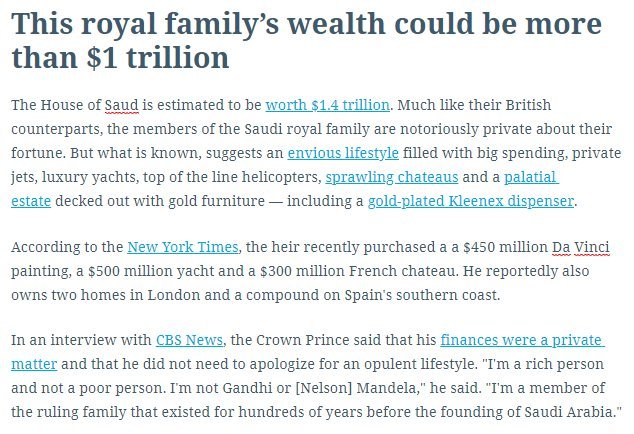
$1 trillion dollars! that’s an obscene, incomprehensible amount. that’s enough to give all 800 million people on earth living in extreme poverty (under $2 a day) $1200 each, or MVR 20,000. all 800 million people in extreme poverty on this planet, most doing back-breaking work every day, even if they somehow didn’t spend a cent of their income, would take two years to save up that much wealth.

$1 trillion dollars generates about $60-100 billion every year in just interest alone even if it all just sits there in a fund untouched (without compounding, so if you spent all $60-100 billion of that interest every year. that’s roughly the total wealth of mark zuckerburg, EVERY YEAR. it’s such an unbelievable number i want to emphasize it: if the saudi royal family spent SIXTY BILLION DOLLARS A YEAR, they would still have a trillion, that’s one thousand billion, dollars left). that said, it doesn’t stay untouched:

who the fuck needs a gold escalator to move 20 feet? and these are the folks claiming to have some kind of unique religious authority? i don’t remember stories of the sahabah getting custom-made gold caravans shipped over to cross the street.

for context– and remember that the whole conceit of wahhabism is a return to the ways of the prophet and the sahabah– that sounds very different from this:

hmm. everything we know about the lifestyles of saudi royalty (used interchangeably with saudi state, or saudi establishment, as is the case in an absolute monarchy), doesn’t really seem to vibe with those principles. anyway.

and prepare to be even more blown away by obscene wealth and obscene greed, this time even on the doorstep of the kaaba:

what the fuck, man.

it’s also important to note here that these hundreds of billions of dollars spent on extravagant displays of wealth could easily have been a smidge less extravagant and actually paid and treated the workers building all of this well. most human trafficking offenses are legal in saudi arabia, and the state has barely bothered to do anything about it. domestic workers are denied protections under saudi labor law. the government resolves most complaints of foreign worker abuse through mediation, setting up a largely powerless non-citizen worker with no provided legal aid thousands of miles from home to receive any justice in name only, and for the most part just sends victims back to their home countries without investigating or prosecuting crimes against them. that said, we as a country are implicit in doing kinda the same things ourselves and it’s horrific in both cases.

but anyway. now for how they’ve affected us as a country. it’s not a unique path that the saudi establishment has taken with the maldives: it’s right out of a playbook that’s applied around the world.

But Saudi Arabia has, for decades, been making investments of a different sort—those aimed at influencing Indonesian culture and religion. The king’s current visit is the apex of that methodical campaign, and “has the potential to accelerate the expansion of Saudi Arabia’s cultural resources in Indonesia,” according to Chris Chaplin, a researcher at the Royal Netherlands Institute of Southeast Asia. “In fact, given the size of his entourage, I wouldn’t be surprised if there will be a flurry of networking activity amongst Indonesian alumni of Saudi universities.”

Since 1980, Saudi Arabia has devoted millions of dollars to exporting its strict brand of Islam, Salafism, to historically tolerant and diverse Indonesia. It has built more than 150 mosques (albeit in a country that has about 800,000), a huge free university in Jakarta, and several Arabic language institutes; supplied more than 100 boarding schools with books and teachers (albeit in a country estimated to have between 13,000 and 30,000 boarding schools); brought in preachers and teachers; and disbursed thousands of scholarships for graduate study in Saudi Arabia. All this adds up to a deep network of Saudi influence.

“The advent of Salafism in Indonesia is part of Saudi Arabia’s global project to spread its brand of Islam throughout the Muslim world,” said Din Wahid, an expert on Indonesian Salafism at Syarif Hidayatullah State Islamic University (UIN) in Jakarta.

Indonesia may be the largest stage for Saudi Arabia’s cultural diplomacy, but it’s hardly the only one. Saudi Arabia built satellite campuses for Egypt’s Al-Azhar university in the 1980s, funded Bosnian rebels and later built them schools in the 1990s, bankrolled numerous madrassas in pre-Taliban Pakistan and Afghanistan, and sent 25,000 clerics to India between 2011 and 2013. Al-Hattem, of LIPIA Jakarta, was previously stationed at Saudi outfits in Bosnia and Djibouti. [x]

for a little backstory, i’m gonna let the same atlantic article summarize it for me:

It arose in reaction to 18th-century European colonialism in the Middle East, but it took particular root in Saudi Arabia in the hands of the influential preacher Muhammad ibn Abd al-Wahhab. Al-Wahhab’s alliance with the House of Saud in 1744 cemented Wahhabism as the spiritual backbone of the Saudi Arabian state. And in the 20th century, Saudi Arabia, which had become fabulously oil-rich, started to invest its considerable resources in propagating its ideology abroad.

the pattern starts to become familiar:

“Theology, which is a mandatory subject there, is only taught by committed Wahhabis, and I really think their ideology is antithetical to traditional Indonesian Islam, which is usually syncretic and relaxed,” he explained.

Hundreds of Indonesians receive scholarships to study at Saudi universities every year. A few decades in, alumni of these programs are becoming nationally influential in their home country. Habib Rizieq, the founder of the Islamic Defenders Front, a hardline organization associated with religion-related violence, attended both LIPIA and King Saud University in Riyadh. Jafar Umar Thalib, who founded the militant Salafi group Laskar Jihad, also graduated from LIPIA. Right-wing Islamist leaders like Hidayat Nur Wahid, a member of parliament who earned three degrees on scholarship from the University of Medina, are prominent in mainstream politics.

LIPIA alumni have also set up pesantren, or Islamic boarding schools, across Indonesia. Many of the country’s 100-odd Salafi pesantren are supplied by Saudi Arabia with teachers, especially of Arabic language, and textbooks, according to Din Wahid. For many poor families, these pesantren are the only feasible option for their kids’ schooling, despite ideological quibbles, Wahid said.

Enterprising Saudi envoys have even made inroads in places like Aceh, the westernmost Indonesian province that’s been wracked by natural disasters like the 2004 tsunami. “We have built mosques, hospitals, and schools there,” the Saudi ambassador to Indonesia, Mohammad Abdullah Alshuaibi, told me. “And an Arabic language institute.”

that timeline is important, by the way. the devastation of the 2004 tsunami on many primarily muslim regions around the indian ocean brought in an influx of rebuilding funds from saudi arabia. of course, that money comes with strings attached, and some of that rebuilding occurred in its own image. think about it. think about the timeline, before 2004 and after 2004.

and why is this important? because controlling access to knowledge is a staggering form of power. it allows you to shape the very fabric of reality that exists because, in many ways, “reality” as we see it is a sort of consensus, where we all agree on hearing and seeing and learning about the same things. but when you shape what we know of reality, what we’re told is the way that we actually live. i’m gonna be lazy and quote from something we’d written before:

the material history of islam wasn’t just a matter of interest for the history books, but a cornerstone of the way people practiced their entire faith, and either a potential source of or threat to the legitimacy of the current ruling establishment. control over that history was, and remains, extremely powerful. i am aware of my own fallibility. i don’t know if the history i know is the right history. i don’t know which details might have been shifted by conservative leaders to justify establishment power, or which details may have been added by ideologues in academia.

i don’t know which translations of arabic, a famously subtle and complex language with more ambiguity and possibilities of interpretation than any other major world language, back up my positions, or even whether verbal and oral histories would have captured those subtleties in their exact form instead of as the listener heard and understood it. i don’t know which philosophical and judicial scholarship over the centuries was brought into this history, and which were left out, and what selection bias might have shaped my knowledge of islamic history, thought, and practice…

here is something we do know, that i think illustrates everything above about the multitude of interpretations, histories, traditions, practices, identities that shift and evolve but, at each point during that evolution, insists that the way things are now is in fact how they always were.. let’s take a zoomed-out view and try to describe the maldives as an observer. confirm this with your own memories: think about dragonfly season from your childhood and try to visualize how you saw faith practiced then. think about old men reading salawat, or about amulets or pieces of paper with written dua that your grandparents told you to keep. dhivehi islamic identity from our first conversion, through to as recently as my childhood, was a form of indigenous-traditional sufi-inspired sunnism. abu barakat al-barbari was a somalian with sufi inspirations. religious leaders’ tombs, zikr, mawlud, barakai kiyevun, all sufism inspired. the idea that it was always wahhabi-inspired sunnism, and the idea that modern political religious figures are upholding our traditional identity is revisionism. half our traditional islam, as practiced by generations and generations before us, would be considered bid’a now.

who decided that, anyway? how did that happen, and how did i not even notice? why was there no real public interrogation of such a drastic shift in how institutions defined what religion was and how we should practice it? how does a country that literally defines itself by its faith switch completely from one interpretation to the other? i mean, the maldives considers its muslim identity such a crucial part of national identity that it’s a condition for citizenship. a huge change in what constitutes muslim identity is a crucial question. and i think it’s an important one.

the answer to “who decided, anyway?” is simple. this is who decides what reality is, and how they do it:

people will protest that what they learn and preach is directly from the texts, that they know arabic and know what’s said, but religious scripture is almost by definition incredibly complex and any study of scripture is influenced by the exegesis. nobody becomes a scholar of anything by just knowing the primary texts without a framework built by hundreds of scholars over decades, even centuries.

this applies even more for a text in arabic, a language that (to directly quote myself from earlier) is known for being more subtle and complex, with more room for ambiguity and possibilities of interpretation than almost any other major world language. any understanding of texts in historical dialects of a language that was literally known for a level of ambiguity and complexity that made it a perfect language for poetry, even in the time of the prophet (pbuh), is based on exegesis. the control of exegesis in any religion is, in a sense, exerting control over how people understand the scripture of that religion, and in this case the extreme wealth of the saudi state and its control over the kaaba means that they’re the ones controlling the realities and knowledge of what we consider religion to begin with, and they shape our entire body of knowledge in ways that bolster their objectives. here’s one example:

there’s other forms of control, aside from the massive funding and the control of access to religious knowledge:

One reason Indonesia has been reluctant to push back on Saudi cultural advances is the all-important hajj quota, the number of citizens who can make pilgrimage to Mecca in a given year. Indonesia gets the largest allowance in the world: 221,000 this year. But decade-long hajj waiting lists are common in many provinces, and jeopardizing the national allowance could provoke a huge backlash, said Dadi Darmadi, a UIN researcher and hajj expert.

“That being said, the Indonesian government has to be more wise and stop considering the hajj quota as a political gambit to attract more populist support in this country,” Darmadi said.

and that’s not good for us. having what we believe to be real about our religion and our own history and memory of how we practiced religion be shaped by parties with clear self-interest. this is particularly clear when we look at extremism here, which, again, is part of a pattern around the world:

Some of Indonesia’s leading jihadists have passed through Saudi institutions. Although Salafism is [officially] largely “quietist,” or discouraging of political activity, there is a growing faction of Salafi jihadists in Indonesia, according to Din Wahid.

In 1972, Saudi money helped to found the “ivy league” of jihadist pesantren, the Al-Mukmin school in Ngruki, Central Java. The Indonesian terrorist group Jemaah Islamiyah received funding from Saudi charities in the early 2000s. Salafi TV, YouTube channels, Facebook groups, and Telegram channels have become a fertile ground for female extremists and ISIS sympathizers in Indonesia in the last few years, according to a 2017 report from the Institute of Policy Analysis and Conflict (IPAC).

“We’ve been seeing some evidence of the transition from Salafism to extremism among female extremists of the ISIS generation,” said Nava Nuraniyah, an IPAC researcher.

“We need King Salman to make a clear and bold statement denouncing radicalism,” said Yahya Cholil Staquf of the moderate Muslim organization Nahdlatul Ulama. Otherwise, he said, “His visit will be easily perceived as more support to radical Islamic movements in Indonesia, as it is already a common public understanding that those radical movements take theological reference from Saudi Wahhabism and have been enjoying various kinds of support from Saudi Arabia.”

“Salafi pesantren, and Saudi-inspired religious education in general, no longer necessarily rely on Saudi donations, as followers have become incredibly adept at raising money locally,” Chaplin said.

As the rise of hardliners, the Arabic language, and Salafi jihadist cells in Indonesia show, Salafism has some undeniable, durable appeal here. In Indonesia, at least, Saudi Arabia is already seeing the fruits of its labor. This new religious ecosystem may be self-sustaining.

“this new religious ecosystem may be self-sustaining.” in other words, we’re now stuck with this shit, just like dozens of countries around the world. i sure hope not, but we may be screwed in ways that will be really hard to repair.

and i’ll leave you on that haunting note: the way things are now may be self-sustaining.

stop telling people they look fat when you meet them

is one from a list of some basic pieces of advice that I wish I could give to every Maldivian, every brown family member, everyone in general:

Don’t comment on weight, period. Don’t compliment people for losing weight when you first see them: it could be an eating disorder, they might be ill or stressed, you don’t know their life. The same for the other way around: it could be many things & none your business regardless.

Don’t jump in with unsolicited health advice. You’ve seen the feedback by strangers on photos a fat person posts talking about how they’re unhealthy and giving them advice on how to lose weight or chastising them. This applies particularly if you don’t say the same things to any skinny person having a cigarette with their burger and coke, or don’t judge a thinner person by immediately writing them off as lacking willpower or being lazy, without knowing anything about them, if you see them having an unhealthy snack. Not only do you not know context, and not only is it none of your business, but people aren’t dumb. They know their own bodies and well-being better than someone else.

You can guarantee that anything insulting or condescending or dismissive you say, or any “health advice” or diet suggestion or attempt at shaming? They’ve heard it a hundred times before, because again, society treats fat people like shit. The inner voice probably says it constantly. So if you find this impulse coming to you, stfu is my advice.

If you feel compelled, if you’re one of those people who get hit with a sudden burst of Social Responsibility whenever you see anything online or off that is remotely respectful or complimentary toward any fat person, and insist that you need to state the importance of health, that it’s some kind of duty to remind or nudge or shame them into losing weight before that sense of duty immediately goes into hibernation until the next body positivity post enters your feed: first of all, that’s so weird, dude. But also, health criticism doesn’t have to be an ever-present 24/7 aspect of any discussion about any fat person’s life or experiences; we don’t pair everything else we ever talk about, every time we talk about it, with common knowledge the listener already knows. It’s dehumanizing to not be able to separate someone from their body. its insulting to think of any fat person as some kind of mindless agency-lacking child who needs to be constantly informed on things they hear and see everyday and aren’t aware of their own body and health.

Society treats fat people like shit. In a superficial society obsessed with monitoring and controlling people for maximum desirability for consumption, pretty much everything except unattainable perfection gets you treated poorly, yeah. But there’s levels. You don’t need to put fat folks down because society is shitty to you too.

While you’re at it, don’t do the #WhatAboutMen or #WhatAboutWhitePeople and derail people talking about the specific ways in which society treats fat people awfully by talking about the ways other bodies (probably every kind of body, in aforementioned superficial society obsessed with control) are also treated poorly. You don’t need to crowd out someone’s discussion. There’s lots of real estate to be carved out for more conversations about body image that don’t need to crowd into the same space and derail another one. And while carving out that new real estate, you need to have some consideration.

Fat shouldn’t be an insult. Don’t tell people “no, you’re not fat”, like being fat is some horrible curse. It’s just a body type, and so many body types look so good, and if you open your mind the world is full of so many more people whose hotness you can appreciate to be honest. There’s studies that suggest many people, especially men, find many overweight people attractive but don’t admit it and limit themselves to only dating thinner people because they’re afraid of their friends looking down on them for going out with a fat person, because people do that, because society treats people like shit.

But that gets to an interesting point, which is that that says is we’ve got kind of a herd mentality about controlling body image that we all keep up even though we’d all be happier if we dismissed all of it. Beauty standards for bodies have differed throughout history with current archetypes arising (at least in the West) after the cultural revolutions of the late 60s. It’s not biological but social: without the openly disciplinary nature of the much more traditional previous eras and in a dysfunctional and alienating society, something needed to fill the role, and one of the earliest of them was diet culture. Having an ideal, being constantly focused on achieving it, restricting yourself from worldly pleasures in pursuit of that ideal goal, monitoring each other constantly to ensure we all conformed because if we all didn’t keep up that illusion we’d have spent so much time and energy denying ourselves pleasures and putting ourselves through hunger and exhaustion for nothing, punishing ourselves for not achieving that ideal. Diet culture and all the ways it makes us treat people like shit for being fat plays a social role that doesn’t do us any good. Of course, as with most theories about social phenomena, that’s a theory where different schools of theorists differ, but I think it’s pretty compelling.

So I understand the psychology behind those reactions: all of us are constantly subjected to the notion of fat as a horror to avoid, and people who do so often feel like its hard work or willpower they had which others didn’t have, and that not getting treated like shit for being fat is some kind of earned reward. And that’s so dysfunctional when you think about it. Sticking to how things are in established society is the lazy option (just like getting defensive before reading all of this and thinking it over is lazy as fuck, and I expect people to do that instead of just reacting reflexively, which a lot of people seem to do on this topic, viscerally, and with venom).

Finally, don’t just listen to me. There are dozens of great articles about all this out there. This is a good one.

deliberative democracy

Deliberative democracy is one of my favorite ideas for how we might govern ourselves in the future, and I believe that we’ll see universal basic income and deliberative democracy happen in some countries in our lifetimes. I think deliberative democracy could find a real home in the Maldives when we’ve gotten our politics back to a reasonable place, so I’m going to do a series on it [guest post]

About deliberative democracy and how it might be a perfect fit for the Maldives

Deliberative democracy is a form of direct democracy that has learnt from the pitfalls of earlier experiments in direct democracy. A common leftist goal, it has only taken place in a few limited situations so far around the world.

A selection of constituents is randomly drawn for a citizens’ jury. The selection is designed to reflect the actual demographics of the region in factors such as gender and age. The citizens’ jury sees stakeholders from all sides and experts on the area to be fully informed on the issue at question. They then deliberate among themselves and come to a conclusion.

In direct models, this decision is a binding vote on the matter. In other models, this decision is seen as a strong recommendation for the elected representative on how to vote. This is also known as deliberative polling and creates a very strong norm for the candidate to vote accordingly, even though it isn’t officially binding.

Candidates that promise to vote according to deliberative polling of their citizens essentially promise to act as a conduit to direct democracy by their constituents.  Even if these candidates don’t win, introducing and normalizing the idea of deliberative democracy to the wider public contributes greatly to its likelihood of success in the future. This is the most likely path to eventually achieving full, binding deliberative democracy.

Deliberative democracy is merely our traditions over hundreds of years, brought back and updated for modern times. The core idea of deliberative democracy is much more natural to Maldivians that it would be in many other countries. Traditionally, Maldivian islands have held island meetings of elders and stakeholders to discuss among themselves and come to a conclusion.

The advantages of deliberative democracy

Deliberative democracy models allow for greater participation by citizens in the democratic process as it reflects the entire constituency.

Citizens’ juries are short-term, randomly drawn, and disbanded after meetings. This means that corruption is extremely unlikely, unlike with elected politicians who can be nudged or bribed by powerful interests. Members of citizens’ juries also have no career political power to try hold on to.

Most voters are not very knowledgeable about policies they vote for. Citizens’ juries get to make informed decisions based on a strong understanding of the issues, not just what politicians say.

It keeps citizens politically engaged. Case studies show deliberative democracy reducing voter turnoff. With the current state of Maldivian politics keeping most citizens disillusioned with the political process altogether, this is important.

Often, the most active or committed citizens or those with the most resources get the biggest say. Citizens’ juries reflect the views of the majority of ordinary citizens.

Citizens’ juries have very high accountability. Written notes of the deliberations of citizens’ juries are made available online, and are often recorded or livestreamed. This lets anyone in the public see the reasoning and evidence supporting their decisions, which means the reasoning has to stand up to scrutiny.

It removes sole decision-making ability from people with power, avoiding the inherently corrupting nature of power over those who wield it. Since citizens’ juries convene, deliberate, and then un-convene with a new set of participants every instance, decisions are not made by career politicians but by ordinary citizens. Decision-making authority being vested purely to career politicians means that our lives are governed by people self-selected to be willing to devote their careers to gaining power, and who need to worry about keeping other power-brokers happy to remain in power. Deliberative democracy is a first step towards dismantling this flaw.

A grassroots plan of action

Ideally, we would be able to establish a deliberative democratic model as part of our system of government. One way that could work would be for an upper house run deliberatively as a branch of government. A biannual council of citizens, drawn randomly but to match population demographics, would meet anew for days of deliberating over a variety of issues with the model outlined above: stakeholders, experts, information, discussion, and so on. After each biannual selection, the council will be dissolved and a new random but representative group of citizens will be selected for the next council. We should call for our political leadership to implement a similar system. But until then, we have to work at the grassroots level. Some goals we might have are:

To create a community of enthusiastic supporters of deliberative democracy to organize, discuss, and promote the idea to as many people as possible: through local organizing, media appearances, direct campaigning, convincing public figures, social media, and so on.

To hold one or two small pilot programs as proof of concept, by being able to have one deliberation meeting run and some results chosen successfully.

To recruit candidates, no matter how unlikely, to run on a platform of deliberative democracy.

In doing so, to raise the profile of deliberative democracy and introduce the idea of establishing it in the grassroots through candidates instead of waiting for it to be implemented top-down in a distant, unlikely future.

Someday, to elect a candidate that has successfully run on a deliberative democracy platform.

Deliberative democracy around the world

Some of the earliest examples of democracy such as in Ancient Athens had a very similar model of sortition, where an assembly of randomly chosen citizens that convened regularly had governing power. Sortition was considered a crucial aspect of true democracy, and seen as necessary to prevent leaders from succumbing to the corrupting nature of power.

Because officially instating deliberative democracy would mean massive changes to the political system, there has only been a few instances in modern times.

Denmark has a variation on deliberative democracy known as Consensus Conferences. A detailed manual of how they carry out consensus conferences is available. Consensus conferences aren’t the same, but share many similarities. South Australia has also recently held a deliberative democracy program on the state’s nuclear power policy.Here is a timeline of deliberative democratic events in recent years.

Top-down change towards deliberative democracy anywhere around the world is unlikely. The most feasible path towards a future of deliberative democracy is for candidates to run on the promise to vote according to citizens’ juries of their constituents. This would raise public awareness of the concept of deliberative democracy and raise support for the policy.

If such a candidate wins a seat, they would hold regular deliberative democracy meetings and vote according to the decisions of their citizens’ juries as a way for their citizens to vote directly could inspire more support as people in the Maldives and around the world see the advantages of deliberative democracy. But a candidate doesn’t have to win to make a change: just running, introducing the idea to the public and normalizing it, could be a huge boost to its acceptance among the public both locally and internationally.

More information on deliberative democracy

An introduction is here. An article on the topic is here. Some studies are hereherehere and here. Some books are hereherehereherehere.

on the pickup/redpill propaganda of human desire

this will be repetitive because i’m trying to drum home a basic point some people seem to struggle to understand

tl;dr: different people are into different things to the point where the idea of a universal scale of sexual value where you luck into a high or low value is completely detached from reality. you can look around you and see all kinds of women horny for all kinds of men and vice versa, instead of all following a universal biological imperative

you ask people around you what they’re into and get a lot of different answers, or even just see what people have written or said online. to believe otherwise would be making the pretty dehumanizing assumption that all these other people attracted to different things instead of all the same thing are either a) lying about what they’re attracted to and just settling, b) so self-deluded that they don’t actually know what they’re attracted to even as they go about it

that is much less sensible than this: people really are horny for what they’re horny for. believing in lucking out into a decided position on a sexual value hierarchy is a fatalistic belief that you’re screwed because of nature or society, instead of being a grown-up surrounded by grown-ups just like you and taking responsibility for doing something about it.

even shorter tl;dr: everyone around you is a fully complex human being who values different things, and women everywhere around you aren’t lying or idiots about what they’re attracted to

Continue reading

simple english communist manifesto pt. 2 – marx & engels

The Communist Manifesto by Karl Marx and Friedrich Engels is one of the most famous essays in history. Like Marx and Engels’ other work, it discusses the power imbalance between the capital owning class, such as landlords and corporate employers, and the working class, whose labor they exploit for rents and profits. Individual workers have little power against capital owners, who would merely replace them with another worker desperate for sustenance enough to accept exploitation. The Communist movement called for the working class to unite and use their power as the majority to bring about a Communist society. It was first published in 1848 and is pretty long, so this is a lightly edited simple modern English version of the second section, with the very last few paragraphs of the whole text at the end. The first section is here. I didn’t include most of the third and fourth sections about Communist literature and the relationship of the Communists to other parties.

II. The Working Class and Communists

In what relation do the Communists stand to the working class as a whole?

The Communists do not form a separate party against to other working-class parties.

They have no interests separate and apart from those of the working class as a whole.

They do not set up any group-based principles of their own, by which to shape and mold the working class movement.

The Communists are distinguished from the other working-class parties by only these things: (1) In the national struggles of the working class of the different countries, they point out and bring to the front the shared interests of entire working class, not related to nationality. (2) In the various stages of development which the struggle of the working class against the capital owners has to pass through, they always and everywhere represent the interests of the movement as a whole.

The Communists, therefore, are on the one hand, practically, the most advanced and resolute section of the working-class parties of every country, that section which pushes forward all others; on the other hand, theoretically, they have over the great mass of the working class the advantage of clearly understanding the situation.

The immediate goal of the Communism is the same as that of all the other working class parties: formation of the working class into a class, overthrow of the capitalist rule, conquest of political power by the working class.

The theoretical conclusions of the Communists are in no way based on ideas or principles that have been invented, or discovered, by this or that would-be universal reformer. They simply express, in general terms, actual relationships springing from an existing class struggle, from a historical movement going on under our very eyes. Getting rid of existing property concepts is not at all a distinctive feature of Communism.

All property relations in the past have always been changed as a result of change in historical conditions.

The French Revolution, for example, got rid of feudal property in favor of capitalist property.

The distinguishing feature of Communism is not the getting rid of property in general, but the getting rid of capitalist property. But modern capitalist private property is the final and most complete expression of the system of producing and deciding ownership products; that is based on the exploitation of the many by the few.

In this sense, the theory of the Communists may be summed up in the single sentence: Abolition of private property.

We Communists have been criticized wanting to abolish the right of personally acquiring property as the fruit of a man’s own labor, which property is said to be the groundwork of all personal freedom, activity and independence.

Hard-won, self-acquired, self-earned property! Do you mean the property of the minor artisan and of the small peasant, a form of property that came before the capitalist form? There is no need to abolish that; the development of industry has mostly already destroyed it, and is still destroying it daily.

Or do you mean modern capitalist private property?

But does wage-labor create any property for the laborer? Not a bit. It creates capital, i.e. that kind of property which exploits wage-labor, and which cannot increase except by creating a new supply of wage-labor for fresh exploitation. Property, in its current form, is based on capital and wage-labor being enemies. Let us examine both sides of this antagonism.

To be a capitalist is to have not only a purely personal, but also a social status in production. Capital is a collective product, and only by the united action of many members can it be set in motion.

Capital is, therefore, not a personal, it is a social power. Owning capital gives you the social power to control workers.

So when capital is converted into common property, into the property of all members of society, personal property is not thereby transformed into social property. It is only the social character of the property that is changed. It loses its class-character.

Let us now take wage-labor.

The average price of wage-labor is the minimum wage, i.e., the means of subsistence, which is absolutely required in bare existence as a laborer. What, therefore, the wage-laborer manages to get through his labor is just enough to keep going and reproduce a bare existence. We by no means intend to abolish this personal share of the products of labor, an appropriation that is made for the maintenance and reproduction of human life, and that leaves no surplus to use to command the labor of others. All that we want to do away with is the miserable nature of this, where the laborer lives just to increase capital for the wealthy capitalists, and is allowed to live only in so far as the interest of the ruling class requires it.

In capitalist society, living labor is nothing but a way to increase accumulated labor. In Communist society, accumulated labor is a way to widen, to enrich, to promote the existence of the laborer.

In capitalist society, those with power in the past dominate the present; in Communist society, the present dominates the past. In capitalist society capital is independent and has individuality, while the living person is dependent and has no individuality.

And the abolition of this state of things is called by the capitalist, abolition of individuality and freedom! And rightly so. The abolition of capitalist individuality, capitalist independence, and capitalist freedom is undoubtedly aimed for.

By freedom is meant, under the present capitalist conditions of production, free trade, free selling and buying. But if selling and buying disappears, free selling and buying disappears also. This talk about free selling and buying, and all the other “brave words” of our capital owners about freedom in general, have a meaning, if any, only in contrast with restricted selling and buying, with the restricted traders of the Middle Ages, but have no meaning when opposed to the Communistic abolition of buying and selling, of the capitalist conditions of production, and of the capital owners itself.

You are horrified at our intending get rid of private property. But in your existing society, private property is already done away with for 90 percent of the population; its existence for the few is solely due to its non-existence in the hands of that 90 percent. You criticize us, therefore, with intending to do away with a form of property that only exists because the immense majority of society cannot have it.

Simply put, you reproach us with intending to do away with your property. Yes, that is just what we intend.

From the moment when labor can no longer be converted into capital, money, or rent, into a social power capable of being monopolized, so from the moment when individual property can no longer be transformed into capitalist property, into capital, from that moment, you say individuality vanishes.

You must, therefore, confess that by “individual” you mean no other person than the capitalist, than the middle-class owner of property. This person must, indeed, be swept out of the way, and made impossible.

Communism deprives no man of the power to gain a share of the products of society; all that it does is to deprive him of the power to control the labor of others using what they own.

It has been objected that upon the abolition of private property all work will cease, and universal laziness will overtake us.

According to this, capitalist society should long ago have been destroyed through idleness. Those of its members who work make nothing, and those who make the wealth do not work. The whole of this objection is just another expression of the obvious statement: that there can no longer be any wage-labor when there is no longer any capital.

All objections urged against the Communistic mode of producing and sharing material products, have, in the same way, been urged against the Communistic modes of producing and sharing intellectual products. Just as, to the capitalist, the disappearance of class property is the disappearance of production itself, so the disappearance of class culture is to him identical with the disappearance of all culture.

That culture, the loss of which he laments, is, for the enormous majority, a mere training to act as a machine.

It makes no sense to respond to our intended abolition of capitalist property, with your capitalist notions of freedom, culture, law, etc. Your ideas are just the outgrowth of the conditions of your capitalist production and capitalist property, just as your wisdom is but the will of your class made into a law for all. The essential character and direction of what we consider wisdom or the way things are, is determined by the economic conditions of existence of your wealthy class.

It is a selfish delusion to think that the social and cultural forms that come from our capitalist economic system and the capital-labor power relationships in that system, which is just one of many economic systems that have existed in history from feudalism to the present. This selfish delusion is something you share with every ruling class that has come before you. What you see clearly in the case of ancient property, what you admit in the case of feudal property, you are of course forbidden to admit in the case of your own capitalist form of property.

Abolition of the modern view of family! Even the most radical flare up at this infamous proposal of the Communists.

Do you charge us with wanting to stop the exploitation of children by their parents? To this crime we plead guilty.

But, you will say, we destroy the most sacred of relations, when we replace home education by social.

And your education! Is not that also social, and determined by the social conditions under which you educate, by what we teach in schools, etc.? The Communists have not invented education being used for the purposes of society. They only want to change the nature of the values taught to children by the education system, and to rescue education from the influence of the ruling class.

The capitalist clap-trap about the family and education, about the hallowed relation of parent and child, becomes all the more disgusting when, by the action of Modern Industry, all family ties among the working class are torn asunder. The poor do not get to have the comfortable family unit that the middle-class and wealthy do. Their social relationships with their family are warped by how their labor and time is controlled by the capitalists. To survive in these families, even the children have to be thought of as means to make money in present or future.

But you Communists would introduce a community of women, screams the whole capital owners in chorus.

The capitalist sees in his wife a mere instrument of production. He hears that the instruments of production are to be exploited in common. So he believes that the lot of being common to all will likewise fall to the women. He does not suspect that the real point is to do away with the status of women as mere instruments of production.

Nothing is more ridiculous than the self-righteous anger of our capitalists at the community of women which, they pretend, is to be openly and officially established by the Communists. The Communists have no need to introduce community of women; it has existed almost from since before we can remember.

The capitalists use their own wives and daughters for labor. They use the wives and daughters of the working class for their labor. Communists want an openly legalized community of women that will not be exploited for the use of capitalists. Women will no longer have to follow the whims of the capitalists to survive.

The Communists are further reproached with desiring to abolish countries and nationality.

The working men have no country. We cannot take from them what they have not got. Since the working class must first of all acquire political supremacy, must rise to be the leading class of the nation, must constitute itself the nation, it is, so far, itself national, though not in the capitalist sense of the word.

National differences and conflict between peoples are daily more and more vanishing. The supremacy of the working class will cause them to vanish even faster. United action, of the leading civilized countries at least, is one of the first conditions for the freedom of the working class.

As we end the exploitation of individuals by others, we will also end the exploitation of countries by other countries. As conflict between classes in a nation vanishes, the hostility of one nation to another will come to an end.

The charges against Communism made from a religious, a philosophical, and, generally, from an ideological standpoint, are not deserving of serious examination.

Does it require deep understanding to comprehend that man’s ideas, views and conceptions, in one word, man’s consciousness, changes with every change in the conditions of his material existence, in his social relations and in his social life?

What else does the history of ideas prove, than that intellectual production changes its nature as material production is changed? The ruling ideas of each age have always been the ideas of its ruling class.

When people speak of ideas that revolutionize society, they only express the fact that within the old society, the elements of a new one have been created, and that the dissolving of the old ideas keeps even pace with the dissolution of the old conditions of existence.

One fact is common to all past ages: the exploitation of one part of society by the other. No wonder, then, that the social consciousness of past ages, despite all of its variety, moves within certain common forms, or general ideas, which cannot completely vanish except with the total disappearance of class struggle.

The Communist revolution is the most radical rupture with traditional property relations; no wonder that its development involves the most radical rupture with traditional ideas.

But enough with the capitalist objections to Communism.

We have seen above, that the first step in the revolution by the working class is to raise the working class to the position of ruling as to win the battle of democracy.

The working class will use its political supremacy to take control, by degrees, of all capital from the capital owners, to centralize all instruments of production in the hands of the State, i.e., of the working class organized as the ruling class; and to increase the total of productive forces as rapidly as possible. Of course, in the beginning, this cannot be done except by force, as the ruling class will resist change.

These measures will of course be different in different countries.

Nevertheless in the most advanced countries, the following will be pretty generally applicable.

1. Abolition of property in land and application of all rents of land to public purposes.

2. A heavy progressive or graduated income tax.

3. Abolition of all right of inheritance.

4. Confiscation of the property of all emigrants and rebels.

5. Centralization of credit in the hands of the State, by means of a national bank with State capital and an exclusive monopoly.

6. Centralization of the means of communication and transport in the hands of the State.

7. Extension of factories and instruments of production owned by the State; the bringing into cultivation of wastelands, and the improvement of the soil generally in accordance with a common plan.

8. Equal liability of all to labor. Establishment of industrial armies, especially for agriculture.

9. Combination of agriculture with manufacturing industries; gradual abolition of the distinction between town and country, by a more equal distribution of the population over the country.

10. Free education for all children in public schools. Abolition of children’s factory labor in its present form. Combination of education with industrial production, etc.

When, in the course of development, class distinctions have disappeared, and all production has been concentrated in the hands of a vast association of the whole nation, the public power will lose its political character.

Political power, properly so called, is just the organized power of one class for oppressing another. If the working class during its contest with the capital owners is compelled, by the force of circumstances, to organize itself as a class by means of a revolution, it makes itself the ruling class.

In place of the old capitalist society, with its classes and class struggle, we shall have an association, in which the free development of each is the condition for the free development of all.

The relationship of the Communists with other working-class parties

Communists everywhere support every revolutionary movement against the existing social and political order of things.

In all these movements they bring to the front, as the leading question in each, the property question, no matter what its degree of development at the time.

Finally, they work everywhere for the union and agreement of the democratic parties of all countries.

The Communists don’t want to hide their views and aims. They openly declare that their ends can be attained only by the forcible overthrow of all existing social conditions. Let the ruling classes tremble at a Communistic revolution. The working class have nothing to lose but their chains. They have a world to win.

WORKING MEN OF ALL COUNTRIES, UNITE!

environmental toxins may have led to our current crime wave

In cities across America, violent crime peaked in the early 90s and then declined sharply, in many cases by up to almost 80%. Crime rates and their decline haven’t shown links to the economy, to demographics, or to policies cracking down on crime. That said, there is one thing that shows a very strong link to crime rates: lead exposure levels from leaded petrol 20 or so years previously. Strict econometric techniques haven’t found any explanations for the variability in crime rates from any specific crime-fighting strategies by governments.

Lead poisoning in children, from sources such as leaded petrol and certain kinds of paint, damages brain development and leads to a whole host of complications later in life: drops in IQ, hyperactivity, behavioral problems, learning disabilities, impulse control, even juvenile delinquency further down the line. This damage is persistent, and lead to much higher rates of crime, teen pregnancy, and drug abuse down the line as a poisoned generation of children reach adulthood.

In studies conducted in America, lead emissions with a lag time of 23 years was found to explain 90 percent(!) of the variation in violent crime in America. In states where the use of leaded petrol declined slowly, crime also declined slowly, while a quick decline in use showed a quick decline in crime two decades later. Another study, looking at crime trends around the world, showed the same pattern found in America to also apply to Australia, and Canada, and the UK, and Finland and France and Italy and New Zealand and Germany, with every single country studied showing the same pattern.

This even applied to the neighborhood level: neighborhoods with high lead concentrations map up near-perfectly with crime maps. Even tiny levels of lead can cause significant and permanent damage to children that lasts over their lives. In the United States, almost 1 in every 40 children had levels of lead in their blood high enough to cause significant damage. What might that number be in a less developed country, without as strict an authority as the US FDA and EPA overseeing levels of toxins in the environment, and with leaded petrol being phased out much later?

Chart: The PB Effect

The biggest source of lead in the environment was leaded petrol, with other sources including leaded paint. Lead emissions around the world rose steadily from the 1940s through to the early 1970s, and then began to fall again as unleaded petrol replaced the leaded variety in many developed countries. With a 20-year offset, this mirrored the much-feared crime waves seen in many American cities, which peaked through the 1980s into the early 1990s before a massive fall.

In many developing countries, leaded petrol continued to be used. I can’t find data on the exact time periods in which we stopped using lead, but when I asked around people mostly remembered it as being in the early-to-mid 1990s. Between the rapid development set off by the tourism industry in the 1970s, which likely led to much increased use of motor vehicles by a now wealthier populace, and the replacement of leaded petrol by presumably the early 1990s, there would be a 20 or so year window where children faced high levels of lead exposure- generations that would be in their twenties and thirties now. If this is true, we should be able to expect an easing of the crime epidemic over coming years.

Chart: Did Lead Make You Dumber?

But we might be repeating this historical mistake, this time through exposure to dioxins and other byproducts from the burning and disposal of plastics. Dioxins are often found built up through the food chain in animal products, mostly cattle products and sometimes, in areas with high exposure, fish high up in the food chain, such as tuna. More directly, it is likely produced in the incomplete burning of huge quantities of plastic waste such as in Thilafushi.

Dioxins are carcinogenic and teratogenic, which means they can cause cancer and birth defects. Exposure to dioxins and other PCBs also affect fertility and reproductive health, and disrupt the balance of hormones in the body. Like lead, dioxins and PCBs may also cause developmental issues in children that persist over years. Some evidence has been found showing links between high PCB levels in children and poor performance on developmental and cognitive tests, with the effect most significant at birth. It appears that Male’, or anywhere exposed to toxins from Thilafushi smoke, is potentially a particularly harmful place to be pregnant in.

We deserve answers

We should be able to demand answers from our governments. For starters, a study on lead exposure and environmental lead levels throughout the Maldives, measuring blood lead levels in children and adults, and a thorough review of other developmentally damaging toxins that may be present in the environment along with a plan of action for cutting down on them. Nobody knew about the dangers of leaded petrol in the 1990s, but with current knowledge, it is the responsibility of the government to conduct proper reviews and the right of the public to know which toxins enter our bodies everyday and which effects they might have on us or our children.